You Collection, Upper Volume
Radical: See (jiàn)
Kangxi strokes: 13
Page 1135, Entry 01
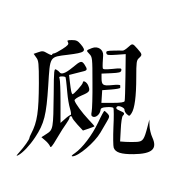
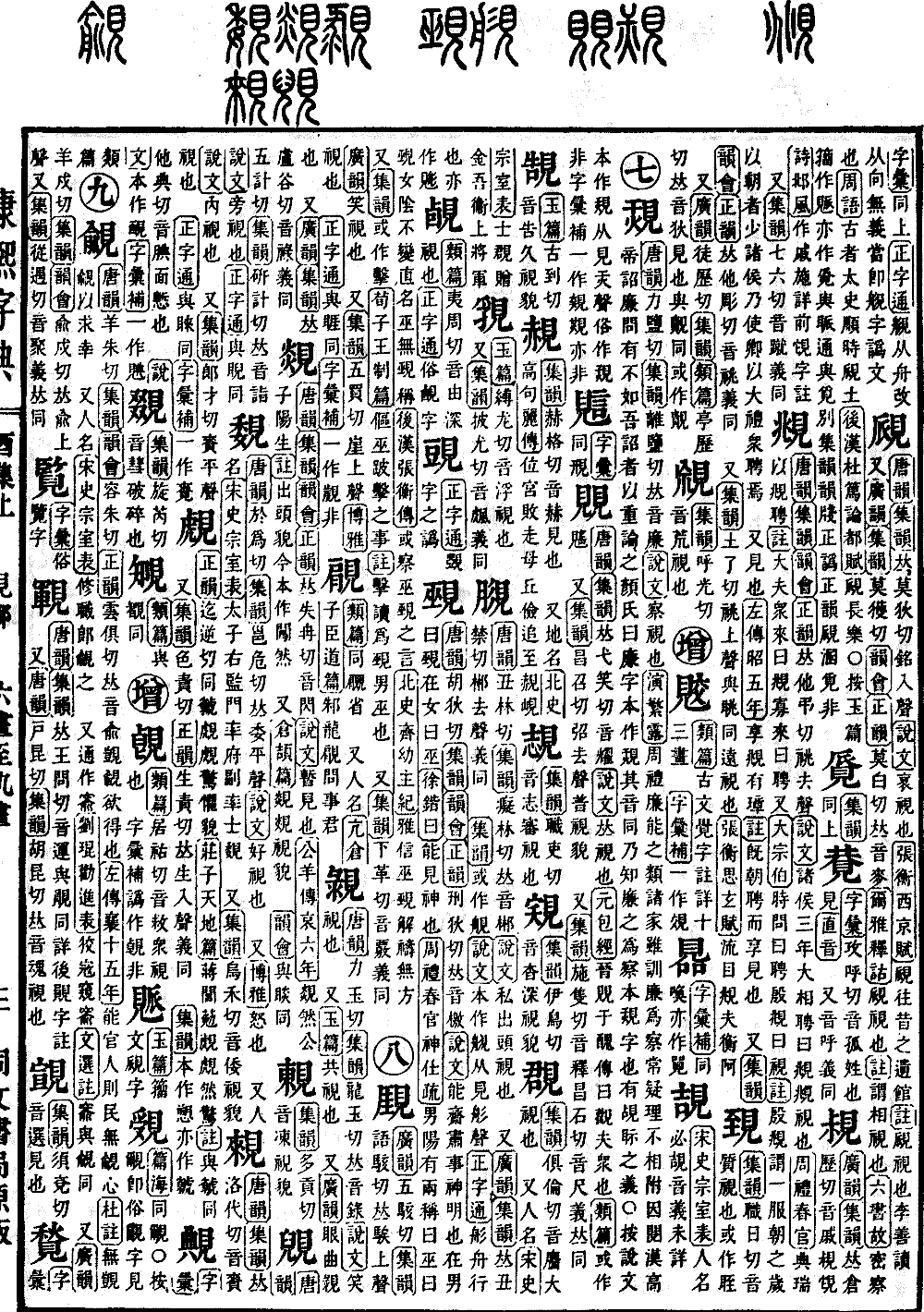
According to the Tang Rhymes (Tangyun) and the Collected Rhymes (Jiyun), the pronunciation is mi. According to the Explaining Graphs and Analyzing Characters (Shuowen Jiezi), it is defined as looking aslant. In the Western Capital Rhapsody (Xijing Fu) by Zhang Heng, there is the phrase, observing the remaining pavilions of the past. The commentary states that the character means to look. Li Shan notes this pronunciation.
Furthermore, according to the Expanded Rhymes (Guangyun) and the Collected Rhymes (Jiyun), as well as the Rhyme Collection (Yunhui) and Correct Rhymes (Zhengyun), the pronunciation is mai. According to the Approaching Elegance (Erya), specifically the section on interpretation, the character means to look. The commentary notes this refers to looking at one another. The Origin of the Six Writings (Liushugu) defines it as observing carefully. In the Discourses of the States (Guoyu), specifically the Discourses of Zhou, it is mentioned that the grand historians of ancient times would observe the land in accordance with the seasons. In the Rhapsody on the Capital (Lun Du Fu) by Du Du in the History of the Later Han (Hou Hanshu), there is the phrase, observing Changle.
According to the Jade Chapters (Yupian), the seal script form is written as such, and it is also written in a variant form. It is synonymous with the character mai, and is distinct from the character mi. The Collected Rhymes (Jiyun), Rhyme Notes (Yunjian), Rectification of Errors (Zhenge), and Correct Rhymes (Zhengyun) are in error for confusing this character with mi.