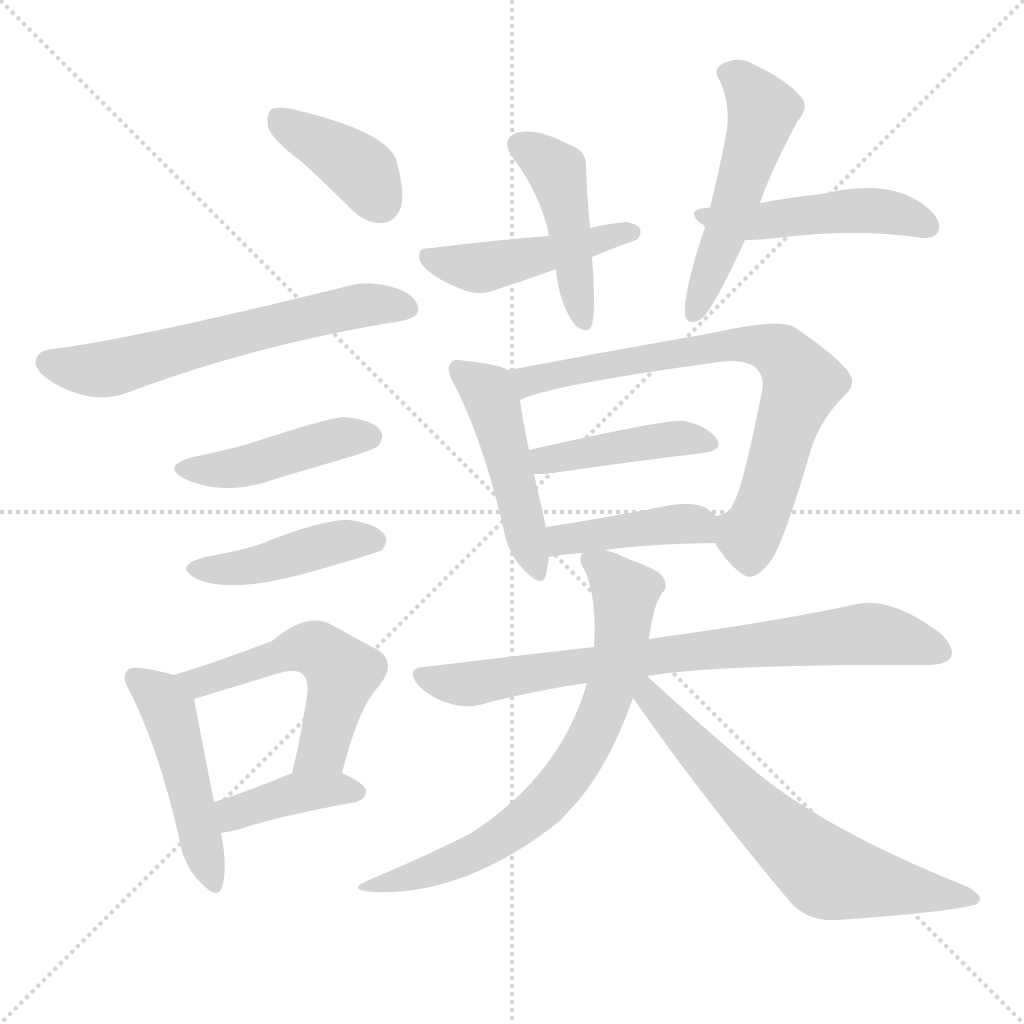
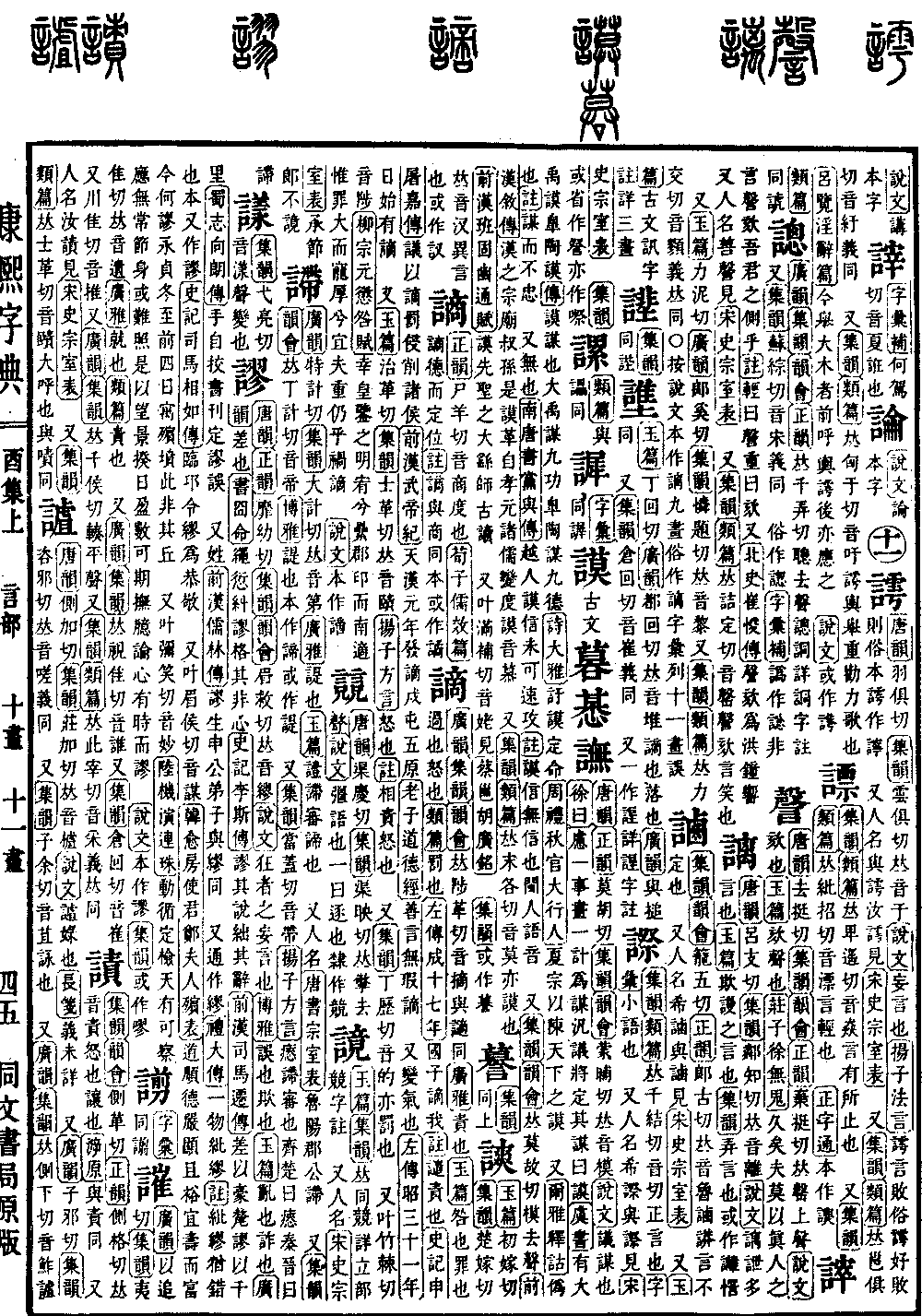
You Collection, Upper Volume
Radical: Speech (yán)
Kangxi Strokes: 18
Page 1177, Entry 15
In ancient scripts, it is written as a variant form (wú).
According to Tang Yun and Zheng Yun, it is pronounced mo (level tone). According to Jiyun and Yunhui, it is pronounced meng (level tone). The pronunciation is the same as mo.
Shuowen Jiezi explains it as: to deliberate or to scheme.
Xu Kai says: To consider a specific matter or to plan a strategy is called mou; to discuss extensively and ultimately finalize a strategy is called mo.
The Book of Documents (Shujing), specifically the sections regarding the Great Yu and Gao Yao, contains the chapters Great Yu's Deliberations and Gao Yao's Deliberations.
The commentary explains: Mo means strategy. Great Yu deliberated on the nine achievements, and Gao Yao deliberated on the nine virtues.
The Book of Odes (Shijing), in the section Great Odes (Daya), contains the line: Great strategies establish government decrees.
The Rites of Zhou (Zhouli), in the section Autumn Official: Great Minister of State, records: During the summer court audience, they presented the strategies of the world to the Son of Heaven.
It is also defined in the Erya (Er Ya: Explaining Ancient Terms) as: False.
The commentary explains: To scheme but without loyalty.
It is also defined as: None.
The History of the Southern Tang (Nan Tang Shu), in the Biography of Factions, records: The people of the Yue region do not keep their promises and should not be attacked hastily.
The commentary explains: Mo xin means having no credibility. This is the local dialect of the Min region.
According to Jiyun and Yunhui, it is pronounced mo (departing tone).
The Book of Han (Hanshu), in the Narrative Chapters, records: The ancestral temple system of the Han dynasty was planned and established by Shusun Tong. From the time of Emperor Xiaoyuan, reforms were made, and the scholars changed the laws. Here, mo is pronounced mu.
According to Jiyun and Leipian, it is pronounced mo (entering tone). It also carries the meaning of mo.
In the Book of Han (Hanshu), Ban Gu's Rhapsody on Obscure Realities (You Tong Fu), the line "to deliberate on the great principles of the former sages" is read in this way by Yan Shigu.
Also, rhyming with the context, it is pronounced mu (rising tone). This is found in Cai Yong's Eulogy for Hu Guang.
Jiyun notes that it is sometimes written in a variant form (mó).