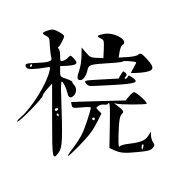
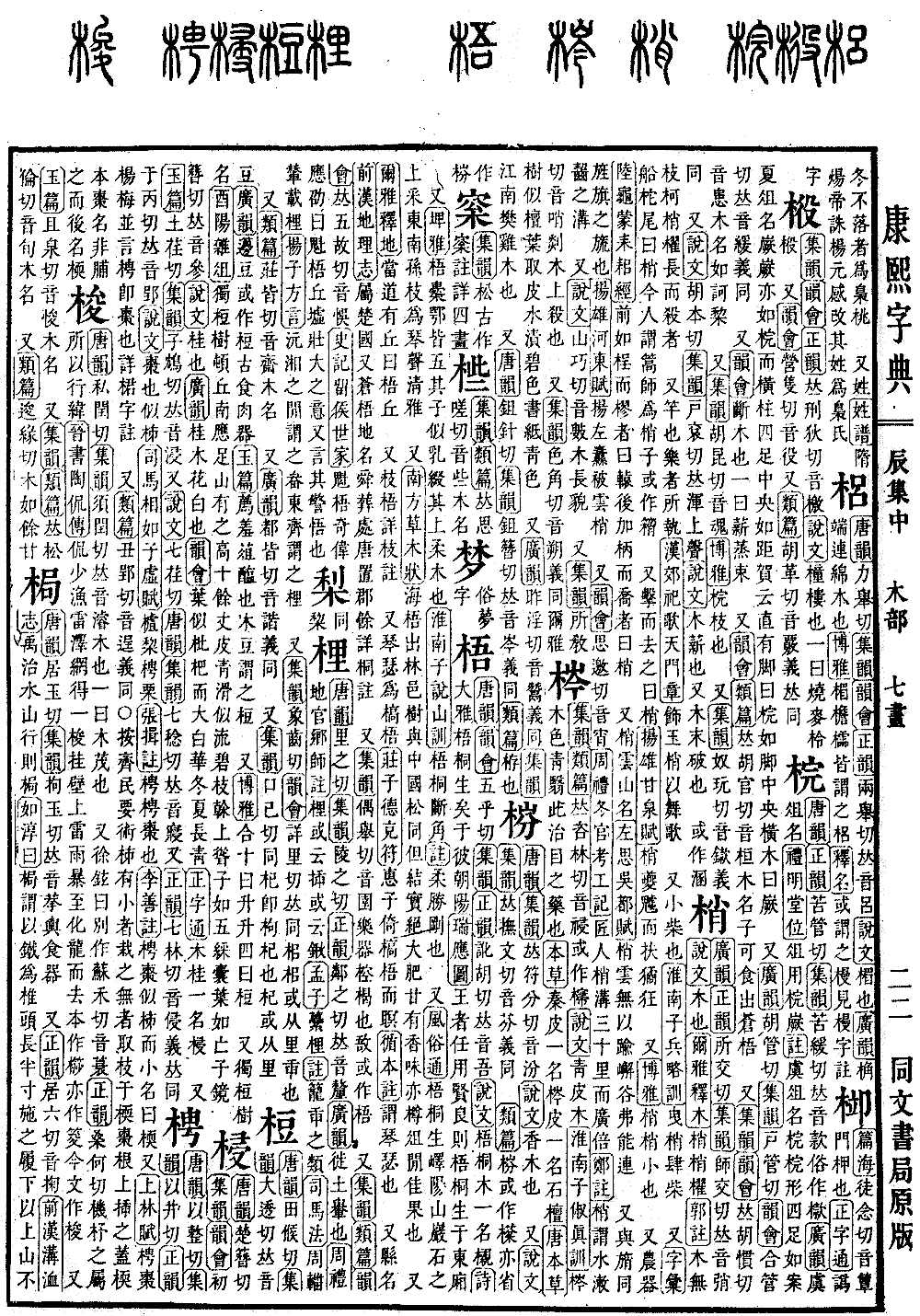
Chen Collection, Middle Volume. Radical: Tree (mù). Kangxi stroke count: 11. Page 530, Entry 04.
Pronounced kuan. Commonly written in a variant form.
According to the Book of Rhymes (Guangyun), it is the name of a sacrificial stand used by the Yu dynasty. According to the Book of Rites (Liji), in the chapter on the positions in the Hall of Distinction (Mingtang Wei), it says: The sacrificial stand used is the huan jie. The commentary states: The Yu dynasty sacrificial stand is called huan. The huan is shaped with four legs, resembling a table or desk. The Xia dynasty sacrificial stand is called jie; the jie also resembles the huan, but has a horizontal crossbar on the four legs, with the center shaped like a chicken spur. He states: If it simply has legs, it is called huan; if it has a crossbar between the legs, it is called jie.
Also pronounced huan. The meaning is the same.
Also, according to the Rhyme Compendium (Yunhui), it refers to cut wood. Another explanation is that it refers to bundled firewood.
Also, according to the Rhyme Compendium (Yunhui) and the Classified Dictionary (Leipian), pronounced huan. It is the name of a tree; the fruit is edible. It originates from Cangwu.
Also, according to the Collected Rhymes (Jiyun) and the Rhyme Compendium (Yunhui), pronounced huan. It is the name of a tree, resembling the myrobalan (heli).
Also, according to the Collected Rhymes (Jiyun), pronounced hun. According to the Erya (Boya), huan refers to a branch.
Also, according to the Collected Rhymes (Jiyun), pronounced wan. The meaning is the same.
Also, according to the Analytical Dictionary of Characters (Shuowen), pronounced hun (rising tone). According to the Analytical Dictionary of Characters (Shuowen), it refers to firewood. It also refers to the splitting of the end of a piece of wood. It is sometimes written in a variant form.