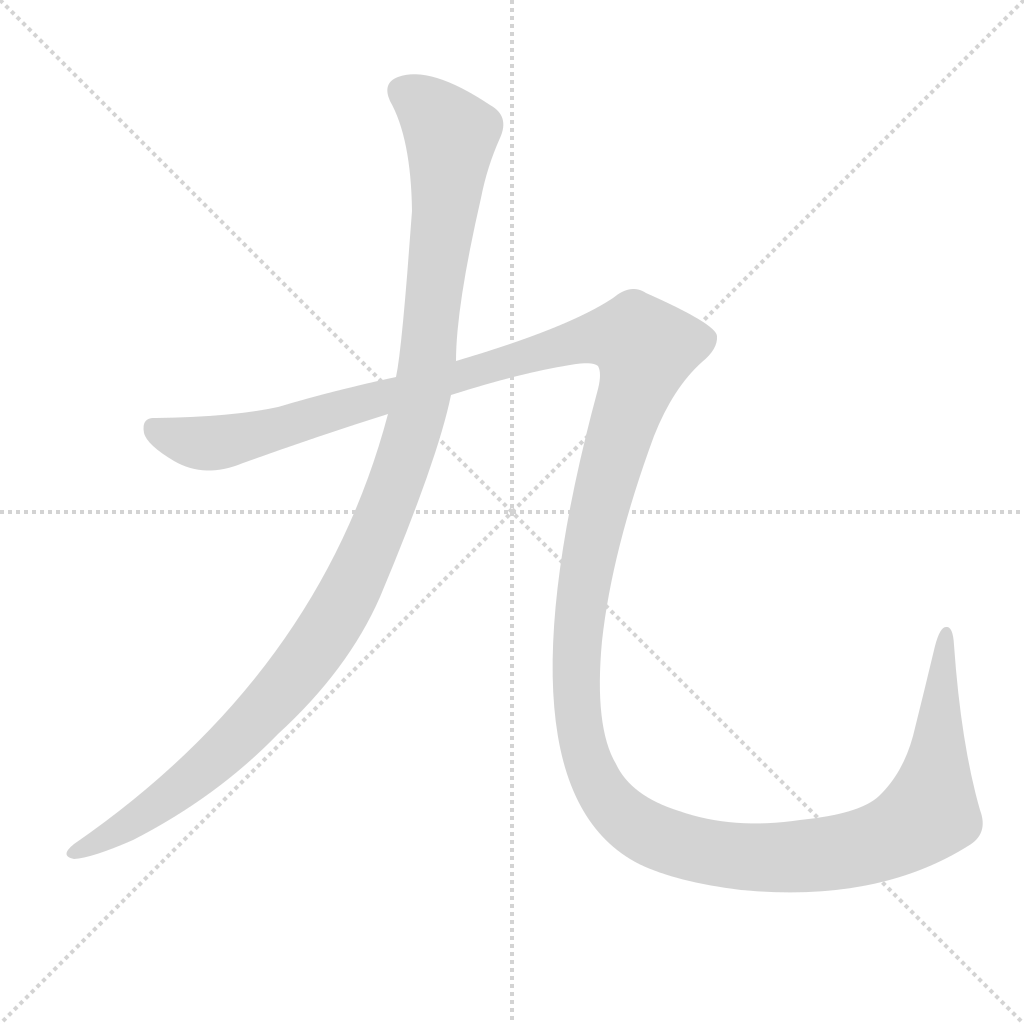
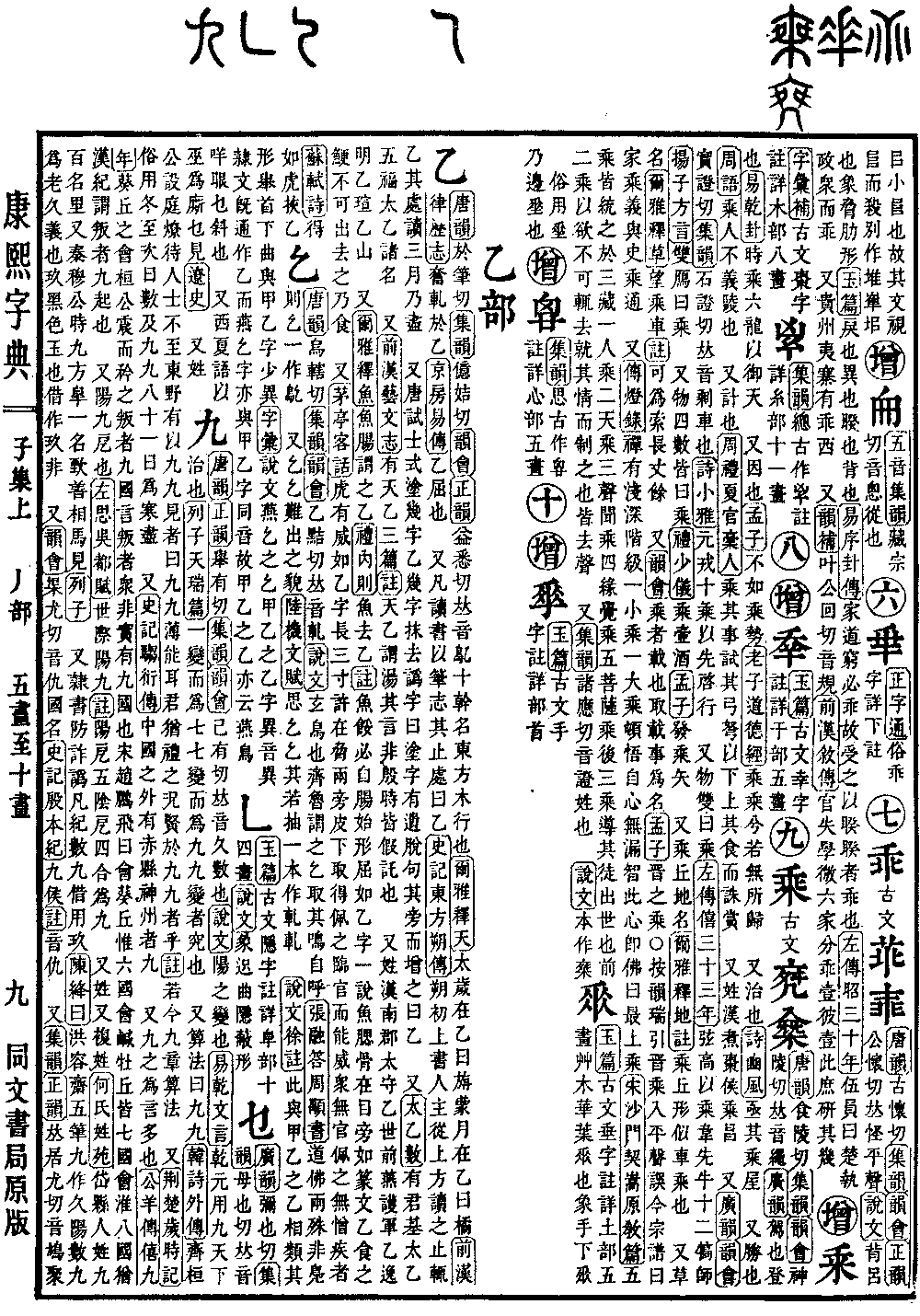
Zi Collection, Page Position: Upper. Radical: Second (yǐ). Nine. Kangxi Dictionary Strokes: 2. Page 83, Line 19.
In the Tang Rhymes (Tangyun) and Correct Rhymes (Zhengyun), the pronunciation is given as ju-you-qie. In the Collected Rhymes (Jiyun) and Rhyme Assembly (Yunhui), the pronunciation is given as yi-you-qie. The sound is the same as the word for long duration (jiu). It represents a numerical value.
The Explaining Graphs and Analyzing Characters (Shuowen Jiezi) defines it as the transformation of the yang principle. In the Commentary on the Words of the Text (Wenyan) of the Book of Changes (Yijing), it says: When the Qian hexagram uses nines, the world is well-governed. The Book of Master Lie (Liezi), Chapter on Heavenly Gifts (Tianrui), records: One changes into seven, seven changes into nine, and the change to nine is the ultimate end.
There is also a calculation method called nine-nine. The Outer Commentary on the Han Version of the Odes (Hanshi Waizhuan) records: Duke Huan of Qi lit torches in his courtyard to recruit talent, but no one came. A man from the eastern fields who knew the nine-nine calculation sought an audience, saying: Nine-nine is but a minor skill, yet if you treat me with courtesy, how much more so for those whose talents exceed nine-nine? Note: This refers to something like the current Nine Chapters on the Mathematical Art (Jiuzhang Suanshu).
The Record of the Seasons of Jing-Chu (Jing-Chu Suishi Ji) records: It is a folk custom to count from the day after the Winter Solstice for nine periods of nine days, totaling eighty-one days, which signifies the end of the cold season.
The Records of the Grand Historian (Shiji), Biography of Zou Yan, records: Outside of China, there are nine other regions like the Divine Land of the Red County.
Additionally, nine is often used to represent a large quantity. The Gongyang Commentary (Gongyang Zhuan), Ninth Year of Duke Xi, records: At the covenant of Kuiqiu, Duke Huan of Qi displayed his majesty and became arrogant, and nine states rebelled. Here, nine describes the many rebels and does not literally mean nine states. Zhao Pengfei of the Song Dynasty said: At the Kuiqiu covenant there were actually only six states, at the covenants of Xian and Muqiu there were seven, and at the Huai region covenant there were eight; it is like the Han Dynasty histories saying rebellions rose nine times.
There is also the term yang-nine, referring to calamities. Zuo Si wrote in his Rhapsody on the Wu Capital (Wu Du Fu): The world encounters the yang-nine. Note: There are five yang calamities and four yin calamities, which together make nine.
Nine is also a surname. There are also compound surnames. He's Register of Surnames (He Shi Xing Yuan) records: In Dai County, there was a person with the surname Jiu-bai and the given name Li. Furthermore, during the time of Duke Mu of Qin, there was a man named Jiu-fang Fu, also known as Yin, who was skilled at judging horses, as mentioned in the Liezi.
In clerical script, to prevent errors, the character for black jade (jiu) is often borrowed for the number nine when recording figures. In the Five Pens (Wubi) by Hong Rongzhai, it is said that nine was written as the character for long duration (jiu) because the yang number nine represents the idea of longevity. However, the character for black jade (jiu) refers to a black stone, and borrowing it for the number nine is incorrect.
In the Rhyme Assembly, it is also pronounced qu-you-qie, sounding like the word for enemy (chou). It is the name of a state. In the Records of the Grand Historian, Annals of Yin, the Lord of Jiu is mentioned; the note says it is pronounced chou.
In the Collected Rhymes and Correct Rhymes, it is also pronounced ju-you-qie, sounding like the word for pigeon (jiu). It means to gather. The Analects (Lunyu) mentions nine times assembling the feudal lords. The Book of Master Zhuang (Zhuangzi), Chapter on Under Heaven (Tianxia), records: Yu personally handled the basket and plow to bring together the scattered rivers of the world. Note: Nine is read as jiu, meaning to unite or intertwine, causing the rivers to flow through and empty into the sea. Nine is interchangeable with characters meaning to gather, unite, or assemble.