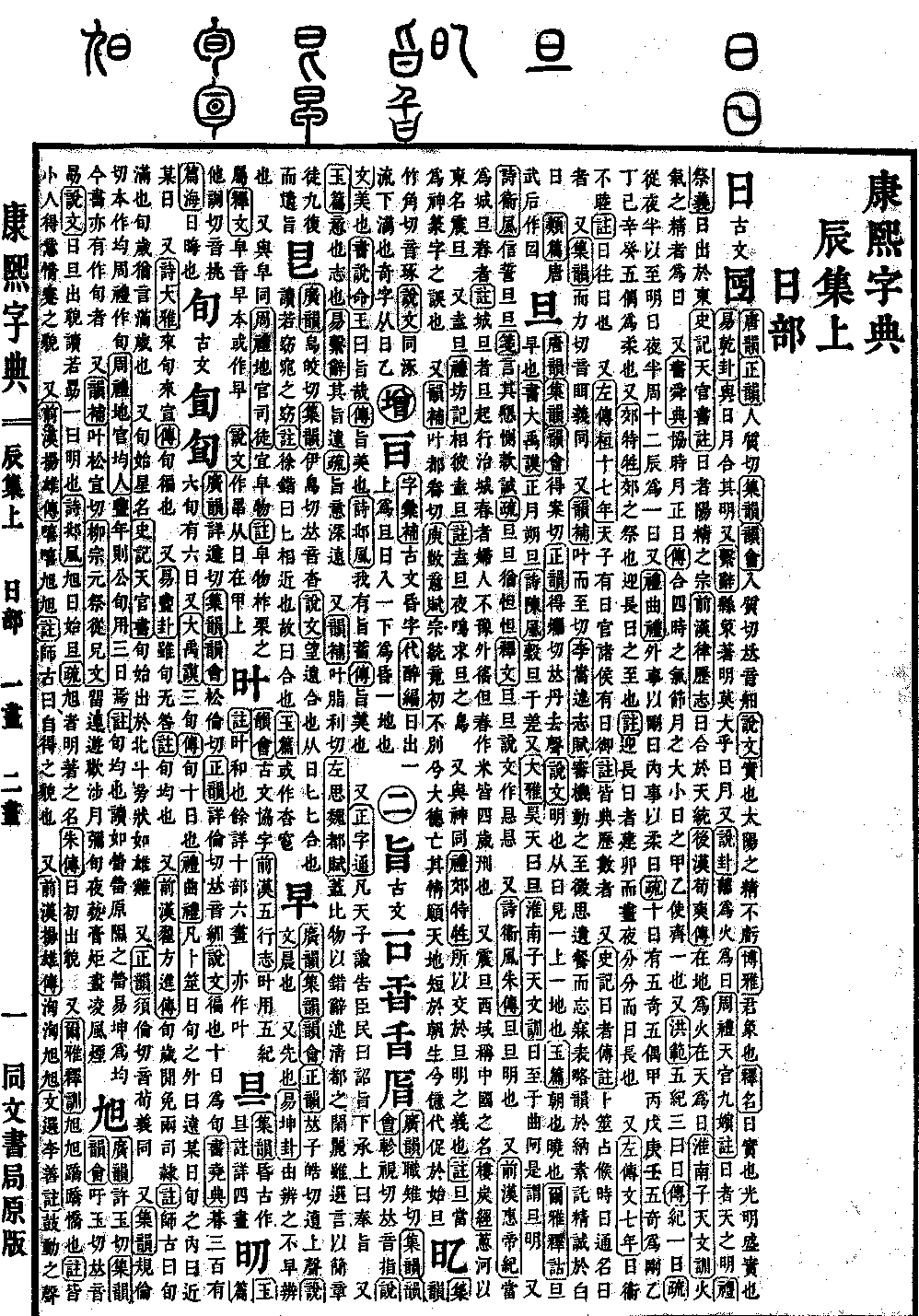
Chen Collection, Upper Volume
Radical: Sun (rì)
Kangxi Strokes: 5
Page 489, Entry 03
Pronounced dan (falling tone). According to the Tang Rhyme (Tangyun), Collected Rhymes (Jiyun), and Rhyme Compendium (Yunhui), the pronunciation is determined by the combination of the given phonetic markers. The Correct Rhyme (Zhengyun) also indicates a pronunciation similar to dan in the falling tone.
The Explaining Graphs and Analyzing Characters (Shuowen Jiezi) defines this as bright. The character structure is formed by sun and one, representing the sun appearing above the horizon, where one signifies the earth.
The Jade Chapters (Yupian) defines this as morning or daybreak.
The Erh Ya (Erya), Explanation of Names, states that this means early.
The Book of Documents (Shangshu), Counsels of the Great Yu (Dayu Mo), refers to the morning of the first day of the first lunar month.
The Book of Odes (Shijing), Odes of Chen (Chenfeng), refers to selecting an auspicious day and hour.
The Book of Odes (Shijing), Odes of Greater Ya (Daya), refers to the Heavens as the dawn.
The Huainanzi (Huainanzi), Teachings on Astronomy (Tianwen Xun), states that when the sun reaches the region of Qu'a, it is called the brightness of dawn.
The Book of Odes (Shijing), Odes of Wei (Weifeng), mentions vows that are sincere and earnest.
Zheng Xuan's annotation interprets this as describing an earnest and sincere demeanor.
Kong Yingda's commentary notes that the reduplicated form refers to a state of sorrowful distress.
The Explanation of Texts (Shiwen) notes that in the Explaining Graphs and Analyzing Characters (Shuowen Jiezi), this is written in a variant form.
The Book of Odes (Shijing), Odes of Wei (Weifeng), as interpreted by Zhu Xi, defines the reduplicated form as meaning clear.
The History of the Former Han (Qian Hanshu), Annals of Emperor Hui, mentions those sentenced to the Chengdan and Chong labor punishments. The annotation explains that Chengdan refers to rising at dawn to repair city walls, while Chong refers to a labor punishment for women involving rice-pounding, both lasting for four years.
Zhendan is the name used by Western regions to refer to China. The Loutan Sutra states that the region east of the Onion River is called Zhendan.
Hedan is mentioned in the Book of Rites (Liji), Record of Customary Norms (Fangji). The annotation notes that this refers to a bird that cries at night awaiting the dawn.
Also used interchangeably with the character for deity or spirit. The Book of Rites (Liji), Record of Offering to the Ancestors (Jiaotesheng), discusses its significance in communicating with the divine. The annotation suggests the character should be read as spirit, and the current form is an error derived from the seal script.
According to the Rhyme Supplement (Yunbu), it rhymes with the sound juan. In the Yi Fu by Yu Kai, the poem reflects on the origins of ancestral lineage and the nature of virtue, noting the brevity of life relative to the vastness of time, even between the ephemeral moments of dawn.