Xu Collection, Upper Volume
Radical: Gate (mén)
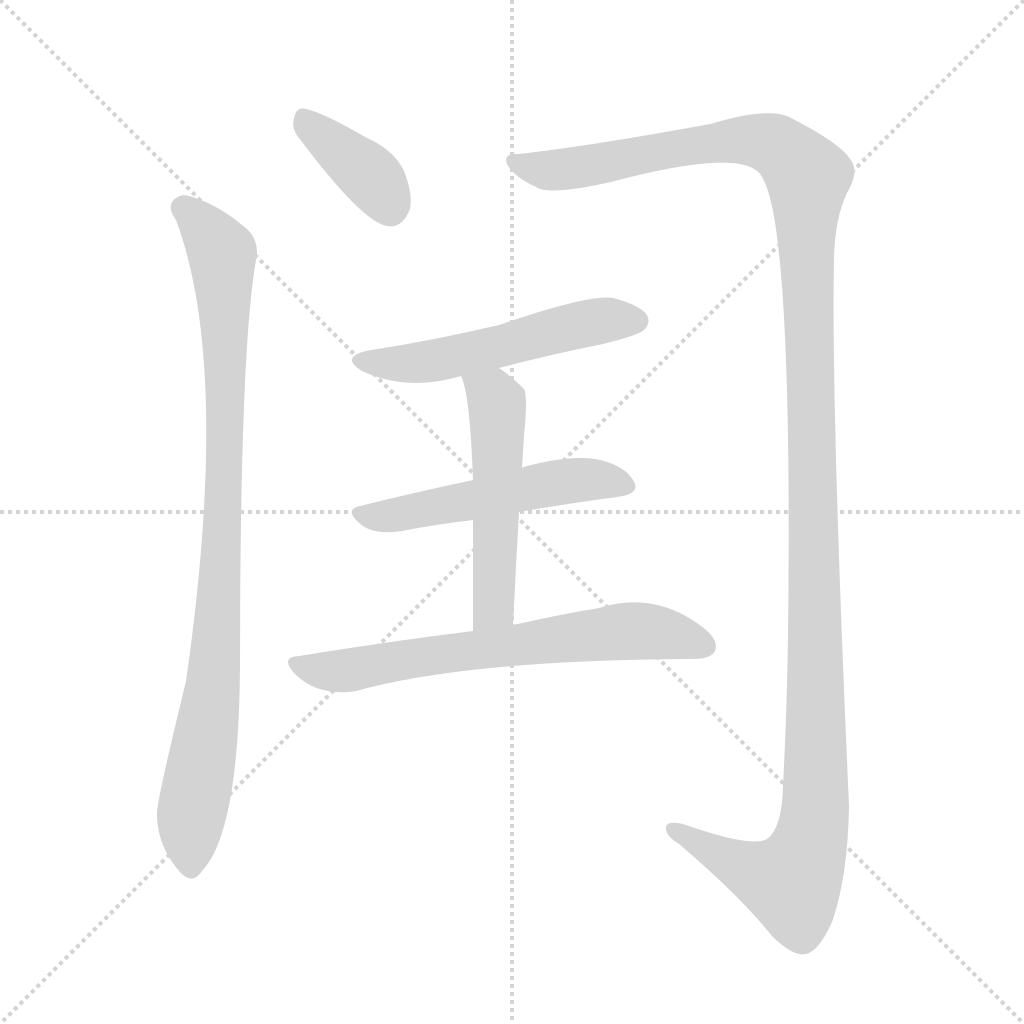
Run
Kangxi Stroke Count: 12
Page 1331, Entry 01
Ancient form. Pronounced run.
Explaining Characters and Phrases (Shuowen Jiezi): An intercalary month; every five years there are two intercalary months. In the ritual of announcing the beginning of the lunar month, the Son of Heaven resides in the ancestral temple, and during the intercalary month, he resides within the gate. It is composed of the character for King, placed within the character for Gate.
Rites of Zhou (Zhouli): During the intercalary month, the King resides within the gate for the duration of the month.
Records of the Grand Historian (Shiji), Annals of the Five Emperors: The Yellow Emperor initiated the calculations of waxing and waning, and rectified the intercalary remainder.
Book of Changes (Yijing), Appended Statements: Returning the remainders to the finger-gap symbolizes the intercalary month; every five years there are two intercalary months.
Commentary: In all matters of intercalation, there are seven intercalations in nineteen years, forming one cycle. The statement that every five years there are two intercalary months is a rough generalization.
Sub-commentary: Returning the remainders to the finger-gap symbolizes the intercalary month. The remainder refers to the surplus from the four-fold counting method; this remainder is returned to the stalks held between the fingers to complete the number, symbolizing the Way of Heaven. This gathers the fractional remainders to form an intercalary month. As for every five years having two intercalations, generally speaking, the time between a previous and subsequent intercalation is thirty-two months, occurring within a five-year period, thus two intercalations occur in five years.
Book of Documents (Shangshu), Canon of Yao: A year has three hundred and sixty-six days; use the intercalary month to fix the four seasons and complete the year.
Sub-commentary: The position held by the handle of the Dipper is the central qi (solar term). When the sun and moon are located between the two constellations where the Dipper points, and there is no central qi, an intercalary month is established.
Guliang Commentary (Guliang Zhuan), Sixth Year of Duke Wen: An intercalary month is the accumulation of the surplus days of the lunar months, where fractional parts are gathered to form a month.
Correcting Characters (Zhengzitong): The Supreme Ultimate World Ordering Principles (Huangji Jingshi) states: Within one year, there are six yin and six yang; three years produce thirty-six days, thus every three years there is one intercalation. Five years produce sixty days, thus every five years there are two intercalations. Heaven, Earth, and Man are not easily understood.
Note: In one year, the constant number recedes six days for yin and advances six days for yang, which is why the intercalation is placed.
Furthermore, it is said: In the ancient calendar, nineteen years form one cycle. The cycle has seven intercalations: three years, intercalate the ninth month; six years, intercalate the sixth month; nine years, intercalate the third month; eleven years, intercalate the eleventh month; fourteen years, intercalate the eighth month; seventeen years, intercalate the fourth month; nineteen years, intercalate the twelfth month. If fractional remainders gradually accumulate, generally after thirty-two months, an intercalation is set. Since each month has thirty days and some surplus, and the sun and moon meet to form one month, each month only has twenty-nine days and some surplus. Each month fluctuates, and the qi gradually becomes irregular; therefore, one observes the location of the central qi to determine the standard of that month, taking the central qi to define the primary month. In the month before the intercalation, the central qi falls on the last day of the month. In the month after the intercalation, the central qi falls on the first day of the month. A month without a central qi is called an intercalary month. The methods of intercalation are detailed in the explanations of Huang Ruijie and in the Charts of Yearly Cycles and Accumulated Days, which are not included here.
Broad Elegant Dictionary (Boya): Mu-run, meaning to commission an envoy.