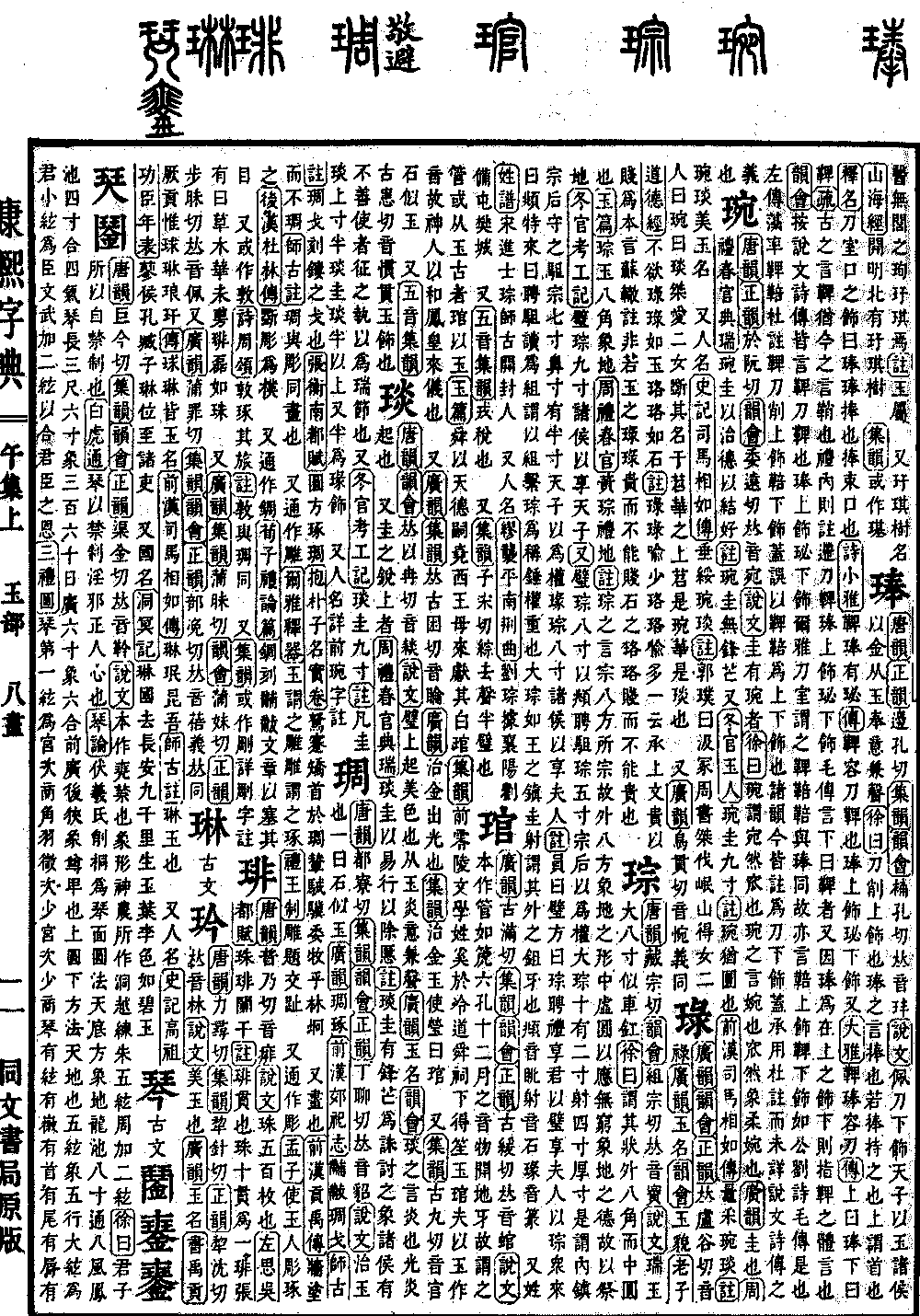
Wu Collection, Upper Volume
Radical: Jade (yù)
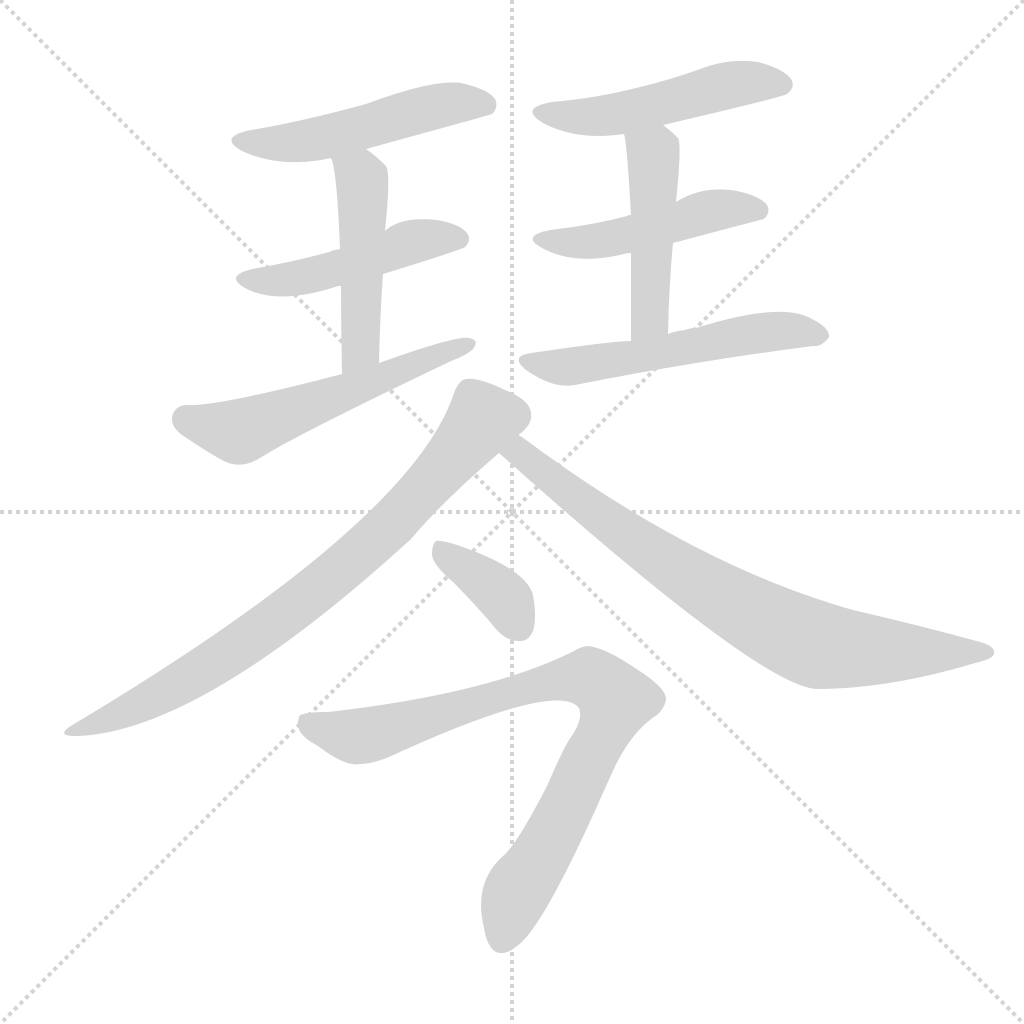
Qin
Kangxi strokes: 13
Page 735, Entry 11
In ancient texts, written as a variant form (qin). Pronounced jin. Pronounced jin. Pronounced jin. The sound is identical to the character for a leather strap on a cart (qin). Explanations on the Origins of Characters (Shuowen Jiezi) states that the original character is written as (qin), which conveys the meaning of prohibition. The character shape is pictographic. It is traditionally said that the mythical figure Shennong created it, with sound holes (yue) in the body, using boiled silk as strings, initially five in number. Two strings were added during the Zhou dynasty. Xu Kai explains that this is an instrument used by a gentleman to restrain himself. The Comprehensive Discussions in the White Tiger Hall (Baihu Tong) states: The qin is used to curb lewd and depraved thoughts and to rectify the human heart. The Discourses on the Qin (Qinlun) records: Fuxi cut wood from a paulownia tree to make the qin. The rounded surface of the qin symbolizes heaven, and the square base symbolizes earth. The dragon pool is eight inches long, corresponding to the winds of the eight directions, and the phoenix pond is four inches long, corresponding to the energy of the four seasons. The qin is three feet and six inches long, symbolizing the three hundred and sixty days of the year. Its width of six inches symbolizes the six directions (the universe). The front is wide and the back is narrow, symbolizing the distinction between high and low status. The design, round on top and square at the bottom, models itself after heaven and earth. The five strings symbolize the five elements; the large string is the ruler, the small string is the minister. King Wen and King Wu of Zhou each added a string to harmonize the benevolence and duty between ruler and subject. The Illustrated Three Rites (Sanli Tu) says: The first string of the qin is the gong note, followed by shang, jue, yu, zhi, then shao gong, and finally shao shang. The qin has strings, bridge positions, a head, a tail, lips, feet, a belly, a back, a waist, shoulders, and sound holes (yue). The lips are called dragon lips, the feet are phoenix feet, the back is the immortal, and the waist is the beauty. The long hole is called the dragon pool, and the short one is called the phoenix swamp. The lin yue is at the head of the qin and is used to fasten the strings. The yue mountain is the raised part at the tail of the qin, also used for fastening strings. The city road is the path beneath the yue mountain. The wild goose feet are located below the shoulders of the qin and are used to wind and secure the strings. The zhen is below the qin feet and is the peg used to tune the strings. The Essentials of Correct Characters (Zhengzitong) records: The qin has several exotic and elegant names, such as the Fuxi Qin, or the qin made of catalpa wood offered as tribute. The qin commissioned by the emperor to be made by his minister Baihuang is called Danwei, also known as Zuchuang. Emperor Jun's qin is called Dianmu. The qin of Yanlong, son of Emperor Jun, is called Junshou, also known as Baimin. The qin of Yizhi is called Guo'a. The qin of King Xuan of Zhou is called Xiangfeng, with the inscription: Emotions have ears; the hidden rebel is within. The qin of the Zhu family is called Taigu. Yuzi Wuqui of the State of Chu played a song called Autumn on Dongting Lake, and his qin was named Qingfan. Cui Yin's qin was called Wobing. Dai Kui's qin was called Heihu. Dai Kui's son, Dai Zhongruo, had a qin called Yuefang. Dai Kui's older brother, Dai Bo, had a qin called Yinggu. Liu Wenchang's qin was called Chunfeng. These names can be cited as beautiful examples alongside famous qins such as Haozhong, Luyue, Luqi, and Jiaowei.
Also a place name. Commentary of Zuo on the Spring and Autumn Annals (Gongyang Zhuan), eighth year of Duke Ding, records: Jia rose at Qinru. The commentary states: Qinru is a place name.
Also, the Classic of Mountains and Seas (Shanhai Jing) records: Between the Black Waters in the southwest, there is the wilderness of Guangdu where they sow qin in both winter and summer. The commentary by Guo Pu states: Sowing qin means sowing and propagating; it is a local colloquialism.
Also a surname. Qin Zhang, a disciple of Confucius, with the courtesy name Zikai. Found in the Zuo Tradition (Zuo Zhuan), twentieth year of Duke Zhao.
Also a personal name. The Classic of Mountains and Seas (Shanhai Jing) records: West of the Red River is the Land of the First People, where there are Mount Mang, Mount Gui, and Mount Yao. There are people on the mountain called Crown Prince Changqin.
Also an insect name. The Classic of Mountains and Seas (Shanhai Jing) records: In the land of the Sushen people, there is an insect with a wild beast's head and a snake's body, named the qin insect. The commentary by Guo Pu states: It also belongs to the snake category.
Also qin city, referring to a tomb. The Commentary on the Water Classic (Shuijing Zhu) records: People in the Chu region call graves qin. There is a large grave in the Doupi of Liu'an County. The common people call it the public qin, and legend says it is the tomb of Gaoyao.
Also, the iron wind chimes under the eaves are called wind qins. A poem by Wang Banshan (Wang Anshi) writes: The wind blowing the iron plates makes them strike and sound, resembling northern soldiers marching at night, their noise echoing through the barracks. Why, in this peaceful world, does one allow oneself to sleep soundly, while this sound becomes instead a noise beneath the pillow in a lonely window?
Critical Research: The Classic of Mountains and Seas (Shanhai Jing) says: West of the Red River is the Land of the First People, where there is Mount Mang, Mount Gui, and Mount Yao. Now, it is carefully corrected based on the original text to change Mount Yao to Mount Yao (Yaoshan).