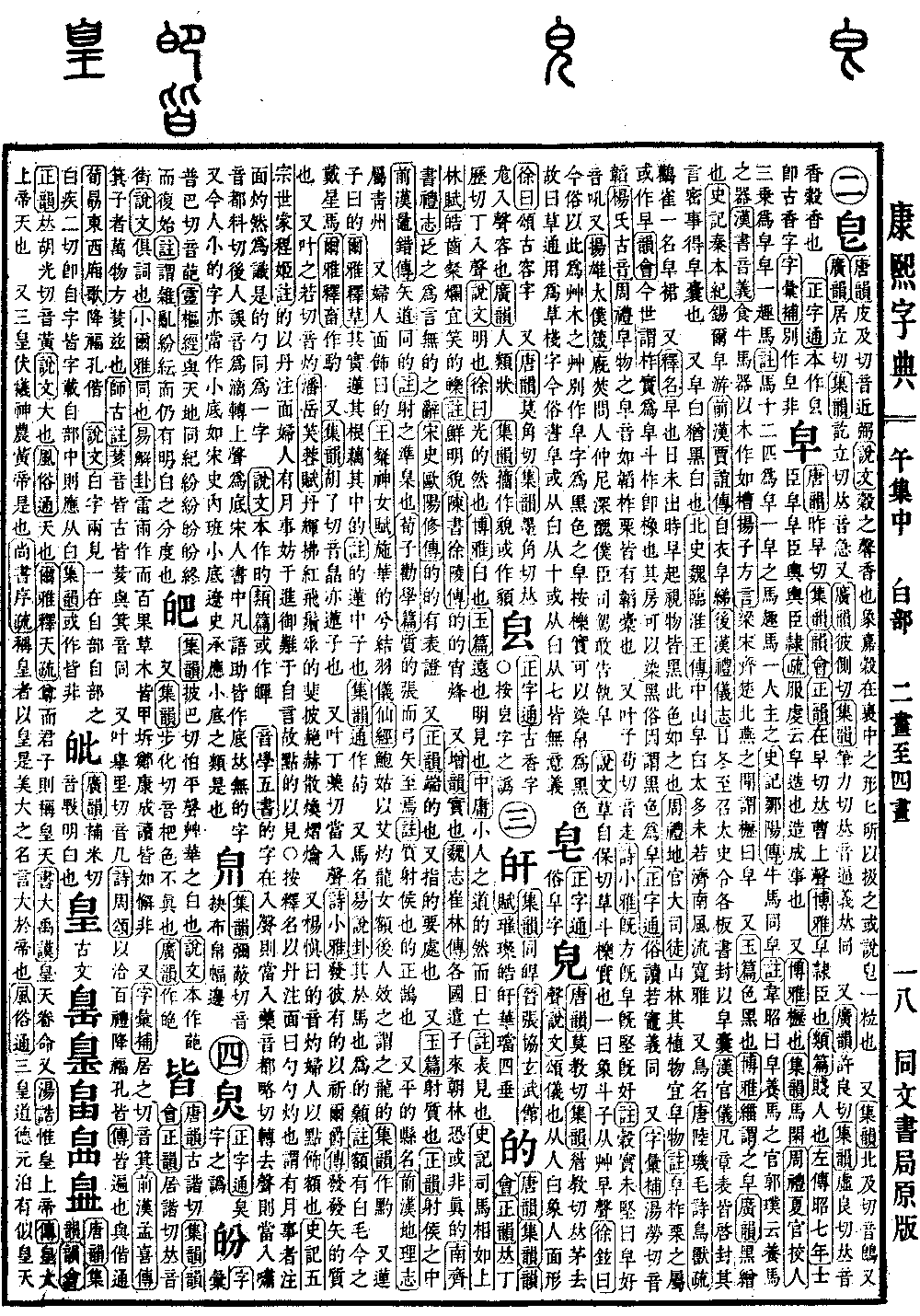
Wu Collection, Middle Volume
Radical: White (bái)
Page 786, Entry 14
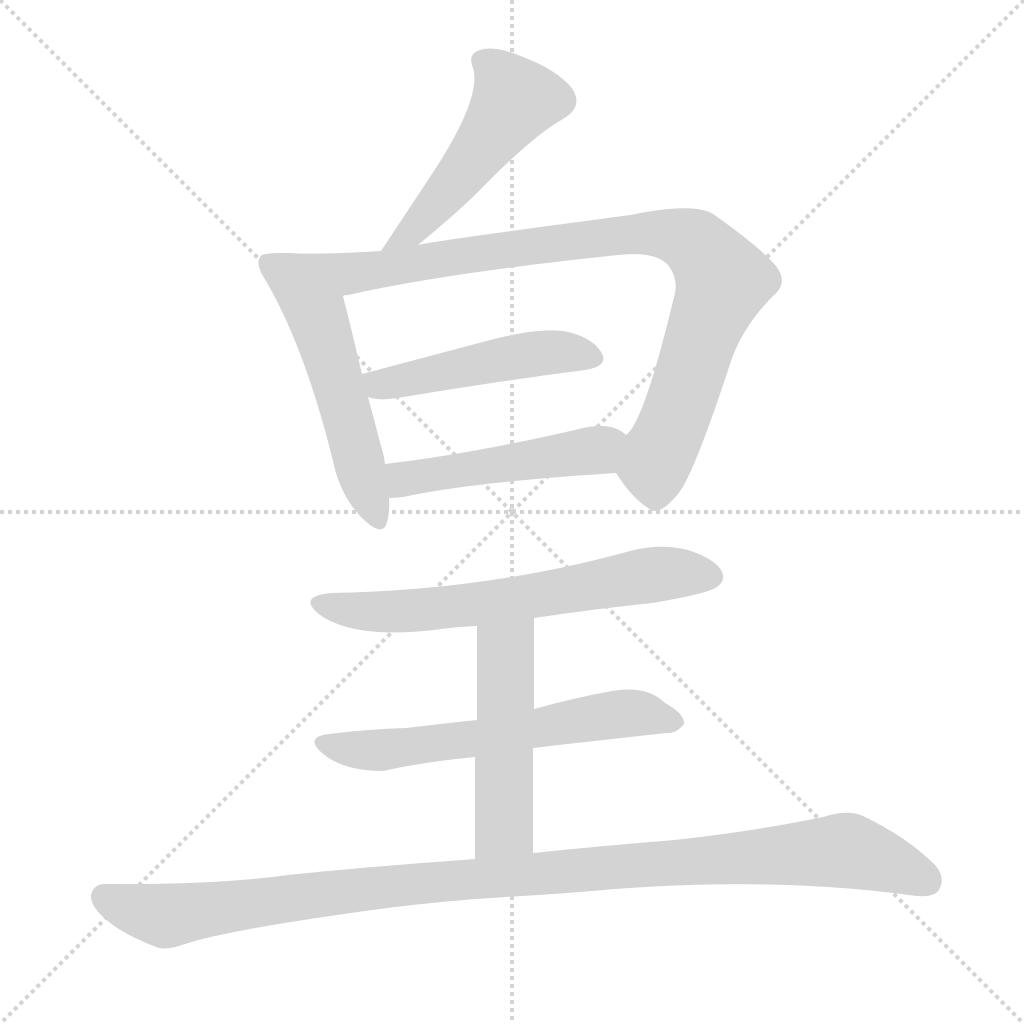
Pronounced huang.
According to the Explaining Graphs and Analyzing Characters (Shuowen Jiezi), it means great.
According to the Comprehensive Customs (Fengsu Tong), it means heaven.
According to the Commentary on the Er ya: Explanation of Heaven (Erya Shitian Shu), when one is honored and treated as a lord, one is called August Heaven.
Book of Documents (Shangshu), Grand Plan of Great Yu: August Heaven bestowed the mandate.
Also, in the Announcement of Tang: It is the August Supreme God.
Commentary: August means great. Supreme God means heaven.
Also refers to the Three Augusts: Fuxi, Shennong, and the Yellow Emperor.
Commentary on the Preface to the Book of Documents (Shangshu Xu Shu): The term August is used because it is a name for beauty and greatness. It implies something greater than an emperor.
Comprehensive Customs: The Three Augusts possessed virtue and morality that were vast and profound, resembling August Heaven, hence they were called August. August means center, brilliance, and magnitude.
It is also a general title for one who possesses the world.
Er ya: Explanation of Words (Erya Shigu): It means ruler.
White Tiger Hall Discussions (Baihu Tong): It is a title. The reason it is called August is that it is so brilliant that no one can disobey it.
Book of Documents, Counsel of Lu: The August Emperor clearly asked the commoners.
Book of Odes (Shijing), Greater Odes: August kings are the rulers.
Spring and Autumn Annals: Prosperity and Luxury (Chunqiu Fanlu): One whose virtue matches heaven and earth is called an Emperor.
Cai Yong, Independent Judgments (Dule Duan): Emperor is a title of supreme honor. In ancient times, the Son of Heaven Fuxi and Shennong were called August. Yao and Shun were called Emperor. Xia, Shang, and Zhou were called King. Qin combined these into one title, and the Han continued this without change.
Book of the Former Han (Qian Han Shu), Chronicle of Emperor Gao: The King of Han ascended the throne as Emperor, honored his queen as Empress, his heir as Crown Prince, and also honored his father as Grand August Emperor.
Annotation: Grand August is a title of ultimate honor. Since he is the father of the Son of Heaven, he is titled August. He does not participate in governing, so he is not called Emperor.
Ming Dynasty regulations: The Crown Prince is titled August. Princes and below are not titled August; the Imperial Clan Court manages the affairs of imperial relatives.
Also, in the Book of Rites (Liji), Record of Ceremonies (Quli): To sacrifice to a grandfather is called August Ancestral Father, to a grandmother is called August Ancestral Mother, to a father is called August Father, to a mother is called August Mother, to a deceased husband is called August Sovereign.
Annotation: These unique titles were established to distinguish the honor of the spirits from that of humans.
Also, in the History of the Song (Song Shi), Chronicle of Emperor Zhenzong: In the fifth year of the Xiangfu era, he personally performed sacrifices to the Jade August at the Chaoyuan Hall.
Annotation: Jade August is the sacred title of the Heavenly Emperor.
Also, in the Extensive Research on Hidden Treasures (Hongbao Bosou): Buddha is also called the August of Enlightenment.
Also, from the Extensive Dictionary (Boya): It means beautiful.
Book of Odes, Greater Odes: Admiring the beautiful and many scholars.
Also, Er ya: Explanation of Words: August means correct.
Book of Odes, Bin Wind: The four states are set right.
Also, it means grand and majestic.
Ceremonial and Rituals (Yili), Rites of Guest-Reception (Pinli): When the guest enters the gate, he is grand.
Also, a appearance of beauty and abundance.
Book of Odes, Greater Odes: Solemn and grand.
Also, it is the same as brilliant.
Book of Odes, Lesser Odes: Brilliant are the flowers.
Er ya: Explanation of Words: August means flower.
Commentary: The flowers of grasses and trees are also called August.
Also, it is the same as flickering.
Yang Xiong, Great Mystery (Taixuan Jing): Things ascend to the bright hall, flickering and brilliant.
Also, it is the same as restless.
Book of Rites, Tan Gong: Restless, as if longing for something, looking but unable to reach.
Also, Yu huang is an exclamation of praise.
Book of Odes, Zhou Odes: How magnificent is the coming of wheat and barley.
Annotation: Yu is pronounced wu.
Also, Yu huang describes speed.
Book of the Former Han, Yang Xiong, Rhapsody on Hunting: The martial cavalry swift and rapid.
Also, Yu huang describes movement back and forth.
Zhang Heng, Rhapsody on Thinking (Si Fu): Examining the entanglement and movement of the two periods and five planets.
Also, a type of crown. It refers to the feathered ornaments on the top.
Book of Rites, Royal Regulations (Wangzhi): The Yu Dynasty used the August crown for sacrifices.
Also, a type of folding screen. It is placed where the king sits.
Book of Zhou (Zhouli), Heaven's Officials: The official in charge of tents sets up the August screen.
Also, a type of dance. It involves splitting five-colored feathers and holding them while dancing.
Book of Zhou, Earth's Officials: The dance master teaches the August dance. He leads the dance during times of drought.
Annotation: August is sometimes written as a variant form.
Also, the Phoenix, a spiritual bird.
Book of Documents, Yi and Ji: The Phoenix comes to perform ceremonies.
Commentary: The male is called Feng, the female is called Huang. Huang is often written as the variant form.
Collected Rhymes (Jiyun): Also written as a variant form.
Also, in the Commentary on the Er ya: Explanation of Birds (Erya Shiniu Shu): August is another name for the yellow bird. Commonly called the yellow oriole.
Also, in the Commentary on the Er ya: Explanation of Grasses: August is another name for field-guardian. It resembles wild oats, like water-oat rice, and grows in abandoned fields.
Also, in the Garden of Anecdotes (Piya): A horse that is black-yellow and white is called August.
Book of Odes, Bin Wind: The August and piebald horses.
Also, the name of a star.
Book of the Former Han, Treatise on Astronomy: The Year Star (Jupiter), when it appears in the tenth month, is called the August of Heaven.
Also, the Country August Star, which is large and red.
Also, Yu huang is the name of a boat.
Zuo Tradition (Zuozhuan), Seventeenth Year of Zhao: The State of Chu defeated the Wu army and captured their imperial boat, the Yu huang. Commonly written in a variant form.
Also, Yu huang is the name of a deity.
Book of the Former Han, Rhapsody on Sima Xiangru: Ahead is the Long-Distance, and behind is the Yu huang.
Records of the Grand Historian (Shiji) writes it differently.
Also, the gate before a tomb is called August.
Zuo Tradition, Nineteenth Year of Zhuang: Buried at the gate of the tomb.
Also, the gate of the sleeping quarters is called August.
Zuo Tradition, Thirteenth Year of Xuan: The footwear reached the gate.
Also, a room without four walls is called August.
Book of the Former Han, Biography of Hu Jian: Arranged the seats in the August hall.
Extensive Dictionary: Written as a variant, which is incorrect.
Also, a name for a type of gate.
Book of Odes, Greater Odes: Beside the gate.
Also, the name of a mountain and a river.
Classic of Mountains and Seas (Shanhai Jing): August-Human Mountain, from which the August River flows.
Also, a place name.
Spring and Autumn Annals, Twenty-second Year of Zhao: Lord Liu and Lord Dan took King Meng to reside at August.
Also, a surname.
Commentary on Zuo Tradition: Song Dai's son, August Father, his descendants used August as their clan name.
Also, August-Father is a double surname.
Also, in the Rules of Posthumous Titles: One who pacifies the people by law is called August.
Also, used interchangeably with the words for restless or wandering.
Zuo Tradition, Thirty-second Year of Zhao: Not restless in his resting place.
Book of Odes, Lesser Odes: Uses the variant.
Er ya: Explanation of Teachings: Uses the variant, meaning leisure.
Book of the Former Han, Yang Xiong, Ganquan Rhapsody: Wandering in the Western Palace.
Annotation: Similar to the word for wandering. Also written in another variant form.
Also, according to the Correct Rhymes (Zhengyun), pronounced huang (rising tone).
Book of Rites, Shao Yi: The beauty of the sacrifice is solemn and grand. Read by Lu Deming.
Also, according to the Correct Rhymes, pronounced huang (departing tone). Same meaning. Read by Xu Miao.
Also, according to the Collected Rhymes, pronounced wang. August-August is the ritual of sacrifice.
Book of Rites, Shao Yi, Annotation: August is read as the word for toward.
Commentary: This refers to where the heart is directed; when a filial son performs sacrifice, his demeanor is strict and proper, and it must have a continuous connection, hence it is solemn and grand.
Book of Odes, Lu Odes: Flourishing and grand.
Annotation: Grand should be written as the variant form, similar to the word for toward.
According to the Explaining Graphs and Analyzing Characters, the original character included the radical for self, meaning beginning.
Xu says: Self means to follow. Therefore it means beginning. Now it is abbreviated as white.