Wu Collection, Upper Volume
Radical: Jade (yù)
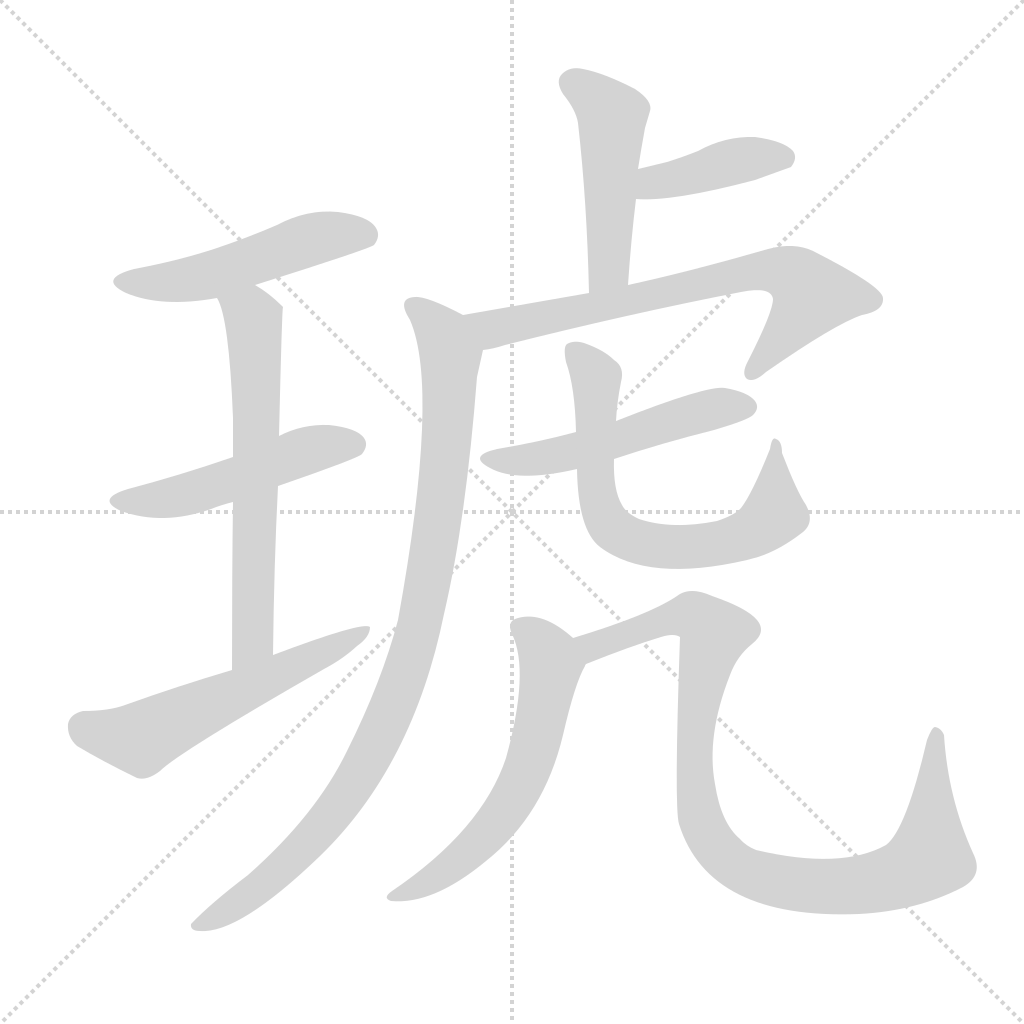
琥
Kangxi Strokes: 13
Page 734, Entry 22
Pronounced hu (rising tone)
Pronounced hu (rising tone)
Pronounced hu (rising tone)
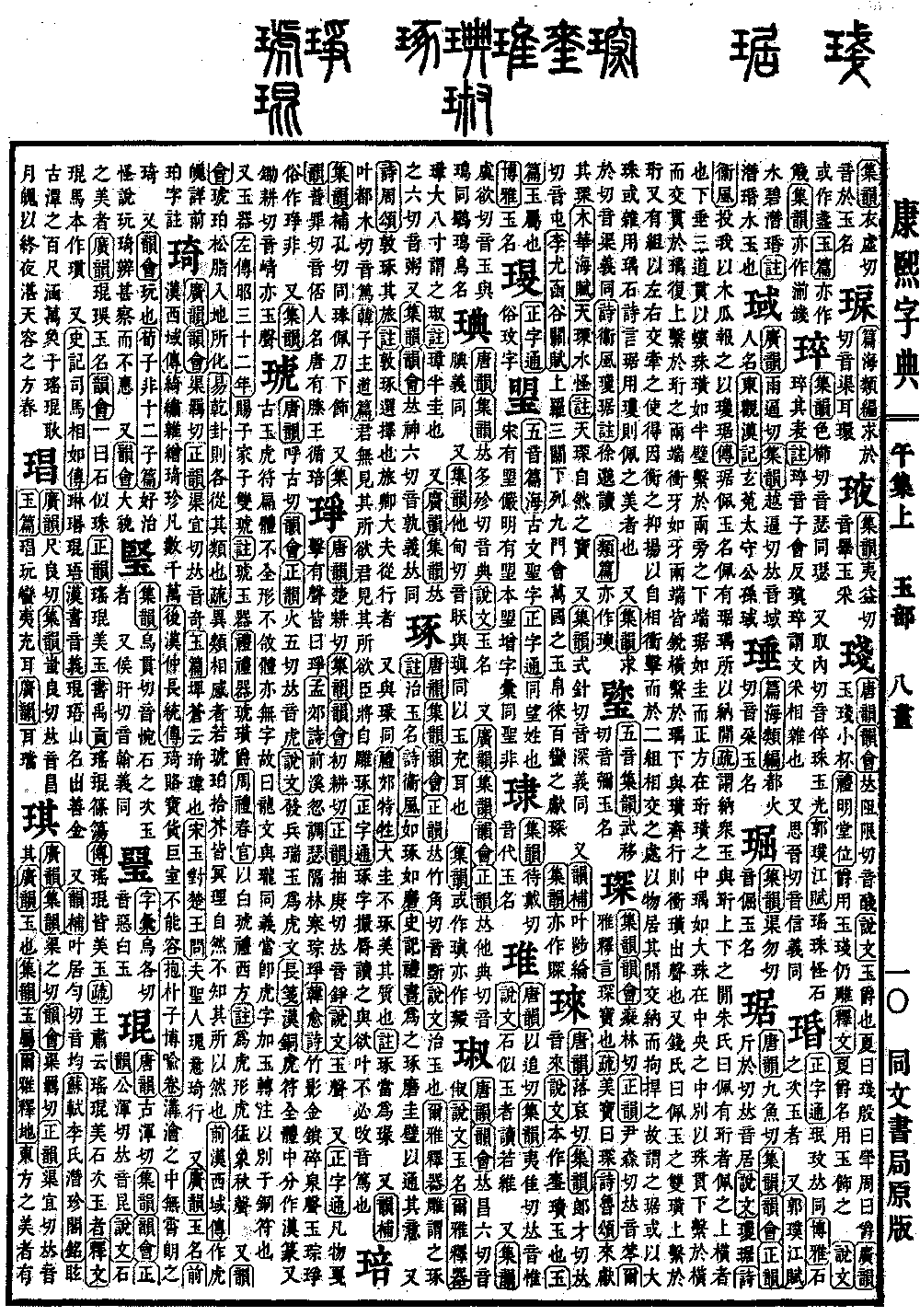
According to the Explaining Graphs and Analyzing Characters (Shuowen Jiezi), this refers to an auspicious jade object used as a credential for dispatching troops, inscribed with a tiger-shaped pattern.
According to the Long Commentary (Changjian), bronze tiger tallies from the Han dynasty were split down the middle and inscribed with Han seal script; there were also ancient jade tiger tallies that were flat, incomplete in form, and lacked inscriptions, thus being referred to as dragon-patterned. The meaning is the same as the character for jade (long). It should be that the character for tiger with a jade radical was created through the principle of derivative meanings (zhuanzhu) to distinguish it from bronze tallies. It also refers to jade vessels.
Zuo Tradition (Zuozhuan), 32nd Year of Duke Zhao: Presented Zijiazi with a pair of jade objects (hu). Note: Hu is a type of jade vessel.
Book of Rites (Liji), Ritual Vessels (Liqi): Hu is a semi-circular jade (huang) vessel.
Rites of Zhou (Zhouli), Offices of Spring (Chunguan): Use white jade (hu) to offer sacrifice to the god of the west. Note: The jade (hu) is made in the shape of a tiger because the tiger is fierce and symbolizes the harsh, killing air of autumn.
According to the Dictionary of Rhymes (Yunhui), amber (hupo) is a fossil formed from pine resin buried underground.
Book of Changes (Yijing), Qian Hexagram, Sub-commentary: Things of different categories resonate with each other, just as amber attracts small bits of straw; these are all deep and subtle natural principles, and people do not know why it is so.
History of the Former Han (Qian Han), Records of the Western Regions: Written as tiger-soul (hupo). For a detailed explanation, see the previous entry for the character amber (po).
Textual Research:
Rites of Zhou (Zhouli), Offices of Spring (Chunguan): Use white jade (hu) to perform rites for the west. Note: Made in the shape of a tiger; the tiger is fierce, symbolizing the harsh (yan) sound of autumn. I have corrected the character sound (sheng) in the original text to harsh (yan) in accordance with the text.