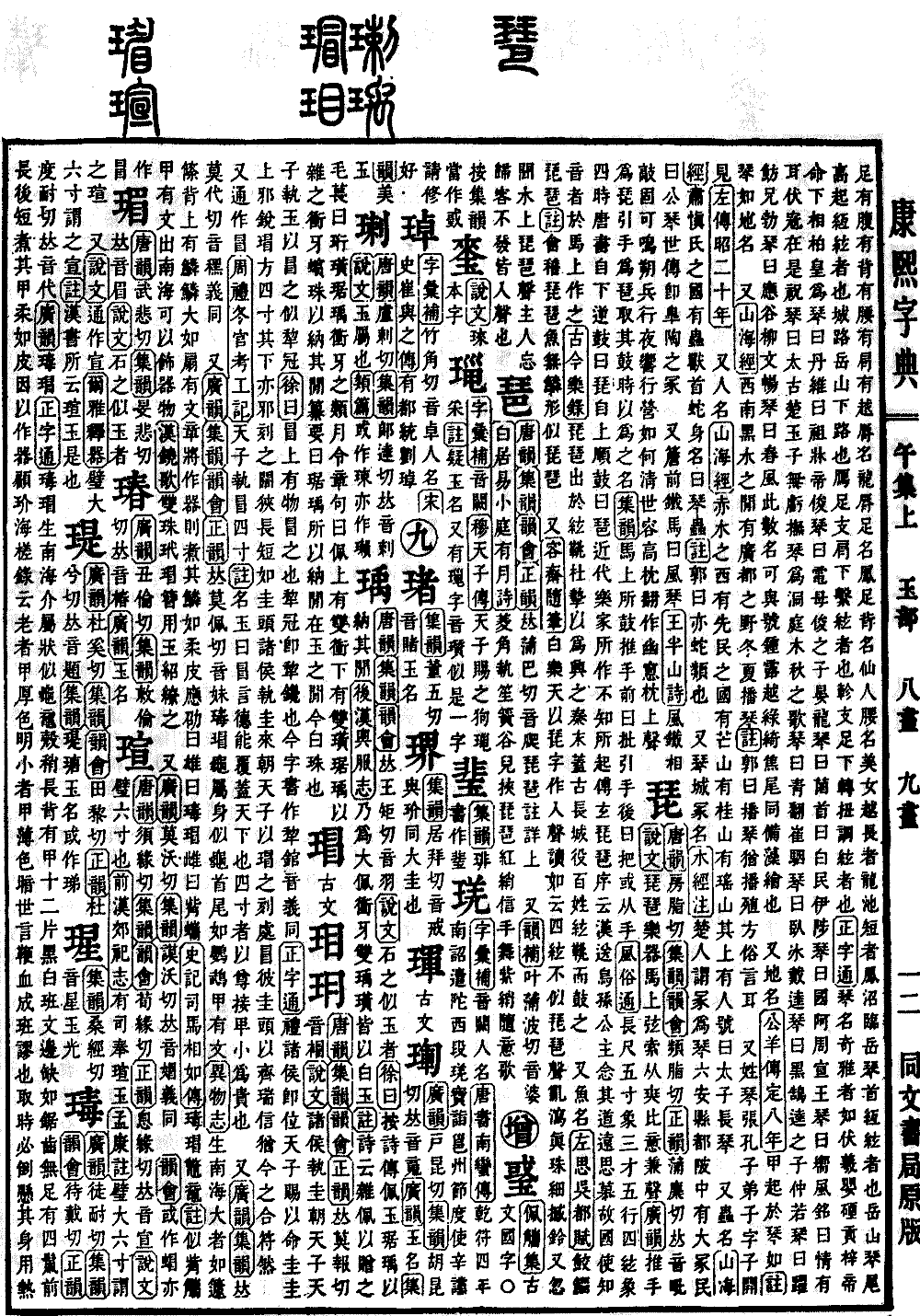
Wu Collection, Upper Volume
Radical: Jade (yù)
Kangxi stroke count: 13
Page 736, Entry 01
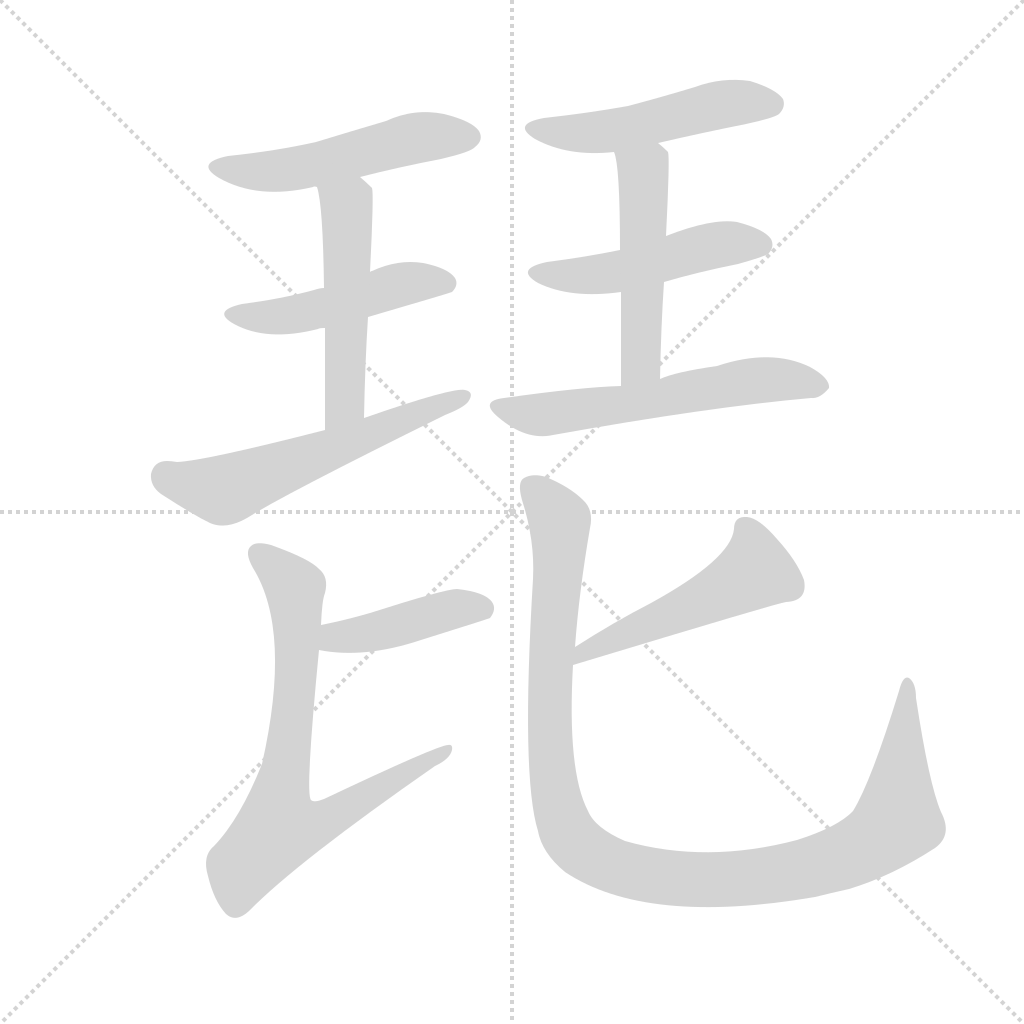
Pronounced pi.
According to the Explaining Graphs and Analyzing Characters (Shuowen Jiezi): Pipa, a musical instrument. Played on horseback with strings. Composed of the graph for zither, with the component bi, which provides both meaning and sound.
According to the Extended Rhymes (Guangyun): Pushing the hand forward is called pi, pulling the hand backward is called pa, named for the motion of striking the instrument.
According to the Collected Rhymes (Jiyin): Played on horseback; pushing the hand forward is called pi, pulling the hand backward is called pa. Sometimes written with the hand radical.
According to the Comprehensive Customs (Fengsu Tong): It is one foot five inches long, symbolizing the three realms and the five phases. Its four strings symbolize the four seasons. The History of Tang (Tangshu) states that striking from bottom to top is called pi, and striking from top to bottom is called pa. Musicians of the modern era do not know its origins. The Preface to the Pipa states: When the Han dynasty sent a princess to the Wusun, fearing the distance and her longing for her homeland, they had a master of music create this instrument for her to play on horseback.
According to the Records of Music Past and Present (Gujin Yuelu): The pipa evolved from the xiantao. Du Zhi believed it originated at the end of the Qin dynasty; likely during the labor on the ancient Great Wall, the common people improvised on the xiantao to play it.
Also refers to a type of fish.
In Zuo Si’s Rhapsody on the Capital of Wu (Wudu Fu): The shark, the mullet, and the pipa.
Commentary: The pipa fish from Kuaiji is scaleless and shaped like a pipa instrument.
Also, according to the Miscellaneous Notes of Rongzhai (Rongzhai Suibi): Bai Letian read the character pi as an entering tone. For instance, he wrote: The four strings do not sound like a pipa, scattering pearls and shaking tiny bells. And also: Suddenly hearing the sound of a pipa on the water, the host forgets to return and the guest does not depart. In these instances, it is used as an entering tone.