Wu Collection, Upper Volume
Radical: Jade (yù)
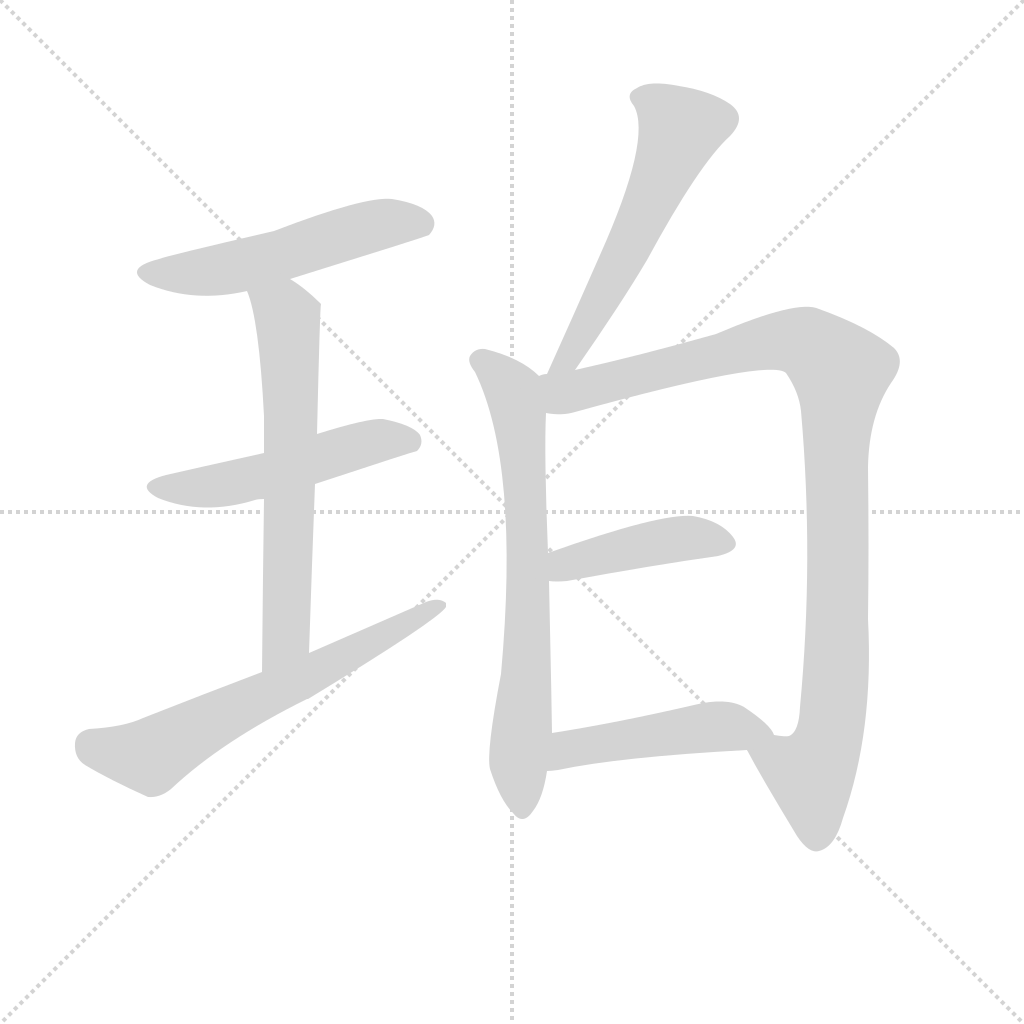
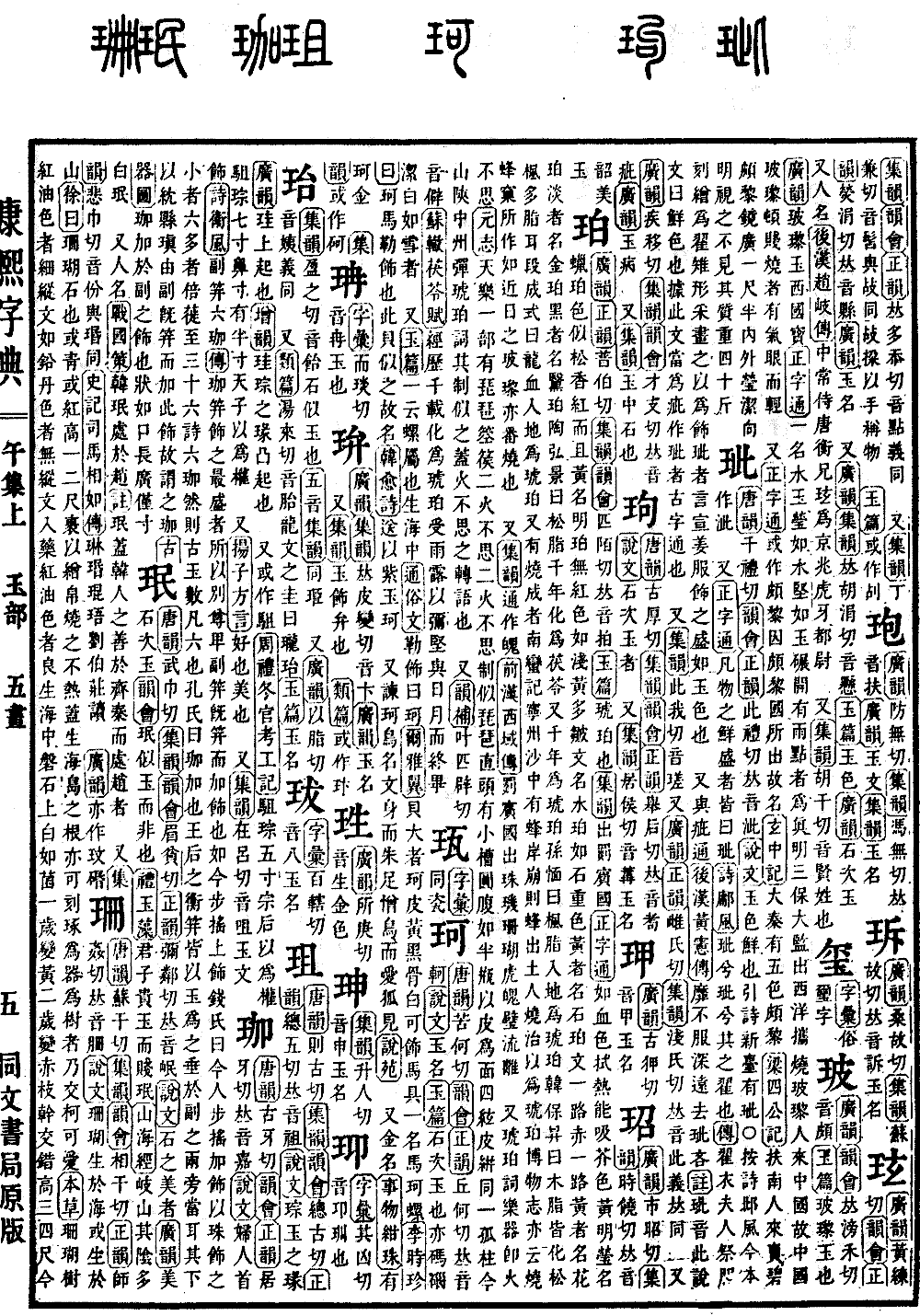
Po; Kangxi strokes: 10; Page 729, Entry 10
According to the Extensive Rhymes (Guangyun) and Correct Rhymes (Zhengyun), the pronunciation is po (falling tone). According to the Collection of Rhymes (Jiyun) and the Rhyme Collection (Yunhui), the pronunciation is pi (entering tone); it is read the same as the word for clap.
In the Jade Chapter (Yupian), it refers to amber.
According to the Collection of Rhymes (Jiyun), it is produced in the state of Bin.
According to the Correct Character Guide (Zhengzitong), it resembles the color of blood and can attract small blades of grass after being rubbed to generate heat. A yellow and bright variety is called wax amber. A variety with the color of pine resin, yellow with a reddish tint, is called clear amber. A variety with no red, appearing pale yellow and often having wrinkles and textures, is called water amber. A variety heavy like stone with a yellow color is called stone amber. A variety with alternating red and yellow patterns is called flower amber. A light-colored variety is called gold amber. A black variety is called dark amber. Tao Hongjing stated: Pine resin turns into tuckahoe after one thousand years, and then into amber after another one thousand years. Sun Mian stated: Maple tree resin buried in the ground turns into amber. Han Baosheng stated: The resin of any tree can transform, it is just that pine and maple trees have more of it. Duan Chengshi stated: Dragon blood seeps into the ground and turns into amber. There is also amber made by burning. The Southern Barbarian Records (Nanmanji) records that in the sandy land of Ningzhou there are bees; when the riverbanks collapse, the bees are revealed, and the local people use fire to burn and process them into amber. The Records of the Investigation of Things (Bowuzhi) also says: It is made by burning beehives, similar to modern glass. It is also produced by foreign tribes through burning.
Additionally, according to the Collection of Rhymes (Jiyun), it is commonly written as the variant form (po).
In the Former Han: Western Regions Account (Qianhan Xiyutuan), the state of Bin produces pearls, coral, tiger-soul (i.e., amber), and glass.
There is also the term amber word, which is a musical instrument. It is the same as the huobusi. The Yuan History (Yuanzhi) records that the heavenly music department includes two lutes, two harps, and two huobusi. The shape of the huobusi resembles a lute; the head of the instrument is straight with a small slot, and the body is round and bulging like half a bottle. It uses hide for the soundboard and has four strings and hide pegs that share a common bridge. Today, the amber word played in the regions of Shanxi, Shaanxi, and Henan is similar in shape and construction to this. It is likely a phonetic transformation of huobusi.
Additionally, according to the Rhyme Supplement (Yunbu), it is sometimes rhymed as pi (entering tone), read the same as the word for secluded.
In Su Zhe’s Rhapsody on Tuckahoe (Fulingfu): Having passed through a thousand years, it transforms into amber, receiving dew and rain to become even more solid, eternal as the sun and the moon.