Wu Collection, Upper Volume
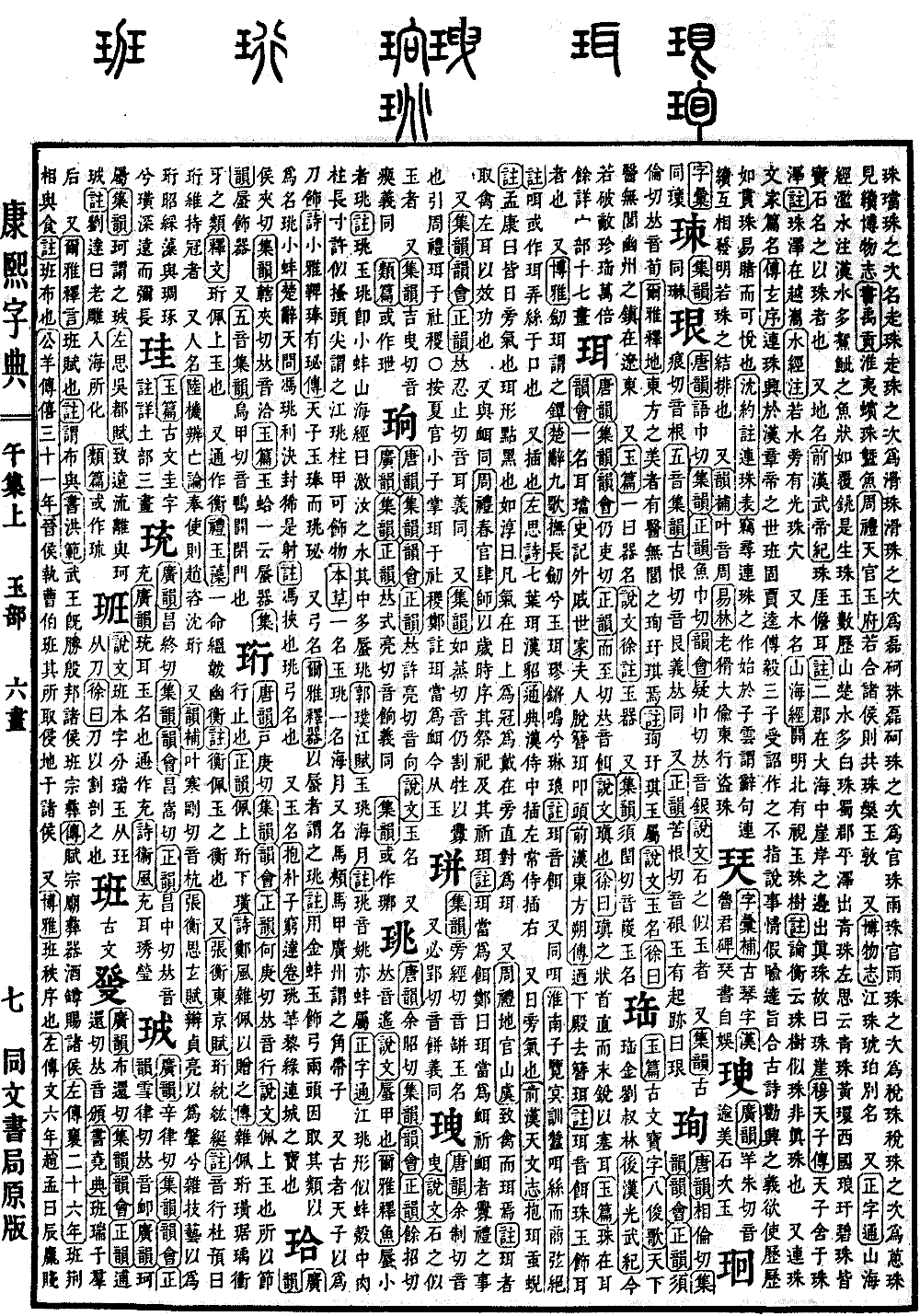
Radical: Jade (yù)
Kangxi Strokes: 11
Page 731, Entry 19
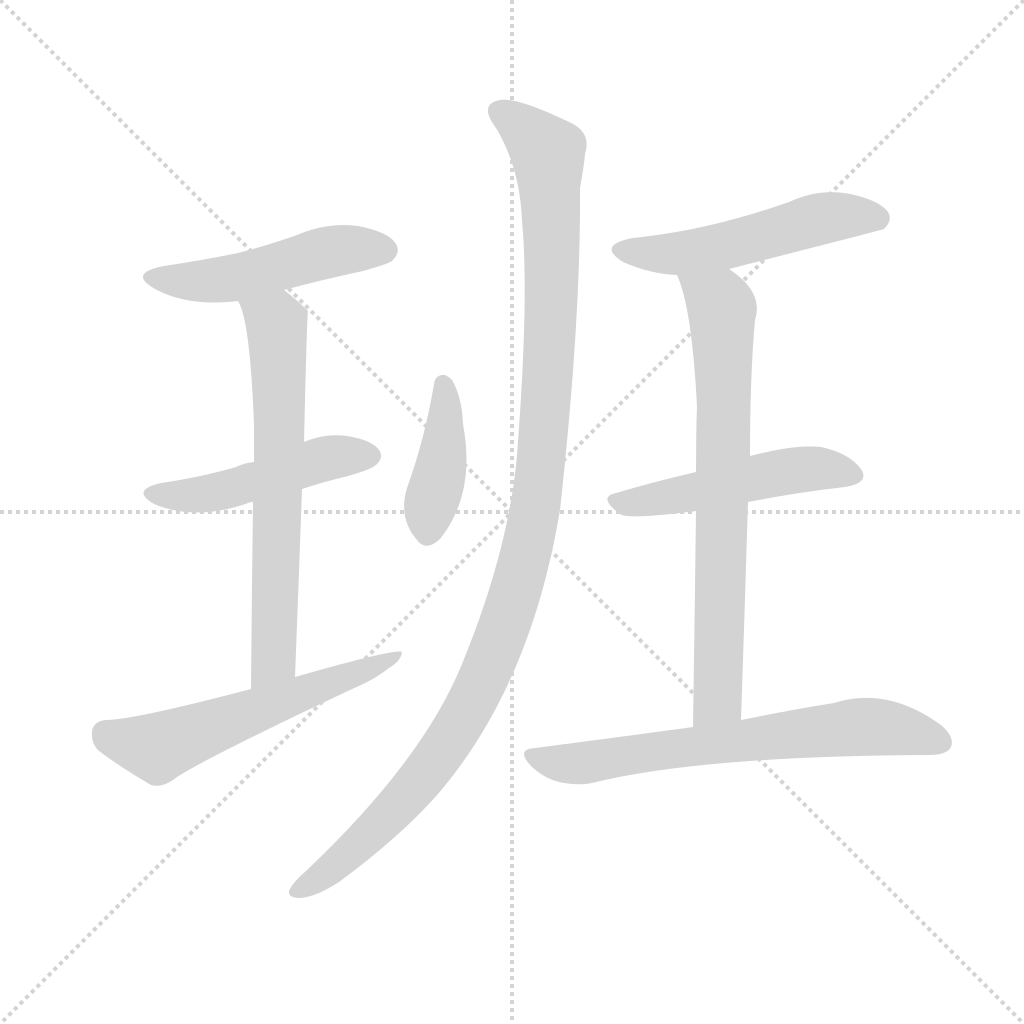
In ancient texts, according to Extensive Dictionary of Rhymes (Guangyun), pronounced ban. According to Collected Rhymes (Jiyun), Rhyme Treasury (Yunhui), and Orthodox Rhymes (Zhengyun), pronounced ban.
Book of Documents (Shangshu), Canon of Yao: Distributed the auspicious jade to the various feudal lords.
Also, Erya: Explaining Words: Ban means to distribute. Commentary: It means to distribute and bestow.
Book of Documents (Shangshu), Great Plan (Hongfan): After King Wu defeated the Shang dynasty, he enfeoffed the feudal lords and bestowed upon them sacrificial wine vessels from the ancestral temples. Commentary: Bestowed the vessels and wine containers from the ancestral temples upon the feudal lords.
Zuo Tradition (Zuozhuan), Twenty-sixth Year of Duke Xiang: Spread out the thorny branches and sat together to eat. Commentary: Ban means to spread out.
Gongyang Tradition (Gongyangzhuan), Thirty-first Year of Duke Xi: The Marquis of Jin captured the Earl of Cao and returned the land previously seized by the state of Cao to the various feudal lords.
Also, Bolun (a dictionary): Ban refers to order or sequence. Zuo Tradition (Zuozhuan), Sixth Year of Duke Wen: Zhao Meng said, "Chen Ying is of low status, and her rank is ninth." Commentary: Ban means rank.
Also, Collected Rhymes (Jiyun): Refers to order or grade. Zuo Tradition (Zuozhuan), Sixth Year of Duke Huan: The grand masters of the feudal lords were guarding the state of Qi; the state of Qi presented them with food and let the state of Lu determine the order of distribution. Commentary: Ban means order.
Also, Collected Rhymes (Jiyun): Refers to separation or parting. Zuo Tradition (Zuozhuan), Eighteenth Year of Duke Xiang: The sound of horses neighing as they leave the herd. Commentary: Ban means parting. Because they could not see each other when fleeing at night, they made sounds of parting.
Also refers to spreading or pervasive. Discourses of Jin (Jinyu): The war chariots were spread throughout the city and its outskirts, and they were taught using the principles of obedience. Commentary: Ban means to spread throughout.
Also, Fangyan (Regional Expressions): Ban means to arrange or deploy. In Northern Yan it is called "ban," while in Eastern Qi it is called "che."
Book of Changes (Yijing), Tun Hexagram: Riding a horse and circling without advancing. Commentary: The six-four line resonates with the initial nine line, therefore it speaks of riding a horse. But worrying that the six-two line obstructs the path, at the beginning one circles and does not advance.
Book of Documents (Shangshu), Counsels of the Great Yu: Withdraw the army and reorganize the ranks.
Also refers to variegated colors. Record of Rites (Liji), Royal Regulations (Wangzhi): Elderly people with gray hair do not need to carry things themselves. Commentary: Variegated colors are called ban.
Also "banban," referring to the sound of carriages. Annals of the Five Elements in the History of the Later Han: The sound of carriages was banban as they entered the Hanjian region.
Also a surname. Customs and Manners (Fengsutong): Descendants of Dou Ban, the Prime Minister (lingyin) of the state of Chu.
Also a county name. Geography Treatise in the History of the Former Han: Banshi County. Commentary: Belonged to Dai Commandery.
Also "banmao," the name of an insect. Records of Ancient and Modern Times (Gujinjin): There are five types of medicinal herbs, the fifth is called banmao, which is neutralized using foreign salt.
Also, Collected Rhymes (Jiyun): Sometimes written in a variant form (bian). History of the Former Han (Qianhan), Biography of Wang Mang: Divided and enfeoffed land to the feudal lords.
Also, Rhyme Treasury (Yunhui): Interchangeable with "ban." Zuo Tradition (Zuozhuan), Thirteenth Year of Duke Cheng: Gongzi Ban of the state of Zheng requested to enter the ancestral temple from Zi. Interpretation: In some versions, "ban" is written as "ban."
Odes of the Former Han (Qianhan), Suburban Sacrifice Songs: First using rain (to clear the way), broadly and continuously (descending). Commentary: "First using rain" means that when the deity travels, rain goes first to clear the road. "Ban" is pronounced the same as "ban" and means to distribute or bestow. "Yiyi" describes the appearance of flowing and continuous movement.
Also, Rhyme Supplement (Yunbu): Rhymes with "lian," pronounced similar to "bian." He Yan, Rhapsody on Jingfu Hall: The brilliance is bright and flashing, the patterns are colorful and variegated, the clear wind gathers to create sound, and the morning sun shines, adding to the vibrancy.
Extensive Dictionary of Rhymes (Guangyun): The vulgar form is written as a compound of two characters.
Orthodox Rhymes (Zhengyun): Also written as "ban" and "fen."
Verification: Also a surname. Customs and Manners (Fengsutong): Descendants of Dou Ban, the Prime Minister of the state of Chu. According to the Customs and Manners cited in the Extensive Dictionary of Rhymes (Guangyun), I have corrected "Que Ban" to "Dou Ban."