Si Collection, Middle Volume
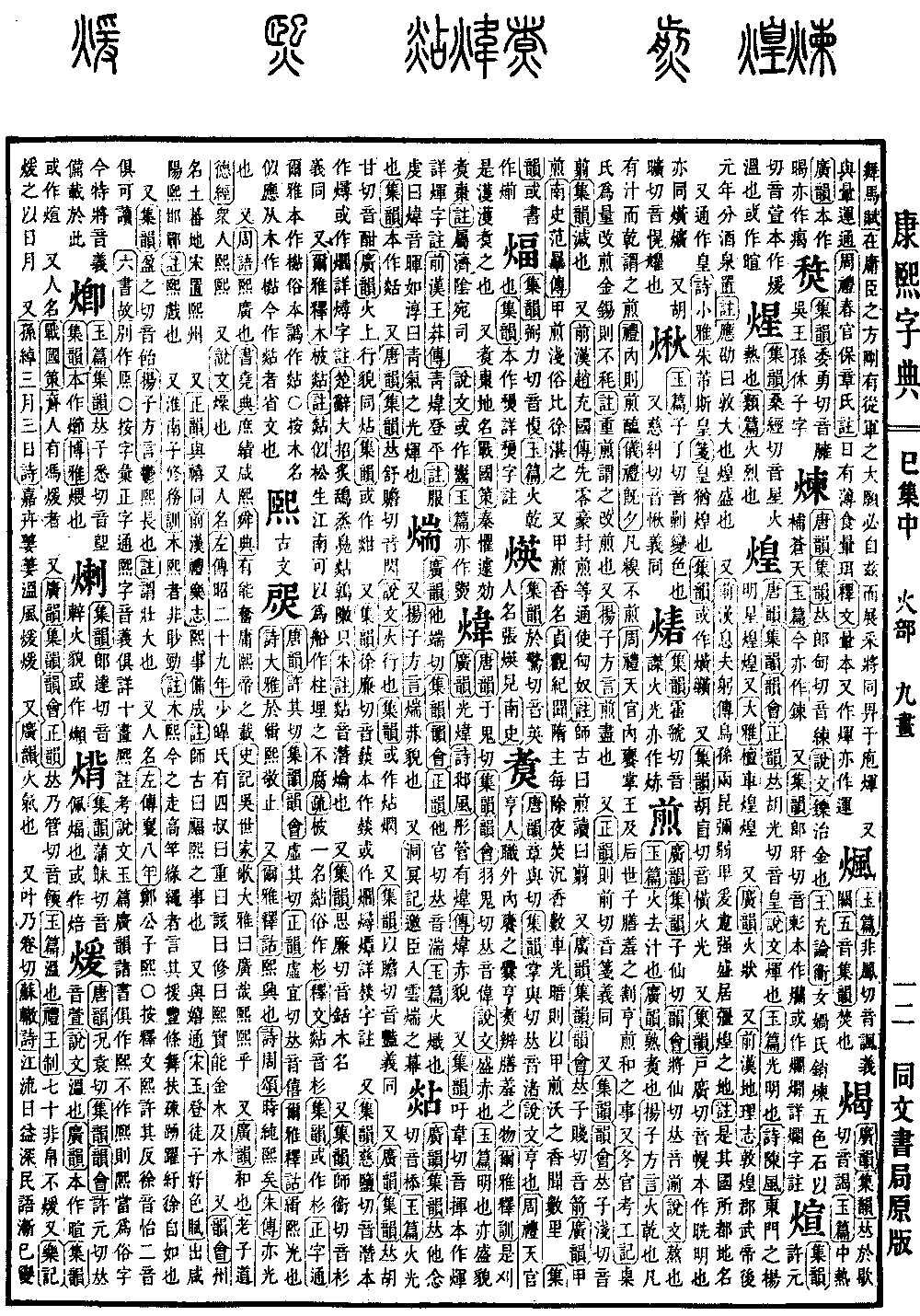
Radical: Fire (huǒ)
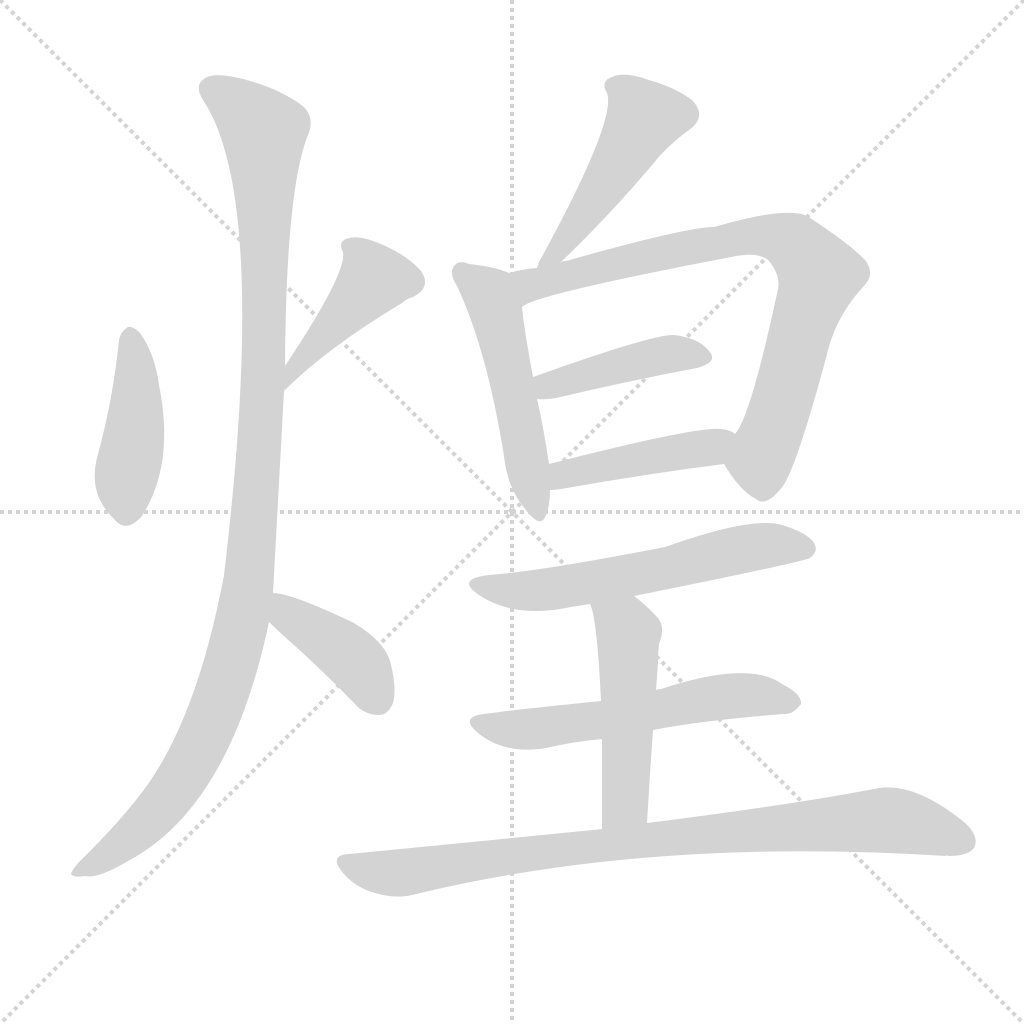
煌
Kangxi Stroke Count: 13
Page 676, Entry 07
Tang Rhymes (Tangyun), Collected Rhymes (Jiyun), Rhyme Anthology (Yunhui), Correct Rhymes (Zhengyun): Pronounced huang (rising tone).
Explaining Writing (Shuowen): Interpreted as radiance.
Jade Chapters (Yupian): Means brightness.
Book of Odes (Shijing), Odes of Chen: The poplar trees by the eastern gate, the morning star shines brightly.
Also, Greater Odes (Daya): The sandalwood chariot is resplendent.
Also, Broad Rhymes (Guangyun): Describes the appearance of fire.
Also, History of the Former Han (Qian Hanshu), Treatise on Geography: Dunhuang Commandery was established in the first year of the Houyuan era of Emperor Wu of Han, separated from Jiuquan Commandery. Commentary: Ying Shao stated: Dun means great; huang means prosperous.
Also, History of the Former Han (Qian Hanshu), Biography of Xifu Gong: The two Kunmi of the Wusun were declining in power, while Beiyuan Di was flourishing, occupying the place known as Qianghuang. Commentary: Qianghuang is the name of the capital of that state.
Also used as a variant form for the character huang (emperor).
Book of Odes (Shijing), Lesser Odes (Xiaoya): The red knee-covers are thus brilliant. Commentary: Huang is equivalent in meaning to huang.
Collected Rhymes (Jiyun): Sometimes also written in a variant form (huang).
Also, Collected Rhymes (Jiyun): Pronounced huang (level tone), with the same sound as heng. Refers to the light of fire.
Also, Collected Rhymes (Jiyun): Pronounced huang (rising tone), with the same sound as huang. The original character is huang. It means bright. It is also identical to the characters huang and kuang.
Also pronounced huang (falling tone), with the same sound as huang. It means to illuminate. The character huang was originally written incorrectly with the radical xian.