Wu Collection, Upper Volume
Radical: Jade (yù)
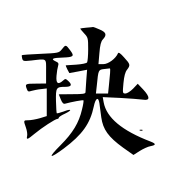
Jue; Kangxi strokes: 9
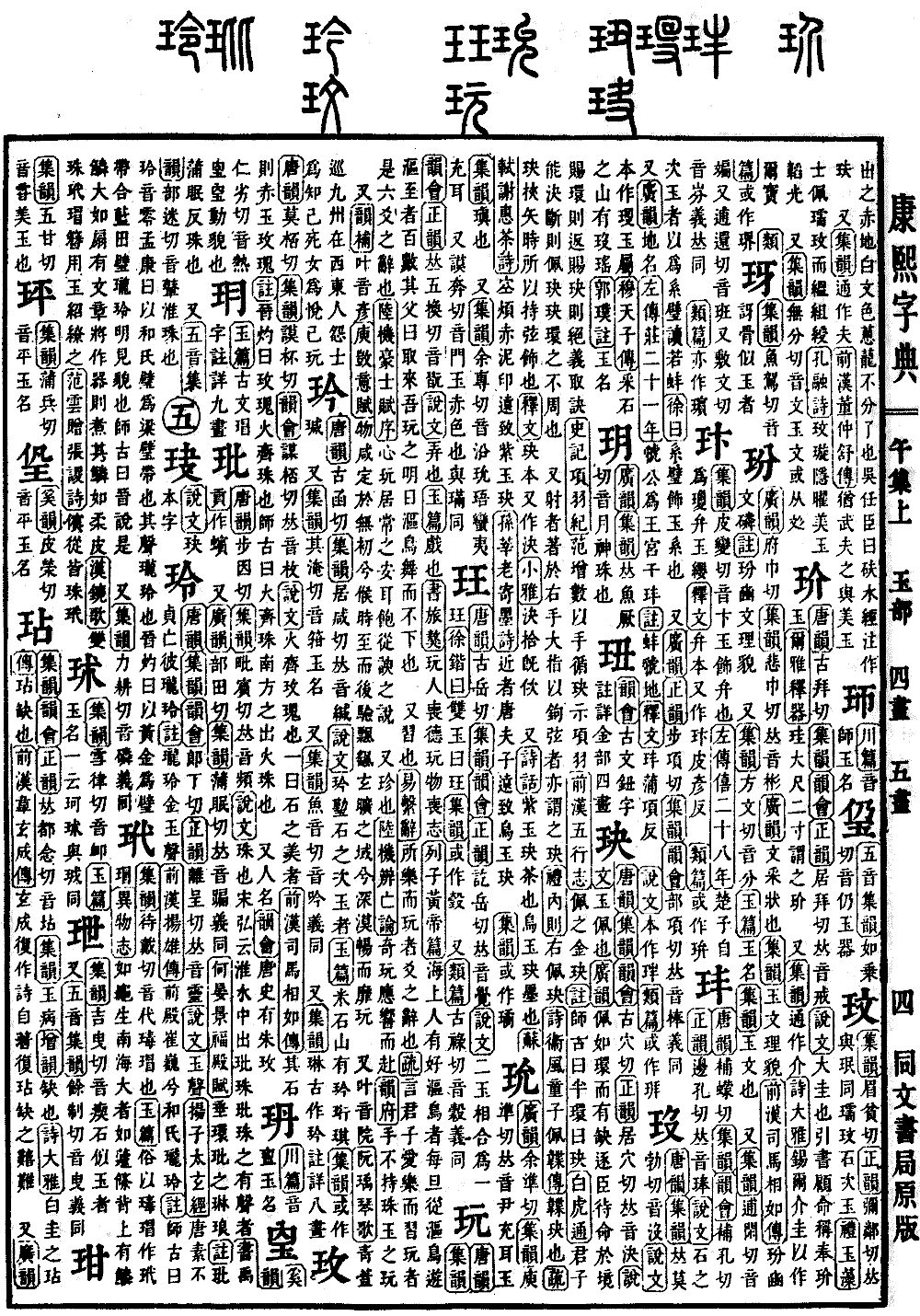
Page 728, Entry 12
Pronounced jue.
According to the Explaining Graphs and Analyzing Characters (Shuowen Jiezi), it is a jade pendant.
According to the Extensive Rhymes (Guangyun), it is a pendant shaped like a ring but with a gap. When a banished official waits for orders at the border, being granted a ring signifies he may return, whereas being granted a jue signifies he is cut off. The meaning is derived from the word for decide.
Records of the Grand Historian (Shiji), Biography of Xiang Yu: Fan Zeng repeatedly touched his jue to signal to Xiang Yu.
Former Han (Qianhan), Treatise on the Five Elements: Worn as a metal ornament. The commentary by Yan Shigu states: A half-ring is called a jue.
Comprehensive Discussions in the White Tiger Hall (Baihu Tong): A noble person who is capable of making decisive judgments wears a jue. A jue is a ring that is not complete.
It also refers to the item worn by an archer on the right thumb to pull the bowstring.
Book of Rites (Liji), Inner Morality (Neize): Wearing a jue on the right side.
Book of Odes (Shijing), Odes of Wei: The commentary on the youth wearing a she (a thumb ring) states: A she is a jue. The sub-commentary explains: The jue is the ornament used to hold the bowstring when drawing an arrow.
The Explanation of Text (Shiven) states: Jue is sometimes also written in a variant form (jue).
Book of Odes (Shijing), Lesser Odes of Kingdom (Xiaoya): The archer's thumb ring and glove are in order.
In poetry criticism, a purple jade jue refers to tea, and a black jade jue refers to ink.
Su Shi, Poem of Thanks for the Gift of Tea: Vainly troubled by the red clay seal, from afar arrived the purple jade jue.
Sun Shenlao's Poem on Sending Ink: Recently Master Tang, from afar sent a black jade jue.
Collected Rhymes (Jiyun): Sometimes written as a variant form (qiong).