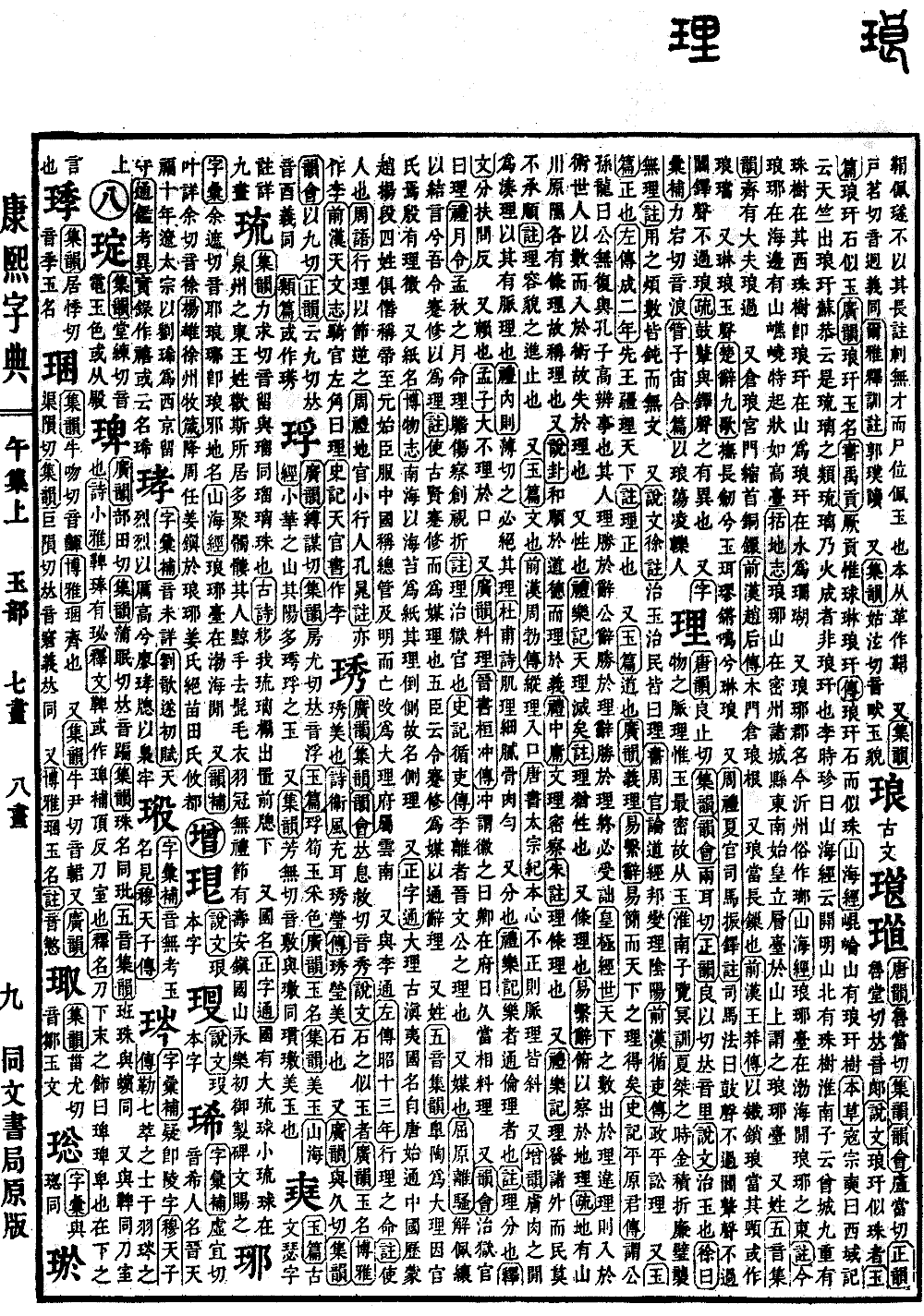
Wu Collection, Upper Volume
Radical: Jade (yù)
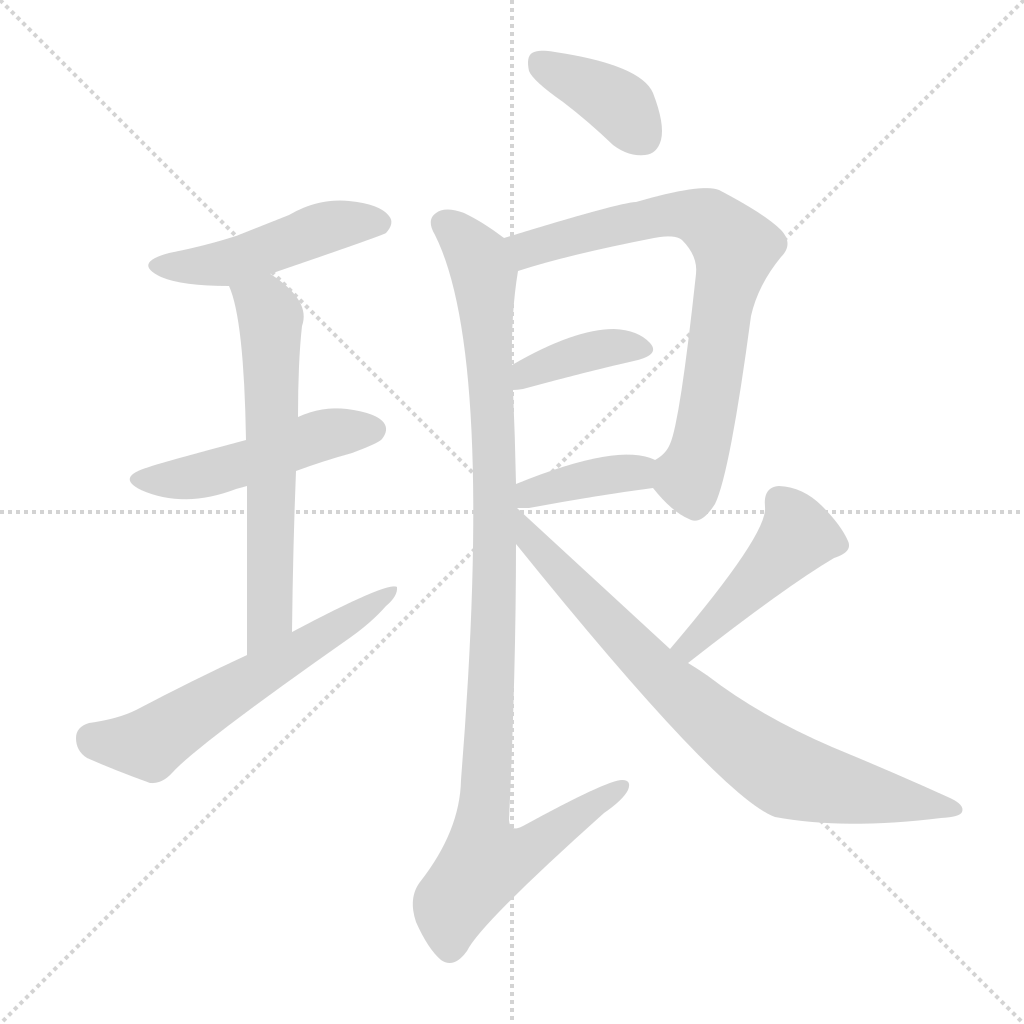
Lang
Kangxi dictionary strokes: 12
Page 733, Entry 01
Ancient form. Pronounced lang.
According to the Shuowen Jiezi, Langgan is a stone resembling a pearl. According to the Yupian, Langgan is a stone resembling jade. According to the Guangyun, Langgan is a name for jade. In the Tribute of Yu (Yugong) section of the Book of Documents (Shangshu), it states: Their tribute consisted of qiu, lin, lang, and gan stones. The commentary states: Langgan is a stone that resembles a pearl. The Classic of Mountains and Seas (Shanhaijing) states: On Mount Kunlun there is a Langgan tree. In the Materia Medica (Bencao), Kou Zongshi says: The Records of the Western Regions says that Tianzhu produces Langgan. Su Gong says: It is a type of colored glaze (liuli), but colored glaze is produced by fire, and is not Langgan. Li Shizhen says: The Classic of Mountains and Seas says that north of Mount Kai-ming there is a pearl tree. The Huainanzi says: There is a pearl tree at the Ninth Layer of the Zeng-cheng Palace located in the west; the pearl tree is Langgan. When it is on a mountain it is called Langgan; when it is in water it is called coral.
Also Langya, a commandery name. Nowadays in Yizhou it is commonly written in the variant form lang. The Classic of Mountains and Seas states: Langya Terrace is located in the Bohai Sea. The annotation states: The current Langya is located by the sea, where there is a mountain peak rising high, shaped like a tall terrace. The Kuodizhi states: Langya Mountain is located southeast of Zhucheng County in Mizhou; the First Emperor built a tiered terrace on the mountain, which is called Langya Terrace.
Also a surname. According to the Wuyin Jiyun, in the state of Qi there was a grand master named Lang Guo.
Also cang-lang, referring to the retractable bronze ring on a palace gate. In the Biography of Empress Zhao in the History of the Former Han Dynasty (Qian Hanshu), it is written: Wooden door with cang-lang rings.
Also lang-dang, meaning a long chain. In the Biography of Wang Mang in the History of the Former Han Dynasty (Qian Hanshu), it is written: Used an iron chain to lang-dang his neck. Sometimes also written in a variant form lang-dang.
Also lin-lang, the sound of jade. In the Nine Songs (Jiuge) from the Songs of Chu (Chuci), it states: Stroking the long sword with jade-adorned hilt, the metal pieces ring out as lin-lang.
Also, according to the commentary on the Supervisor of the Army section in the Summer Office of the Rites of Zhou (Zhouli): The Sima Fa states: The sound of the drum does not exceed chang, the sound of the pei-drum does not exceed ta, and the sound of the bell does not exceed lang. The sub-commentary states: Drums, pei-drums, and bells have different sounds.
Also, according to the Zihuibu: Pronounced lang. The Guanzi states: Using lang-dang to bully others.
Lang: According to the Guangyun, this is a common variant form of the character lang.