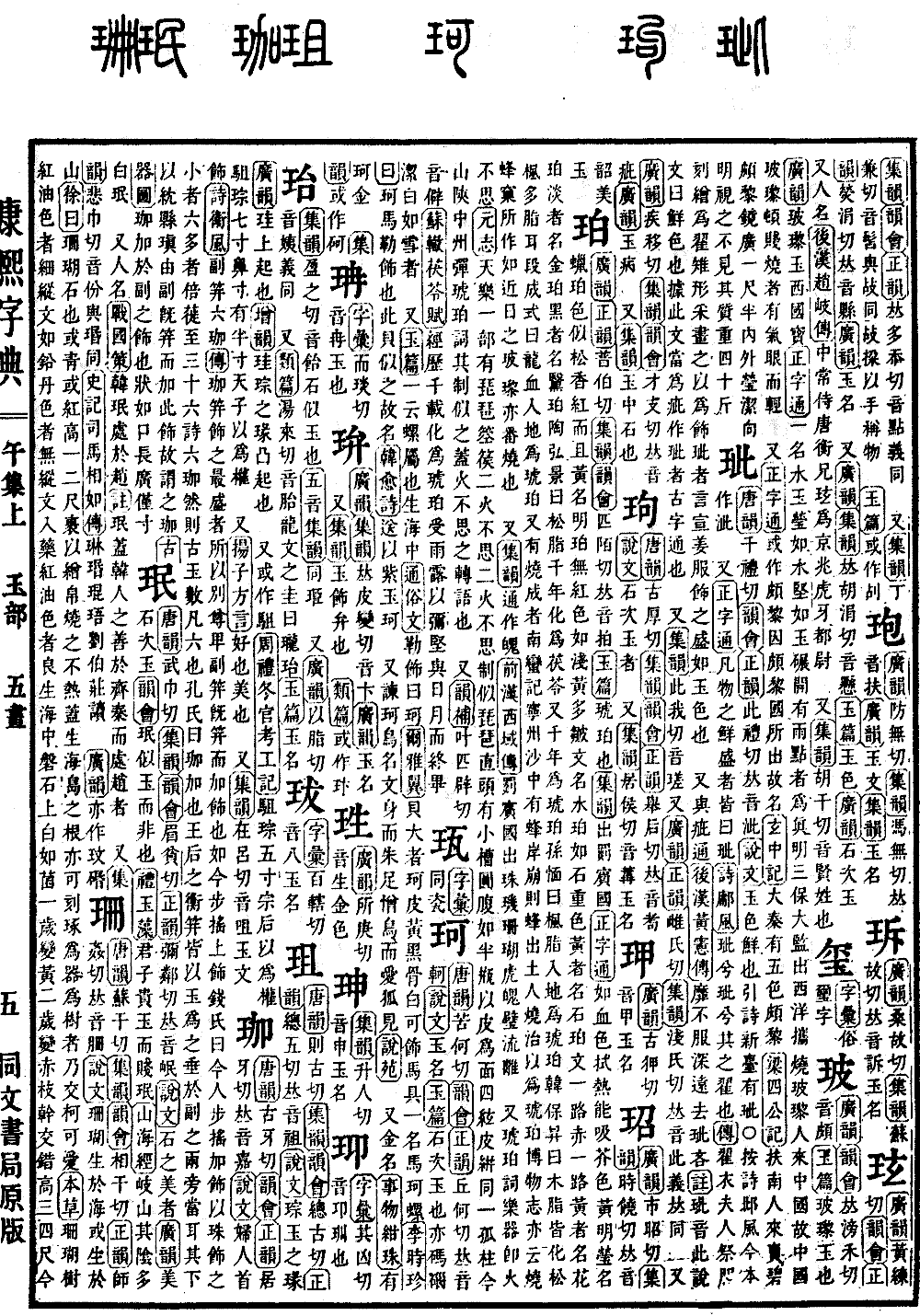
Wu Collection, Upper Volume
Radical: Jade (yù)
Shan; Kangxi strokes: 10; Page 729, Entry 23
Pronounced san.
According to Explaining Graphs and Analyzing Characters (Shuowen Jiezi), coral grows in the sea or on mountains. Xu Shen states that coral is a type of stone. It can be blue or red, reaching a height of one or two feet. When wrapped in silk and burned, it does not become hot. It is said to grow from the base of island rocks and can be carved into utensils. Its form resembles tree branches crossing one another, which is quite lovely.
According to the Materia Medica (Bencao), the coral tree is red and oily with fine vertical markings; there is also a variety the color of red lead with no vertical markings. For medicinal use, the red oily variety is superior. It grows on rocks in the sea; it is white like a mushroom, turning yellow after one year and red after two. The branches cross, and it grows three to four feet high. It is currently found in Guangzhou, where it is as bright and lustrous as red jade. Some have holes, some do not. Specimens with many branches are considered of the highest quality. Li Shizhen says: It grows on the seabed; when five to seven stalks form a forest, it is called a coral forest. While in the water, it is straight and soft, but it bends, hardens, and turns red upon exposure to wind. Zhao Tuo of the Han dynasty called it the fire tree. There are also black and blue varieties; the blue variety is also excellent.
Book of Han (Qian Han), Biography of Sima Xiangru: Coral grows in clusters. The commentary notes that coral grows alongside rocks at the bottom of the water; large trees reach over three feet in height, with branches crossing, but without flowers.
Also, Records of the Grand Historian (Shiji), Biography of Sima Xiangru: Crawling and moving slowly up the golden embankment. The commentary Suoyin states that panshan refers to the appearance of crawling up and down.
Also, Rhyme Anthology (Yunhui): Shanshan is the sound of jade pendants. Du Fu writes in a poem: Weary of the Zheng valley from the Qin tower, occasionally one hears the sound of mixed pendants—shanshan.
Also, Emperor Wen of Wei, Fishing Rod Ballad: How graceful is the fishing rod, how flickering are the fish tails.
Also, Rhyme Anthology (Yunhui): Lanshan describes the appearance of wilting and being scattered. Li Houzhu writes in a lyric: Outside the curtains the rain is pattering, the feeling of spring is waning.
Also, Collection of Rhymes (Jiyun): Pronounced sa. The shan in coral is also read in the entering tone.
Also, Rhyme Supplement (Yunbu): Rhymes with xian. Song Yu, Rhapsody on the Goddess (Shennü Fu): Settling in the high palace to broaden the mind, wings spread wide and free. Moving the mist-like silk in slow steps, brushing the courtyard steps with a sound—shanshan.
Textual research: Zhao Tuo of the Han dynasty called it the fire tree. Per the original text of the Materia Medica, Zhao Tuo has been corrected to Zhao Tuo.