Chen Collection, Lower Volume
Radical: Weapon (shū)
Kangxi Strokes: 10
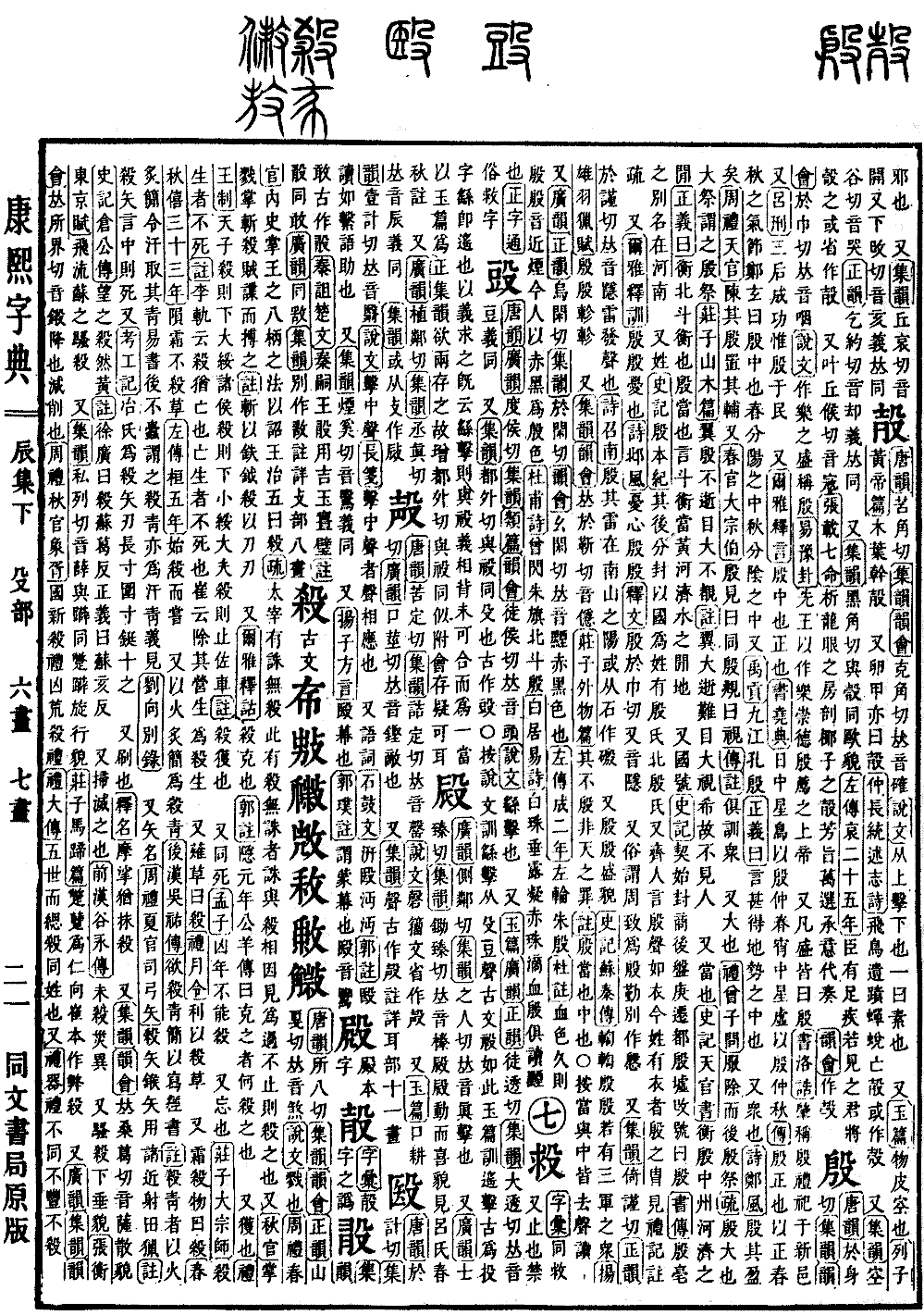
Page 585, Entry 02
Pronounced yan.
According to the Explaining Graphs and Analyzing Characters (Shuowen Jiezi), it refers to the magnificence of performing music.
Book of Changes (Yijing), Hexagram Yu: The former kings created music to honor virtue and offered it abundantly to the Supreme Deity.
It also refers to anything that is prosperous or abundant.
Book of Documents (Shangshu), Luo Gao: To initiate the abundant rituals, sacrificed at the new capital.
Book of Documents (Shangshu), Lu Xing: The three former kings achieved success, being truly abundant among the people.
According to the Er Ya, Explanation of Words: Yin means the center, or correct.
Book of Documents (Shangshu), Canon of Yao: When the sun is at the meridian and the star Bird is visible, it marks the middle of spring; when the night is balanced and the star Void is visible, it marks the middle of autumn. Commentary: Yin means correct, referring to the correct solar terms of spring and autumn. Zheng Xuan says: Yin means the center. The vernal equinox is the center of yang; the autumnal equinox is the center of yin.
Tribute of Yu (Yu Gong): The nine rivers are very central.
Orthodox Interpretation: It means it truly occupies the center of the terrain.
It also means many or numerous.
Book of Odes (Shijing), Zheng Feng: It is filled with abundance.
Rites of Zhou (Zhouli), Offices of Heaven: Arrayed in their multitude, provided with their assistants.
Rites of Zhou (Zhouli), Spring Offices, Grand Master: An abundant audience is called tong; an abundant observation is called shi. Commentary and Annotations: Both refer to a multitude.
It also means great.
Record of Rites (Liji), Zengzi Wen: Only after the mourning period concludes is the great sacrifice performed. Sub-commentary: Yin means great. A major sacrifice is called an abundant sacrifice.
Zhuangzi, Mountain Tree: If the wings are too large, one cannot fly; if the eyes are too large, one cannot see. Commentary: If wings are large, flight is difficult; if eyes are large, sight is narrow, therefore one cannot see people.
It also means to correspond to or to be located at.
Records of the Grand Historian (Shiji), Treatise on the Celestial Offices: The heng star corresponds to the area between the middle states, the Yellow River, and the Ji River. Orthodox Interpretation: Heng is the star in the handle of the Big Dipper. Yin means to correspond to. It means the Dipper handle corresponds to the region between the Yellow River and the Ji River.
It is also a state name.
Records of the Grand Historian (Shiji): Xie was first enfeoffed in Shang; later, Pan Geng moved the capital to Yin, changing the name of the dynasty to Yin.
Book Commentary (Shuzhuan): Yin is another name for Bo, located in Henan.
It is also a surname.
Records of the Grand Historian (Shiji), Annals of Yin: Later descendants were enfeoffed, taking the state name as their surname, including the Yin clan and the North Yin clan.
People of Qi pronounce the surname Yin like yi (clothing). Today, those with the surname Yi are descendants of the Yin. See Record of Rites (Liji), Annotations and Sub-commentary.
According to the Er Ya, Explanation of Teachings: Yin-yin describes worry.
Book of Odes (Shijing), Bei Feng: My worried heart is full of grief.
Explanation of Characters: Yin is pronounced yin (rising tone), also pronounced yin.
Popularly, the phrase for showing great concern is written as yin-qin, otherwise written with the character for worry.
Also pronounced yin (rising tone).
Refers to the sound of thunder.
Book of Odes (Shijing), Shao Nan: The thunder rumbles on the south side of the southern mountains. Sometimes written with the stone radical.
Also yin-yin, describing a magnificent appearance.
Records of the Grand Historian (Shiji), Biography of Su Qin: Roaring and resounding, as if there were the strength of three armies.
Yang Xiong, Fu on the Imperial Hunt: Vast and echoing.
Pronounced yan.
Zhuangzi, Outer Things: That it is not central is not Heaven’s fault. Commentary: Yin means to correspond to, to be in the center. Note that both to correspond to and center are read in the departing tone.
Pronounced yan.
Refers to a deep red-black color.
Zuo Commentary (Zuozhuan), Second Year of Duke Cheng: The left wheel was crimson and deep red. Du Commentary: When blood color ages, it becomes yin. Yin sounds similar to smoke (yan). Today people call a dark red color an yin color.
Du Fu’s poetry: The crimson flags flashed, and the Big Dipper was deep red.
Bai Juyi’s poetry: White pearls like hanging dew congeal, red pearls like dripping blood are deep red. Both are read as yan.