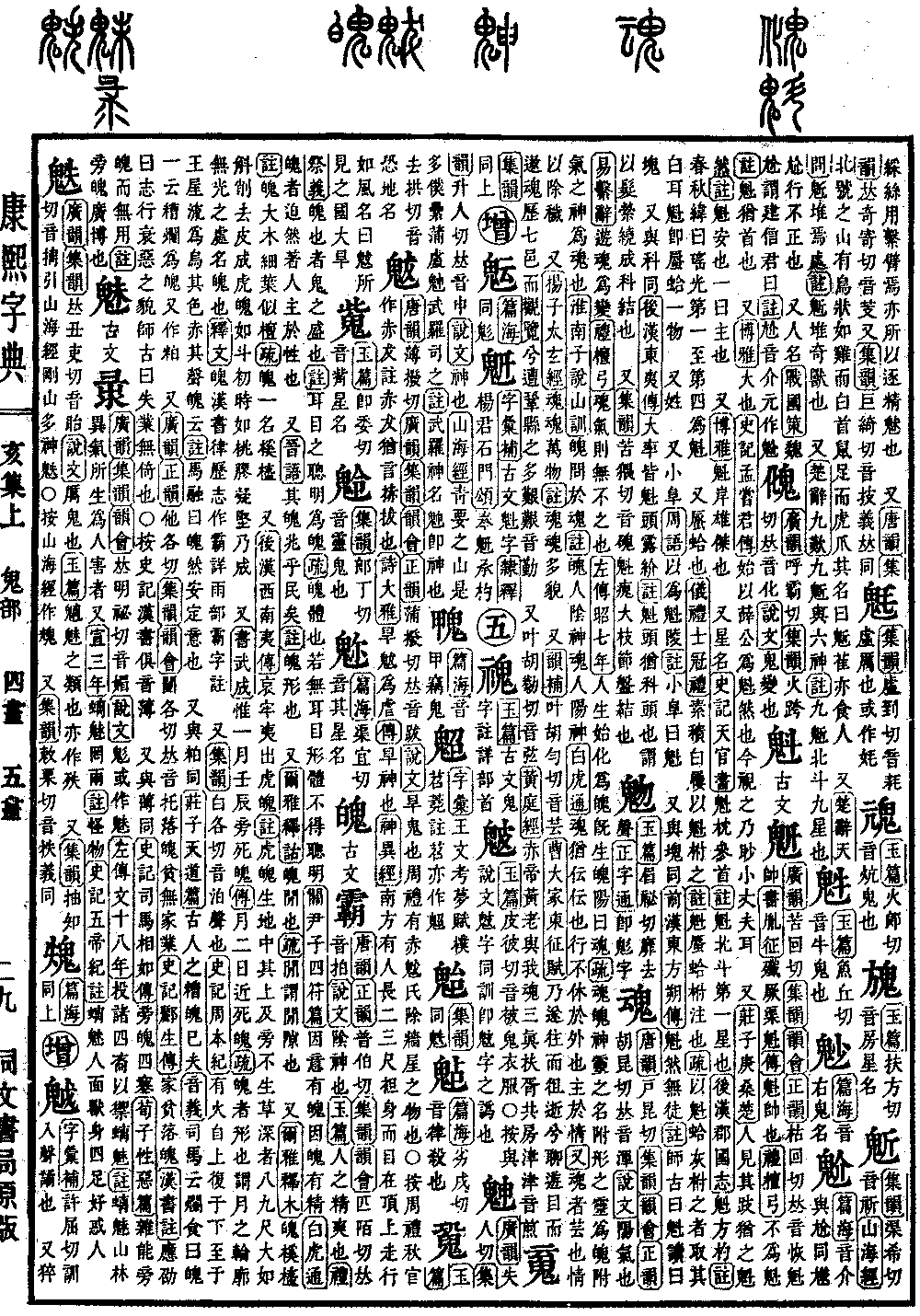
Hai Collection, Upper Volume
Radical: Ghost (guǐ)
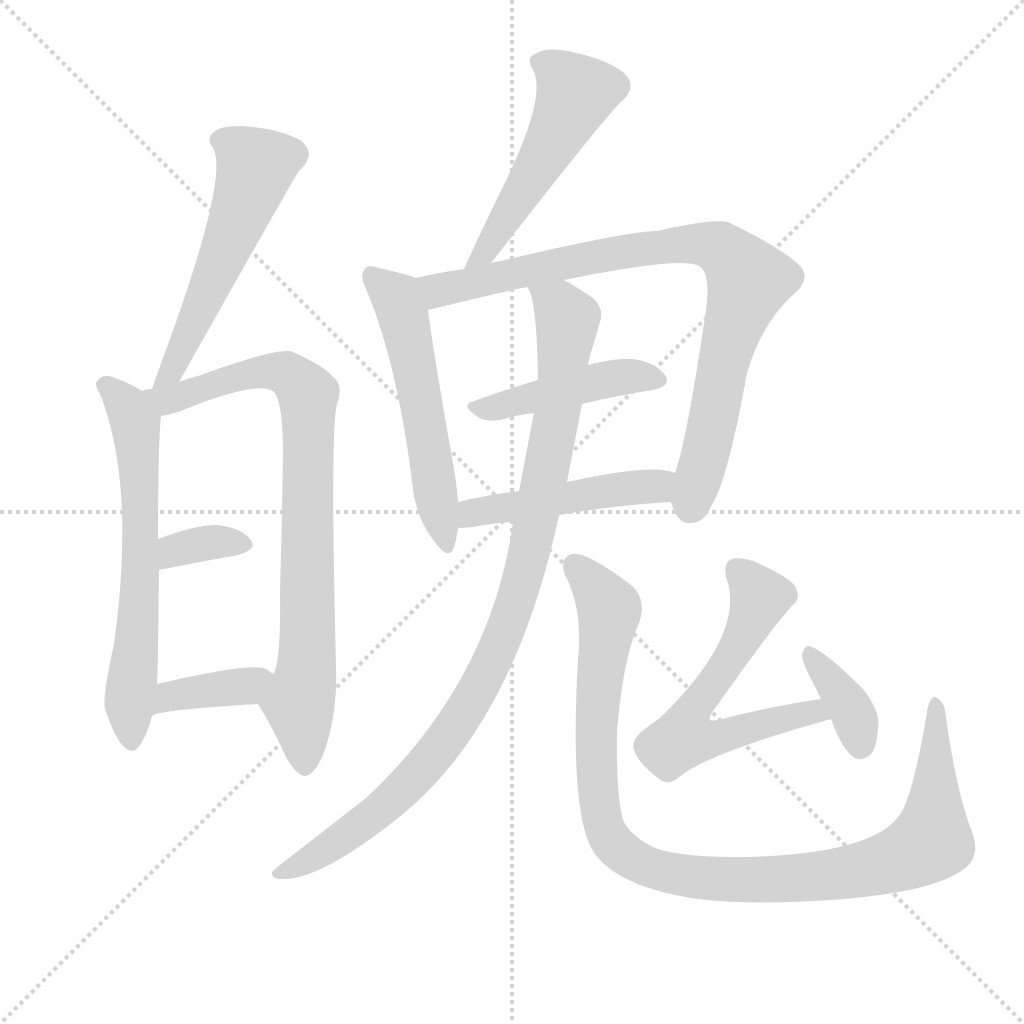
魄
Kangxi strokes: 15
Page 1461, Entry 28
Ancient form of Ba.
Tang Dynasty Rhyme (Tangyun) and Correct Rhymes (Zhengyun): pronounced po (entering tone). Collected Rhymes (Jiyun) and Rhyme Assembly (Yunhui): pronounced po (entering tone).
Shuowen Jiezi: The yin spirit.
Yupian: The essence and vitality of a person.
Book of Rites (Liji), Meaning of Sacrifices (Jiyi): The po is the manifestation of the ghost.
Commentary: The intelligence of the ears and eyes constitutes the po.
Sub-commentary: The po is the body. Without ears and eyes, the physical form would not possess intelligence.
Guan Yinzi, Four Symbols (Sifu pian): Because of the intention, there is the po; because of the po, there is the essence.
Comprehensive Discourses of the White Tiger Hall (Baihu tong): The po is that which forcefully attaches to a person, presiding over their nature.
Also, Narratives of the States (Jin yu): Its po has manifested among the people.
Commentary: The po is the physical form.
Also, Erya, Explanation of Words (Shigu): The po is a gap.
Sub-commentary: A gap refers to an interval or interstice.
Also, Erya, Explanation of Trees (Shimu): The po is the xi-xu tree.
Commentary: The po is a large tree with fine leaves, resembling sandalwood.
Sub-commentary: Po is another name for the xi-xu tree.
Also, Book of the Later Han (Hou Hanshu), Account of the Southwest Barbarians: The Ailao barbarians produce amber.
Commentary: Amber is formed in the ground; neither grass nor trees grow above or beside it. It is found at a depth of eight or nine feet and can be as large as a hu (a unit of volume). Its bark is shaved away to reveal the amber, which can be as large as a peck. Initially, it is like peach resin, then it hardens into its final form.
Also, Book of Documents (Shujing), Success of the Martial King (Wucheng): On the renchen day of the first month, near the death of the po.
Commentary: The second day of the moon is near the death of the po.
Sub-commentary: The po is the physical form. It refers to the part of the moon's outline that has no light, which is called the po.
Explanation of Terms (Shiwen): In the History of the Han (Hanshu), Treatise on Harmonics and Calendars, it is written as ba. For further details, see the note on the character ba under the rain radical.
Also, Collected Rhymes (Jiyun): pronounced bo (entering tone). The sound.
Records of the Grand Historian (Shiji), Annals of Zhou: There was fire that returned from above to below, reaching the king's chambers, flowing and turning into a crow; its color was red and its sound was po.
Commentary: Ma Rong says: Po-ran means a sense of stability.
Also, same as po (dregs/residue).
Zhuangzi, The Way of Heaven (Tiandao pian): The dregs of the ancients are already gone.
Sound and Meaning (Yinyi): Sima says: Rotten food is called po. Others say dregs are called po. Also written as po (dregs).
Also, Guangyun and Correct Rhymes (Zhengyun): pronounced tuo (entering tone). Collected Rhymes (Jiyun) and Rhyme Assembly (Yunhui): pronounced tuo (entering tone). Luo-po (down-and-out/destitute), poor and without family property.
Records of the Grand Historian (Shiji), Biography of Li Sheng: His family was poor and he was down-and-out.
Commentary on the History of the Han (Hanshu): Ying Shao says: This describes a person of declining ambition and poor conduct. Yan Shigu says: It means being unemployed and having no one to rely on. According to the Records of the Grand Historian and the History of the Han, both are pronounced bo (entering tone).
Also, same as bo (extensive/thin).
Records of the Grand Historian (Shiji), Biography of Sima Xiangru: Spreading out and filling all directions.
Xunzi, The Nature of Man is Evil (Xing e pian): Possessing various minor abilities but being extensive and useless.
Commentary: Pang-po means extensive or broad.