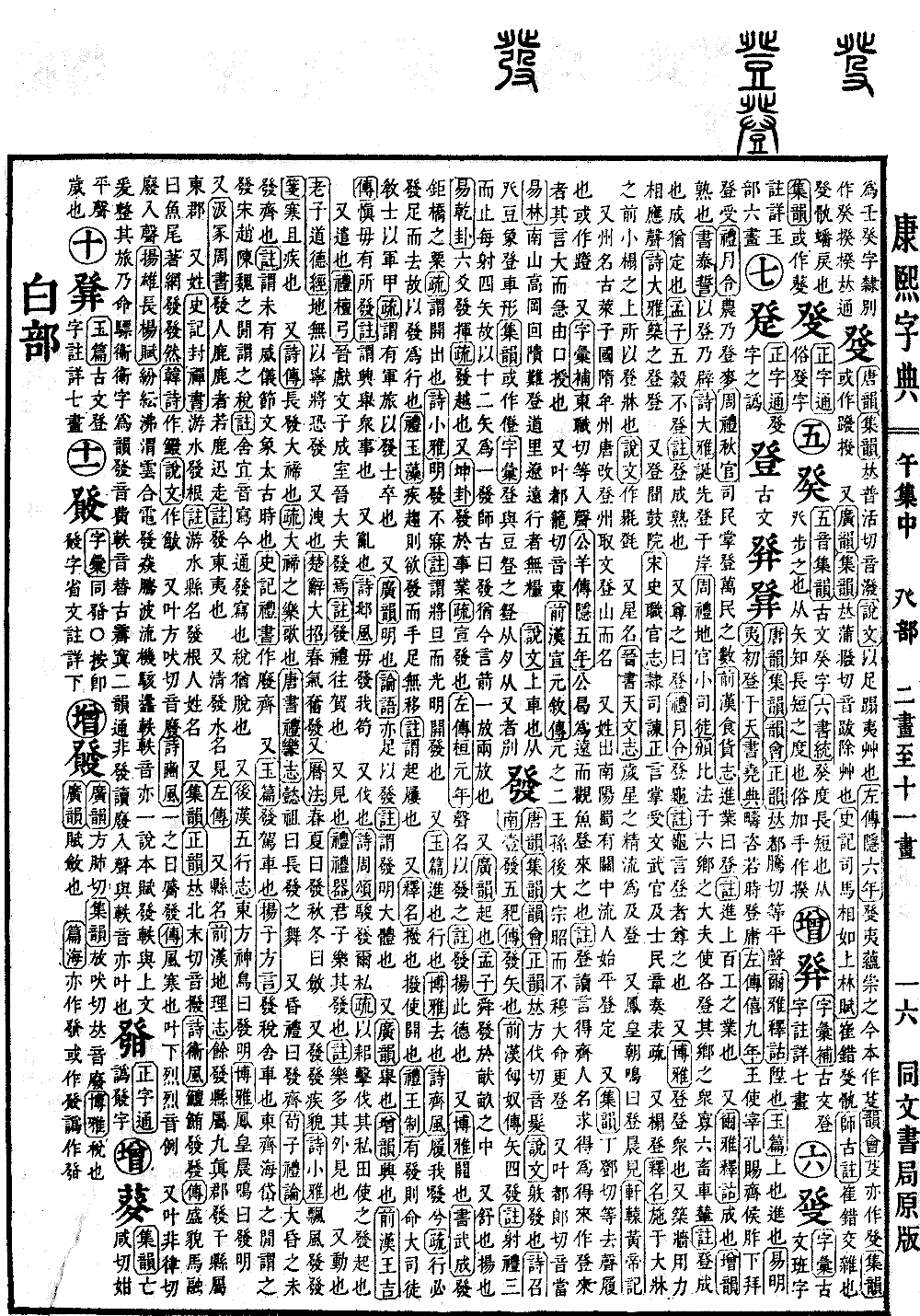
Wu Collection, Middle Volume
Radical: Step (bù)
Page 784, Entry 10
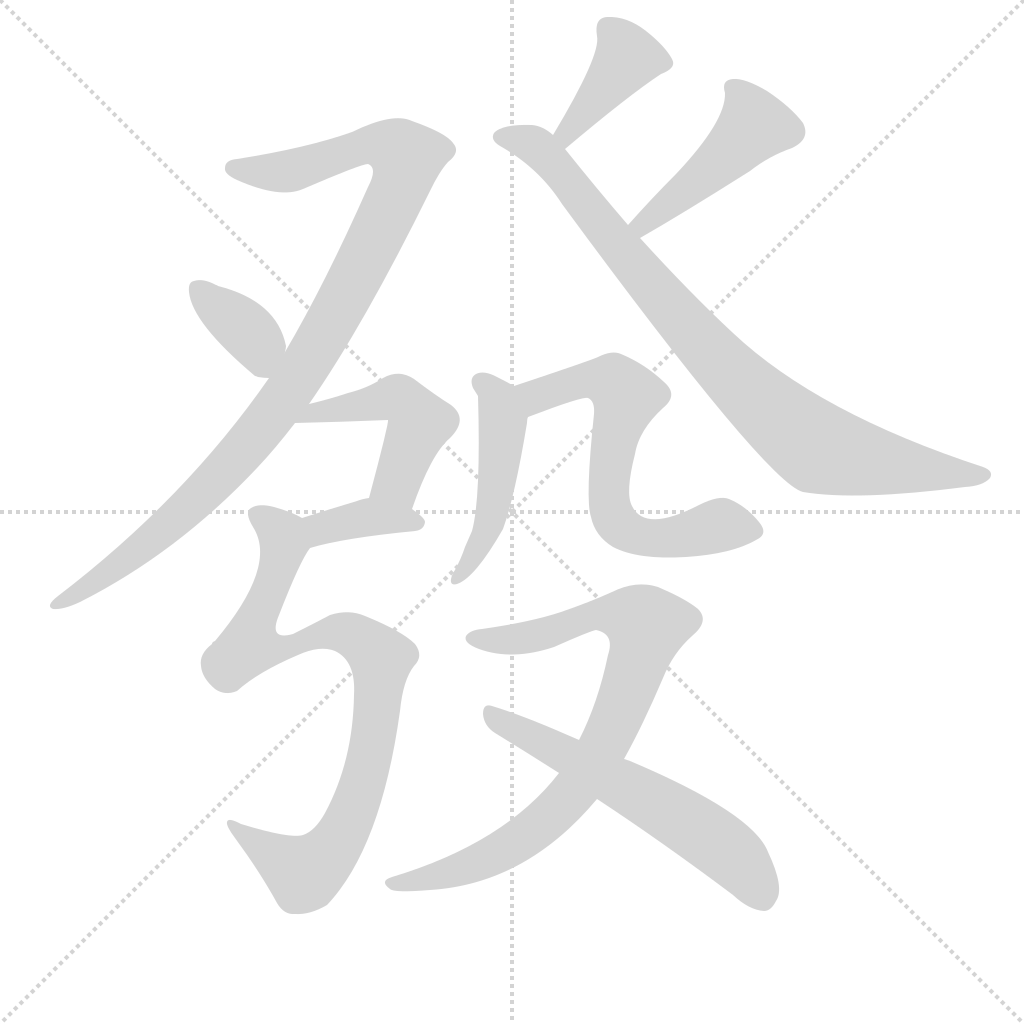
Pronounced fa.
Explanation of meanings:
According to the Explaining Graphs and Analyzing Characters (Shuowen Jiezi), it means to issue or send forth.
In the Book of Odes (Shijing), it refers to shooting an arrow. In the History of the Former Han (Qianhan Shu), it is stated that in the rites of archery, one stops after three rounds, each round consisting of four arrows, thus twelve arrows constitute one fa. Master Shigu commented: Fa is used like saying one or two releases of an arrow.
Also, according to the Guangyun (Rhyme Dictionary), it means to arise. In the Mencius, it says Shun arose from the midst of the fields.
It means to loosen or to manifest. In the Book of Changes (Yijing), it refers to developing and manifesting the six lines. In the same book, it refers to manifesting in business and affairs.
In the Zuo Commentary (Zuo Zhuan), it refers to manifesting or displaying one's virtue.
According to the Guangya (Dictionary of Etymology), it means to open. In the Book of Documents (Shujing), it refers to opening the granaries of Juchiao. In the Book of Odes (Shijing), it describes the light of dawn spreading.
According to the Jade Chapters (Yupian), it means to advance or to move forward. The Guangya states it means to depart. In the Book of Odes, it refers to lifting the feet to walk. In the Book of Rites (Liji), it refers to rising from one's seat.
According to the Explaining Names (Shiming), it means to push aside, to cause to open. In the Book of Rites, it refers to mobilizing soldiers when there is a military campaign.
According to the Guangyun, it means to be clear or enlightened. In the Analects (Lunyu), it refers to manifesting or clarifying the general principles.
According to the Guangyun, it means to raise. According to the Zengyun (Expanded Rhyme Dictionary), it means to excite or flourish. In the History of the Former Han, it means to engage in or raise various affairs.
It also means to disorder. In the Book of Odes, it refers to disturbing the fishing weir.
It means to cut or strike. In the Book of Odes, it refers to striking the private fields with a plowshare to break them open.
It means to send. In the Book of Rites, it refers to sending gifts to offer congratulations.
It means to appear or to be visible. In the Book of Rites, the gentleman enjoys its manifestation.
It means to move. In the Laozi (Tao Te Ching), it says if the earth is not peaceful, it is feared it will move.
It means to leak or discharge. In the Chu Ci (Songs of Chu), it refers to the spring air being stirred up and released.
In the study of calendars, spring and summer are called fa, while autumn and winter are called lian (to gather).
Also, fa-fa describes a state of speed or intensity. In the Book of Odes, it describes a cold and rapid wind.
In the Book of Odes Commentary, "Long Fa" refers to the music of the Great Di sacrifice.
In the Tang History (Tang Shu), it refers to the Dance of Long Fa.
In the marriage rites, it is called fa-qi. In the Xunzi, it refers to the state before the perfection of the formal rites. In the Records of the Grand Historian (Shiji), it is written as fei-qi.
According to the Jade Chapters, it means to drive a carriage. According to Yang Xiong's Dialects (Fangyan), it means to unyoke or release a carriage. In the region of the eastern Qi, between the sea and Mount Tai, it is called fa, while in the regions of Song, Zhao, and Wei, it is called shui (to remove).
According to the History of the Later Han (Houhan Shu), the divine bird of the east is called fa-ming. The Guangya states that when the phoenix calls at dawn, it is called fa-ming.
According to the Jizhong Zhoushu (Bamboo Annals), fa-ren refers to a people who move like deer in a swift, running manner.
Qingfa is the name of a river, found in the Zuo Commentary.
It is the name of a county. According to the History of the Former Han, Yu-fa County belongs to Jiuzhen Commandery, and Fagan County belongs to Dong Commandery.
It is a surname. In the Records of the Grand Historian, mention is made of a place called You River and a person named Fa Gen.
Pronounced bo.
In the Book of Odes, it describes the abundant appearance of sturgeon and tuna. Ma Rong said it describes the movement of fish tails against a net. The Han version of the Odes writes it as bo. The Explaining Graphs and Analyzing Characters writes it as bo.
Also pronounced fei (falling tone). In the Book of Odes, it refers to the cold wind.
Also pronounced fei (entering tone). In Yang Xiong's Changyang Fu, it is used in a rhyming sense related to electricity and movement.