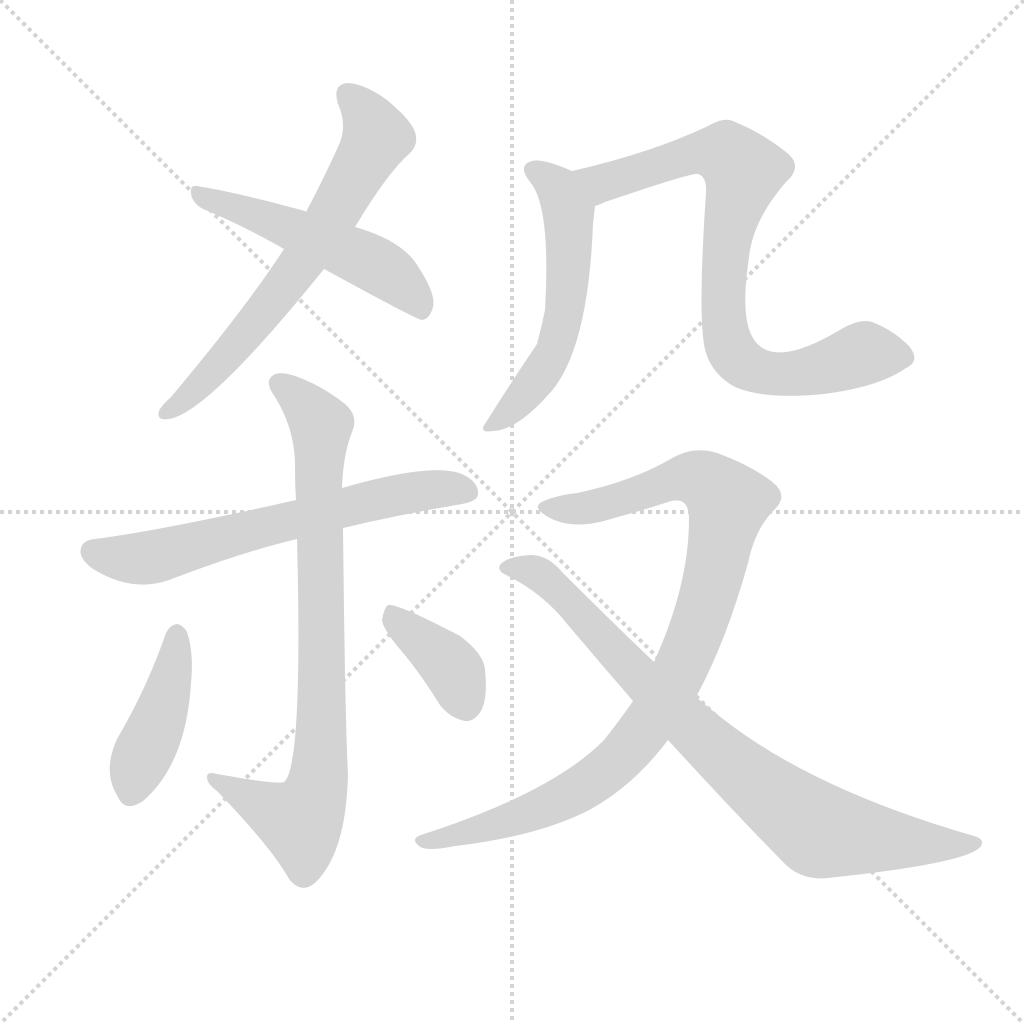
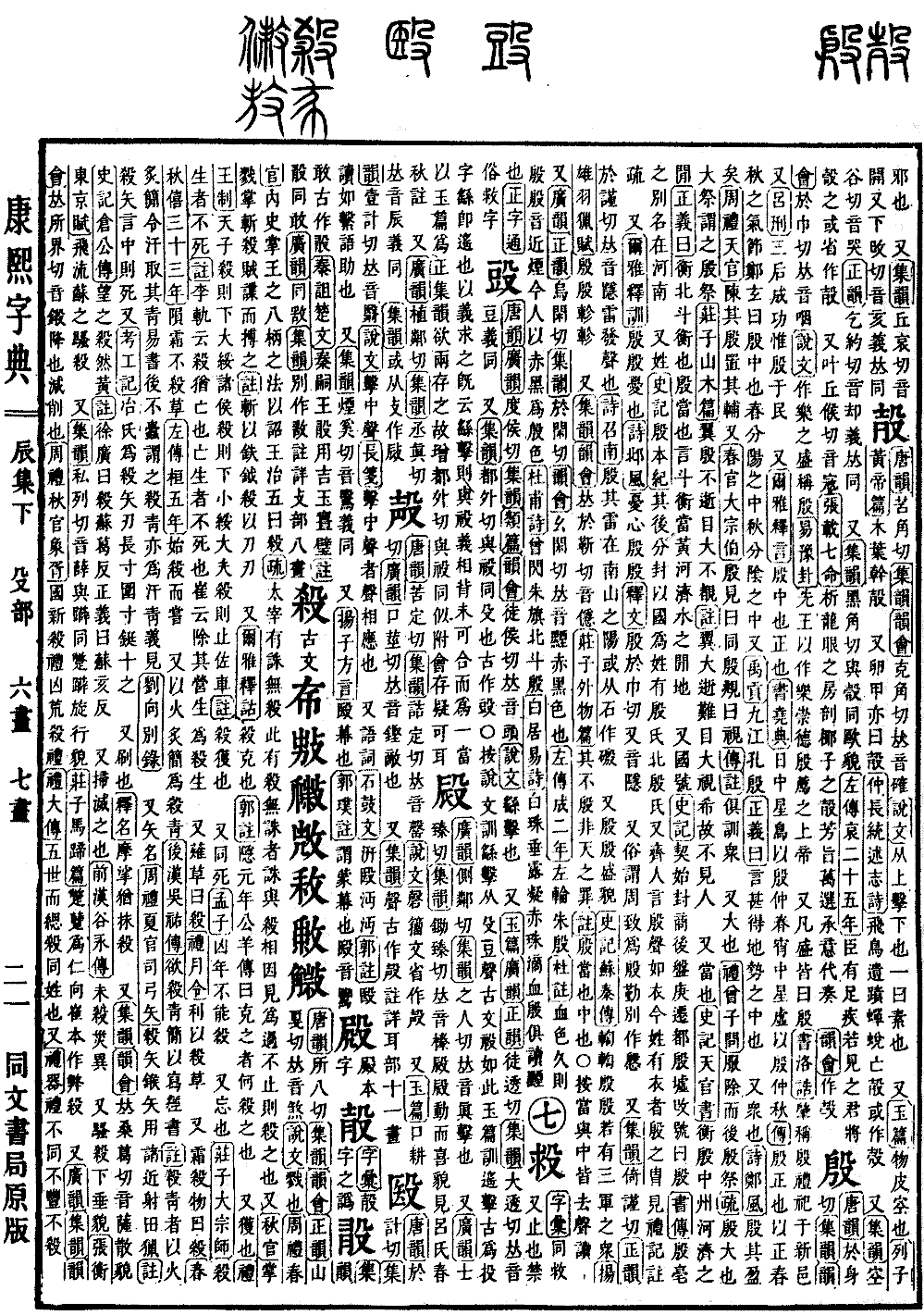
Chen Collection, Lower Volume
Radical: Weapon (shū)
Page 585, Entry 11
Ancient form. Pronounced sha.
According to Explaining Graphs and Analysis of Characters (Shuowen Jiezi), it means to slaughter.
Rites of Zhou (Zhouli), Ministry of Spring: The Inner Archivist holds the method of the eight handles for the King to advise on governance; the fifth is to execute. Commentary: The Grand Preceptor manages executions but not killings. In this context, there is killing but no execution. Execution and killing are interdependent; if a transgression is seen and not stopped, one kills the offender.
Also, Ministry of Autumn: The Master of Executions manages the beheading and killing of thieves and spies, and captures them. Commentary: To behead is to use an axe; to kill is to use a blade.
According to Erya, Interpretation of Words: To kill is to overcome. Commentary: The Commentary of Zuo on the Spring and Autumn Annals (Chunqiu Zuozhuan), first year of Duke Yin, states: What does it mean to overcome? It means to kill.
Also means to capture. Record of Rites (Liji), Royal Regulations: When the Son of Heaven kills (captures), he lowers the large banner. When the feudal lords kill (capture), they lower the small banner. When the ministers kill (capture), they stop the assistant carriage. Commentary: To kill means to capture.
Also, the same as to die. Mencius: In years of famine, one cannot be killed (cannot die).
Also means to forget. Zhuangzi, Great and Venerable Teacher: One who kills life does not die. Commentary: Li Gui says: To kill means to perish. One who perishes from life does not die. Cui says: To remove the sustenance of life is to kill life.
Also, to mow grass is called killing. Record of Rites (Liji), Monthly Ordinances: It is beneficial to kill (mow) the grass.
Also, when frost kills things, it is called killing. Spring and Autumn Annals (Chunqiu), 33rd year of Duke Xi: Frost fell but did not kill the grass. Zuo Commentary, 5th year of Duke Huan: It began to kill (wither) and then was tasted.
Also, to heat bamboo slips with fire to remove the moisture is called "shaqing." Biography of Wu You in the History of the Later Han (Hou Hanshu): He wished to perform shaqing to copy the classics. Commentary: Sha-qing means heating it with fire to cause it to sweat, extracting the green color so that it is easy to write upon and will not be eaten by worms; this is called shaqing. It is also called "hanqing" (sweating green), the meaning of which is seen in Liu Xiang's Miscellaneous Records (Bielu).
Also, the name of an arrow. Rites of Zhou, Ministry of Summer, Minister of Bows and Arrows: The killing arrow and the Hou arrow are used for short-range shooting and hunting. Commentary: The killing arrow is so named because if it hits, the target dies.
Also, Kao Gong Ji (Book of Diverse Crafts): The metal workers make killing arrows; the blade is one inch long, one inch in circumference, and the tang is ten times that.
Also, to brush. Explaining Names (Shimings): "Mosa" (to touch) is like "masha" (to rub off/erase).
Pronounced sa. The appearance of being scattered. Records of the Grand Historian (Shiji), Biography of Cang Gong: Looking at it, it was sa-ran and yellow. Commentary: Xu Guang says: Sha is pronounced su-ge. The Correct Meaning says: Pronounced su-hai.
Also, to sweep away. Biography of Gu Yong in the History of the Former Han (Hanshu): Had not yet killed (eradicated) the disasters and anomalies.
Also, "sa-sha" refers to a drooping appearance. Zhang Heng, Eastern Capital Rhapsody (Dongjing Fu): The flying tassels hang in a drooping manner.
Pronounced xue. Same as the variant form. "Biexie" describes a twisting gait. Zhuangzi, Horse's Hooves (Matui): "Biexie" is to practice benevolence. The version of Xiang and Cui uses the variant form.
Pronounced sha. To lower or to reduce/diminish. Rites of Zhou, Ministry of Autumn, Elephant Interpreters: The state newly reduced the rituals; in times of disaster and famine, one reduces the rituals. Record of Rites, The Great Transmission: After five generations, the mourning status is reduced for those of the same surname.
Also, Record of Rites, Records of Ritual Vessels: If the rituals are different, they are neither opulent nor diminished.
Pronounced shai. Same meaning.
Also, when fur or feathers are worn out, it is called sha. Book of Odes (Shijing), Bin Odes: "Your feathers are worn" — Commentary: "Qiaoqiao" means sha (worn out).
Also, Rites of Zhou, Ministry of Heaven, Surgeons: The scraping and killing agent. Commentary: "Killing" refers to using medicine to consume the necrotic flesh.
"Qiaosha" refers to sound. Record of Rites, Record of Music: Those whose hearts are moved by sorrow have a sound that is "qiao" and "sha." Commentary: "Qiao" is exhausted and lacks luster; "sha" is diminished and not resonant.
Also, to cut and sew. Analects: If it is not the curtain-skirt, one must "sha" (hem) it. Also written in a variant form.
Also, implements for shrouding a corpse; the upper is called "zhi," the lower is called "sha." Etiquette and Ceremonial (Yili), Funeral Rites for Scholars: Sha is used to cover the feet.
Also, fast. Bai Juyi, Poem on a Half-Opened Flower: The western sun shines lightly, let the east wind not "sha" (hurry/blow hard) the breeze. Author's note: Sha, read in the departing tone.
The Correct Explanation of Characters (Zhengzitong) states: In modern musical theatre, there is a distinction between "yuan-sha" and "pang-sha." In the Yuan dynasty drama "The White Crane," the first "sha" and second "sha" are remnants of these sounds. The colloquial pronunciation of the "sha" in "life and death" (shengsha) is incorrect.
Pronounced shuo. Also to lower.
Pronounced shi. Same as to kill (murder). History of the Former Han, Annals of Emperor Gaozu: Xiang Yu released and killed (murdered) his lord. Commentary: "Sha" should be "shi" (to murder).
Also, Ban Gu, Western Capital Rhapsody (Xijing Fu): Grabbing the swift and cunning, biting fiercely, breaking horns and crushing necks, fighting alone and killing alone. Commentary: "Sha" here also rhymes with the sound of "shi."
Also rhymes with "se." Liang Su, Proclamation on Military Weapons: Extending the beauty of weapons, altering the standards with laws. The wise men of old, their divine martial power did not kill.
Also rhymes with "she." Shu Xi, Recent Travels Rhapsody (Jinyou Fu): Wearing a padded jacket to resist winter, binding a sweat shirt to endure heat. A cap pulling at the four corners, a skirt with several pleats. "Sha" is also written in a variant form.