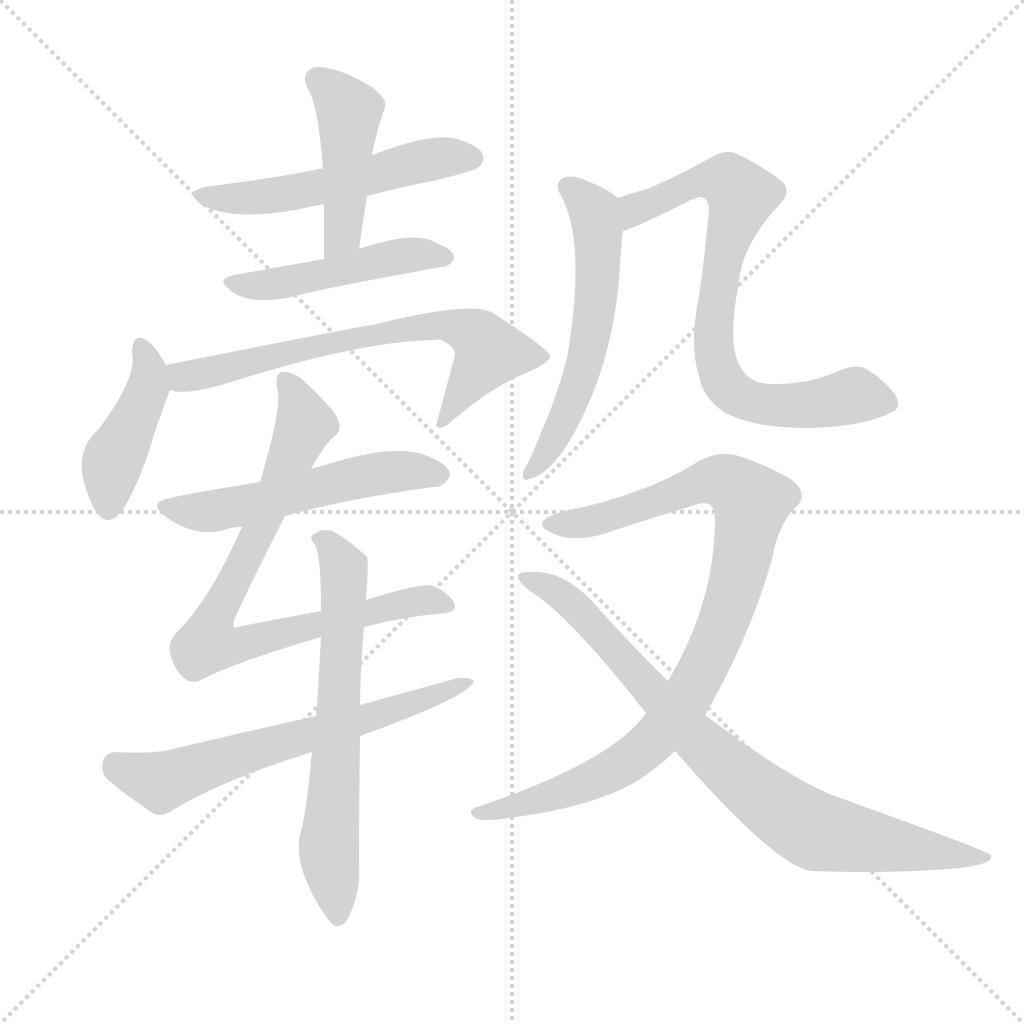
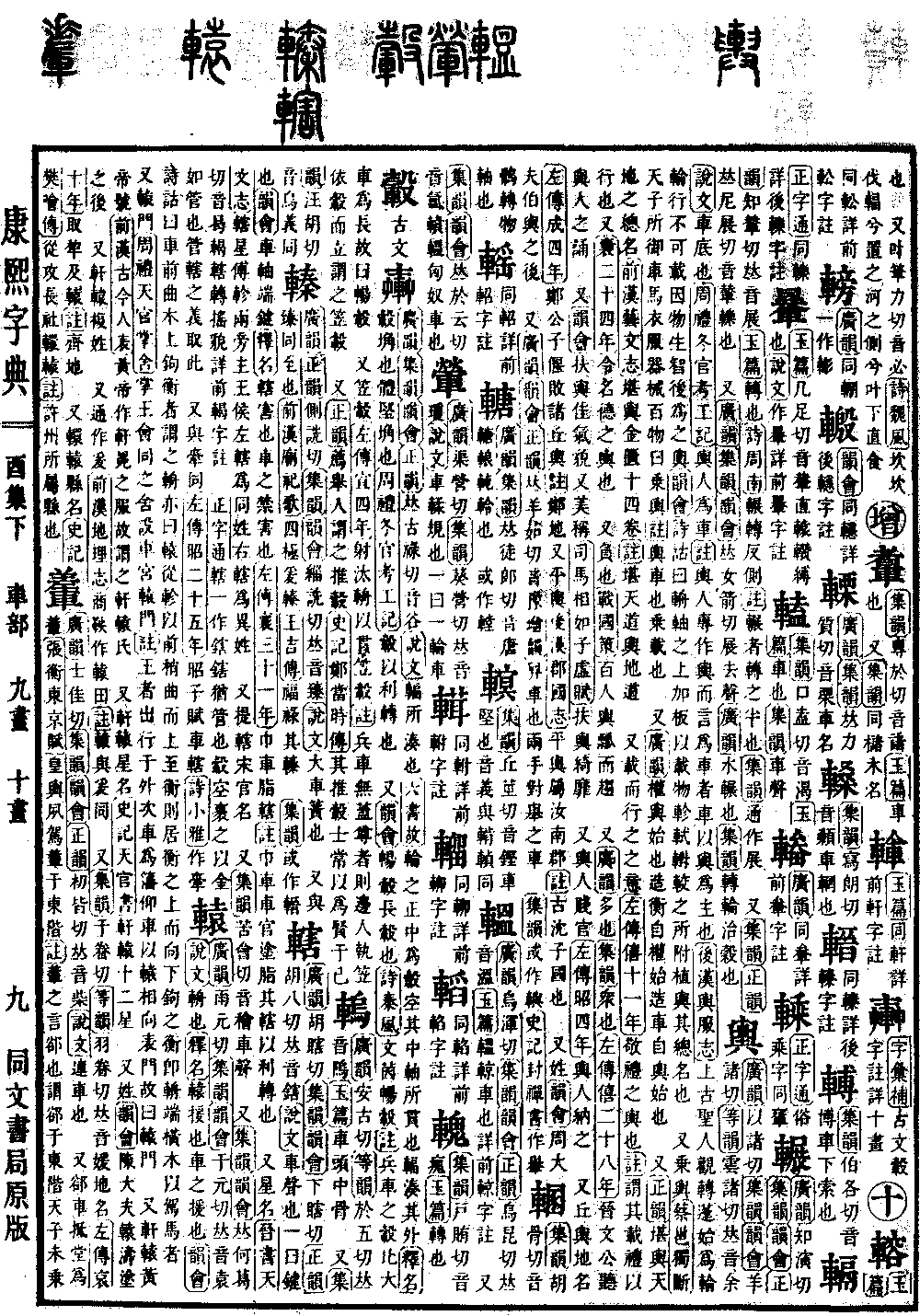
You Collection, Lower Volume
Radical: Carriage (chē)
Kangxi stroke count: 17
Page 1247, Entry 01
Ancient form. Pronounced gu.
Shuowen Jiezi (Explanation of Writing and Analysis of Characters) states: The part where the spokes converge.
Liushu Gu (Explanations of the Six Writings) states: The very center of a wheel is the hub, which is hollow in the middle, and through which the axle passes, with the spokes gathered around the outside.
Shiming (Explanations of Names) states: Hub means hard. The body is firm and hard.
Rites of Zhou (Zhouli), section on the Artificer's Record (Kaogongji), states: The hub is used to facilitate rotation.
Yunhui (Compilation of Rhymes) states: A changgu is a long hub.
Book of Odes (Shijing), Odes of Qin, states: With tiger-skin rugs and long hubs. Commentary: The hub of a war chariot is longer than that of a cart, so it is called a long hub.
Also, a ligu (hat-hub). Zuo Zhuan (Commentary of Zuo), fourth year of Duke Xuan, states: He shot at the pole and pierced the ligu. Commentary: War chariots have no roofs; when a person of status is present, an attendant stands by the hub holding a hat, which is called a ligu.
Zhengyun (Correction of Rhymes) states: To recommend someone for office is called pushing the hub.
Records of the Grand Historian (Shiji), Biography of Zheng Dangshi, states: In recommending scholars, he always acted as if they were more virtuous than himself.