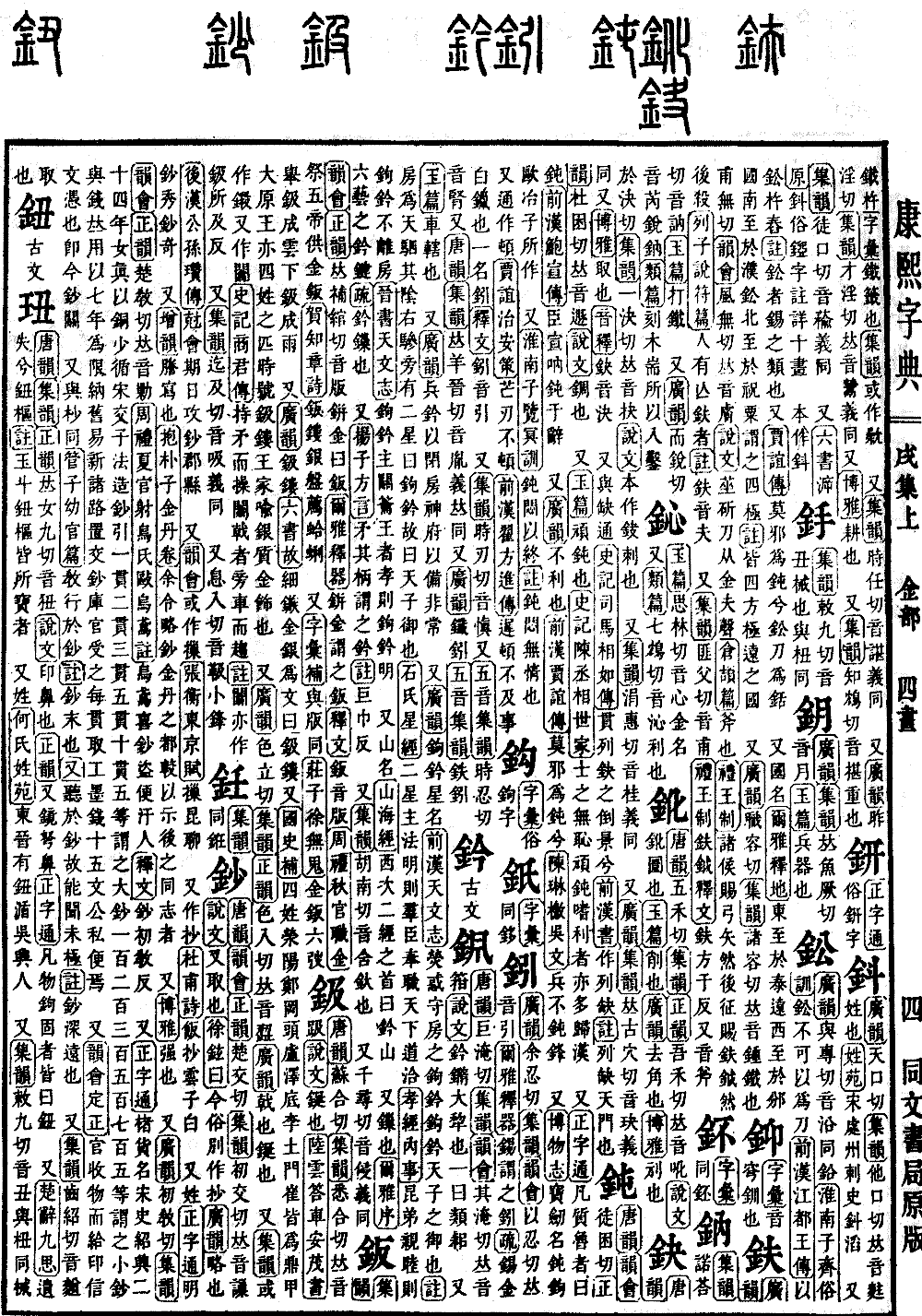
Xu Collection, Upper Volume
Radical: Metal (jīn)
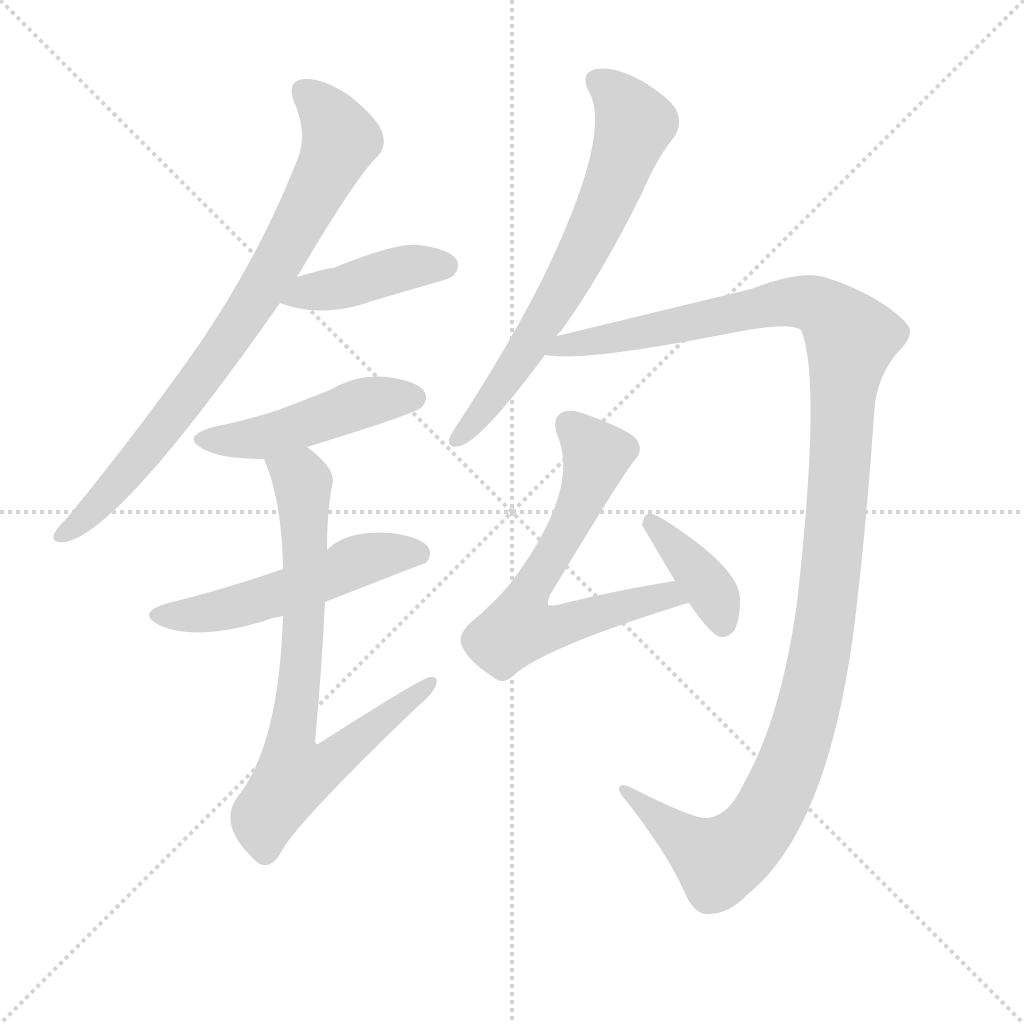
Gou
Kangxi Strokes: 13
Page 1298, Entry 01
Pronounced gou.
A curved iron implement.
Also a type of sword.
Ancient weaponry includes the gou and the xiang, both varieties of swords. That which draws toward one is called a gou; that which pushes away is called a xiang.
Book of Han (Hanshu), Biography of Han Yanshou: Cast into swords, knives, hooks, and pommels.
Annotation: The hook is also a weapon. It resembles a sword but is curved, used for hooking and killing people.
Also, a sword ring.
Strategies of the Warring States (Zhanguoce): Without hook, guard, or pommel, one loses the advantage of the sleeve.
Annotation: The hook is the ring at the end of a sword.
Records of the Grand Historian (Shiji), Annals of Chu: The curved beak of a hook from the State of Chu is enough to serve as the nine tripods.
Annotation: Every halberd has a hooked beak, which is the tip of the hook's mouth. This refers to the fact that the hooks on the halberds of the State of Chu, even those with broken tips, could be used to cast a tripod.
Also, the name of a sword.
Huainanzi (Huainanzi), Chapter on Cultivating Tasks: Pure Hook and Fish Gut.
Annotation: Pure Hook is the name of a sharp sword.
Also, the name of a knife.
Bao Zhao, Yuefu (Yuefu): The silk belt wears a Wu Hook.
Shen Kuo says: The Wu Hook is a knife. The blade is curved; people of the southern barbarians use it today, calling it the Gedang knife.
Li He's poetry: Why should a man not wear a Wu Hook?
Also, a fishing hook.
Zhuangzi (Zhuangzi), Chapter on External Things: Ren Gongzi made a great hook and a huge cable, using fifty oxen as bait, crouching at Mount Kuaiji, casting his rod into the East Sea, fishing day after day.
Also, a belt hook.
Mencius (Mengzi): Does it refer to a single hook of gold?
Annotation: The hook refers to a belt hook.
Also, a sickle for harvesting grain is called a yi gou.
Book of Han (Hanshu), Biography of Gong Sui: Sui became the Governor of Bohai; the bandits abandoned their bows and crossbows to take up hoes and hooks.
Also, a curtain hook.
Book of Sui (Suishu), Biography of Su Wei: Wei saw that the palace used silver for curtain hooks, displaying the beauty of thrift, and the Emperor changed his expression out of respect.
Also, a horse's jaw hook.
Classic of Poetry (Shijing), Greater Odes: Hooks for the jaw and leather straps.
Annotation: Hooks attached to the jaw.
Also, any implement used for hanging things is called a gou. It is also called a lu gu or a gou ge. See the Dialects (Fangyan) by Yang Xiong.
Also, to hook or fetch things.
Zuo Tradition (Zuozhuan), Twenty-third Year of Duke Xiang: Some used halberds to hook it.
Also, Zhengzitong: To probe into principles, similar to saying to investigate the underlying logic of affairs.
Book of Changes (Yijing), Appended Remarks: Probe the deep and reach the far.
Commentary: When things are in deep places, one can hook and retrieve them.
Also, to circle.
Book of Rites (Yili), Record of the Shooting Ritual: If prepared, then circle the pillars within.
Annotation: Circling the pillar means moving around the pillar and heading east.
Also, bent or curved.
Strategies of the Warring States (Zhanguoce): The bow is pulled and the arrow is curved.
Annotation: The hook refers to the curve of the arrowhead. Sometimes written as a variant form (ju). In ancient times, the two were used interchangeably.
Also, to detain.
Book of Han (Hanshu), Biography of Bao Xuan: Sent officials to hook and detain the Chancellor's aides.
Annotation: The hook means to detain.
Also, to lead or probe.
Book of Han (Hanshu), Biography of Zhao Guanghan: Skilled at hooks and gaps to obtain the truth.
Annotation: Hook means to induce. Gap means to close. It makes the respondent have no doubts, acting as if not asking while knowing oneself; the crowd does not perceive the method or source, using the concealment of means as the gap.
Book of Han (Hanshu), Biography of Wannian: All were investigated and uncovered for their treachery and greed.
Also, to plan or regulate.
Book of Han (Hanshu), Biography of Yang Xiong: Wearing the hook and square and girding the balance.
Annotation: Hook is the compass; square is the rule.
Also, to implicate.
Book of the Later Han (Hou Hanshu), Annals of Emperor Ling: All were implicated as part of the Hook Party and sent to prison.
Annotation: Hook refers to being implicated or drawn in by others.
Also, a type of carriage.
Book of Rites (Yili), Records of the Bright Hall: The Hook Carriage was the carriage used by the Xia Dynasty.
Annotation: A carriage with a curved carriage-box.
Also, a piece of wood in the center of a carriage.
Book of Changes (Yijing), Commentary on the removal of spokes from the carriage in the Small Taming hexagram: This refers to the wood bound under the carriage, connecting the carriage-box and the axle; this is the hook-heart wood.
Book of Rites (Zhouli), Records of Artificers: Used to chisel its hook.
Annotation: Hook refers to the hook-heart.
Also, an archery implement.
Classic of Poetry (Shijing), Lesser Odes: The thumb ring and the guard were already in order.
Commentary: The thumb ring (jue) is used to hook the bowstring.
Also, a name for clothing.
Book of Rites (Yili), Record of the Post-Burial Sacrifice: Hook-tunic.
Annotation: Similar to wearing clothes with an exposed arm today.
Commentary: Like people in the Han dynasty who bared their arms; this is why it says it is like wearing clothes in that manner.
Also, the name of a star.
Book of the Later Han (Hou Hanshu), Biography of Ban Gu: Zhou relied on the position of the Hook.
Annotation: The pronunciation and meaning of the previous book say: The Hook is a star outside the Purple Forbidden Enclosure. The position of the palace guards also mimics this.
Also, Gouqian; see the detailed annotation under the entry for the character Qian.
Also, Zihui Bu: Goumang, the name of a deity. Same as Jumang.
Book of Han (Hanshu), Biography of Yang Xiong: Accompanied by Goumang and riding beside Rushou.
Also, the name of a Han palace.
Book of Han (Hanshu), Biography of Che Qianqiu: Lady Gouyi.
Annotation: Gouyi is the name of a palace. Zhao Jieyu liked to live there, hence the title Lady Gouyi.
Also, Biographies of Immortals (Liexian Zhuan): When Lady Gouyi opened her hand, she obtained a jade hook, hence the title.
Also, an office for eunuchs.
Book of Han (Hanshu), Annals of Emperor Zhao: The Emperor plowed in the Gou-dun field.
Annotation: Gou-dun is the official bureau for eunuchs.
Also, a title.
Book of Han (Hanshu), Table of Officials: There were also the Central Secretariat, the Attendants, the Yellow Gate, the Gou-dun, the Shangfang, the Imperial Treasury, and the Yongxiang, with eight officials overseeing them.
Annotation: Gou-dun managed the nearby royal parks.
Also, a place name.
Book of Han (Hanshu), Biography of Li Ling: Blocked the path of the Gou camp.
Annotation: A key strategic path of the Xiongnu leader.
Also, a mountain name.
Classic of Mountains and Seas (Shanhaijing): Mount Gouwu.
Also, a river name.
Erya (Erya), Explaining Water: Of the nine rivers, eight are Gou-pan.
Annotation: The river bends like a hook and circles around.
Commentary: Located south of Dongguang and north of Ge County.
Also, a plant name.
Erya (Erya), Explaining Plants: Gou-ao.
Annotation: As large as a thumb, hollow inside, with a platform at the stem head, resembling a thistle; it can be eaten when young.
Commentary: A thistle-like plant. Also called Gou. Also called Ao.
Also: Gou is the name for the Trichosanthes plant.
Annotation: Gou is the Snake Gourd (Wang-gua). Its fruit is like a small melon and is bright red; the taste is bitter.
Boya: Lang is the Gouwen (Gelsemium plant).
Also, a vine name.
Classic of Mountains and Seas (Shanhaijing): Above it are many peach-branch Gou-duan.
Annotation: Guo Pu says: Gou-duan is a type of peach branch. Wu Renchen says: Gou-duan is a vine.
Also, a bird name.
Classic of Mountains and Seas (Shanhaijing): There is a bird there, shaped like a mallard but with a rat's tail; it is good at climbing trees and is called the Xie-gou.
Also, a surname.
Zhengzitong: Song official Gou Guangzu.
Also, the game of hiding the hook.
Fengtuji: In the capital, people hold the game of hiding the hook, divided into two teams, competing for victory or defeat.
Li Shangyin's poetry: Passing the hook across the seats, the spring wine is warm.
Also, Zhengyun: Same as the character for drawing lots (jou).
Xunzi (Xunzi), Chapter on the Way of the Ruler: Seeking lots and casting hooks.
Also, jiao-gou, meaning continuous speech without stopping.
Ouyang Xiu's poetry: Speaking of jiao-gou another day.
Also, gou-zhou, the sound of a partridge singing.
Lin Bu's poetry: Clouds and water call out gou-zhou.
Also, Jiyun: Pronounced ju. Gouding, the name of a country in the southwest.
Book of Han (Hanshu), Biography of the Southwestern Barbarians: Established Wangbo as the King of Gouding.
Annotation: Gou is pronounced as in the syllable 'ju', ding is pronounced as in the syllable 'ding'.
Also, Jiyun: Pronounced gou. Gouti, a siege implement.
Classic of Poetry (Shijing), Greater Odes: With your hooks and ladders.
Commentary: Gou refers to the hook-ladder. Used for hooking and pulling oneself up onto city walls.
Pronunciation: Pronounced gu.
Also, Yunbu: Rhymes as ju.
Ancient poem, "Sun Rises in the Southeast Corner": Luofu is good at picking mulberries, picking mulberries at the southeast corner of the city. Green silk for the basket ropes, cassia branches for the basket hooks.