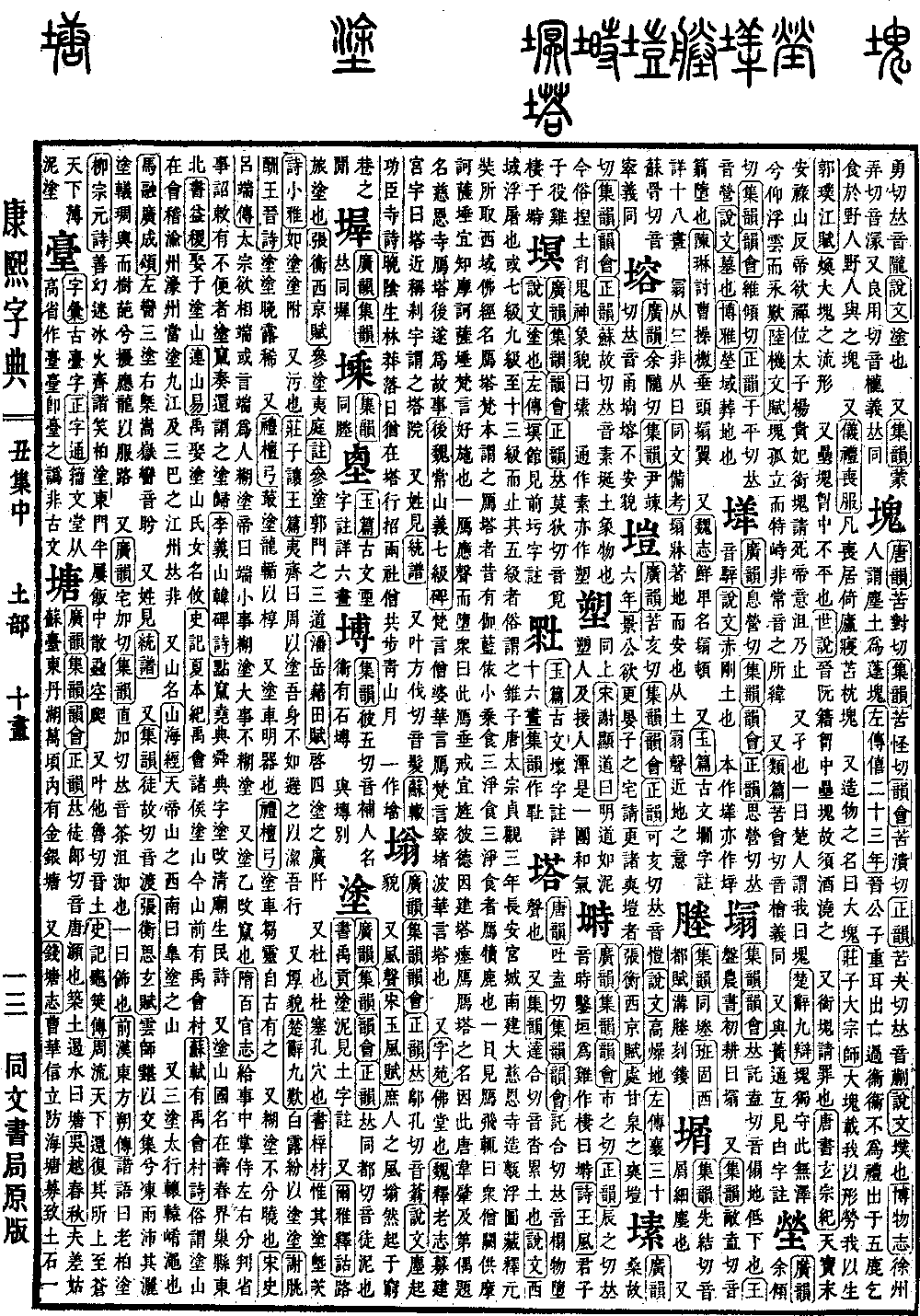
Chou Collection, Middle Volume
Radical: Earth (tǔ)
Kuaai
Kangxi strokes: 13
Page 235, Entry 01
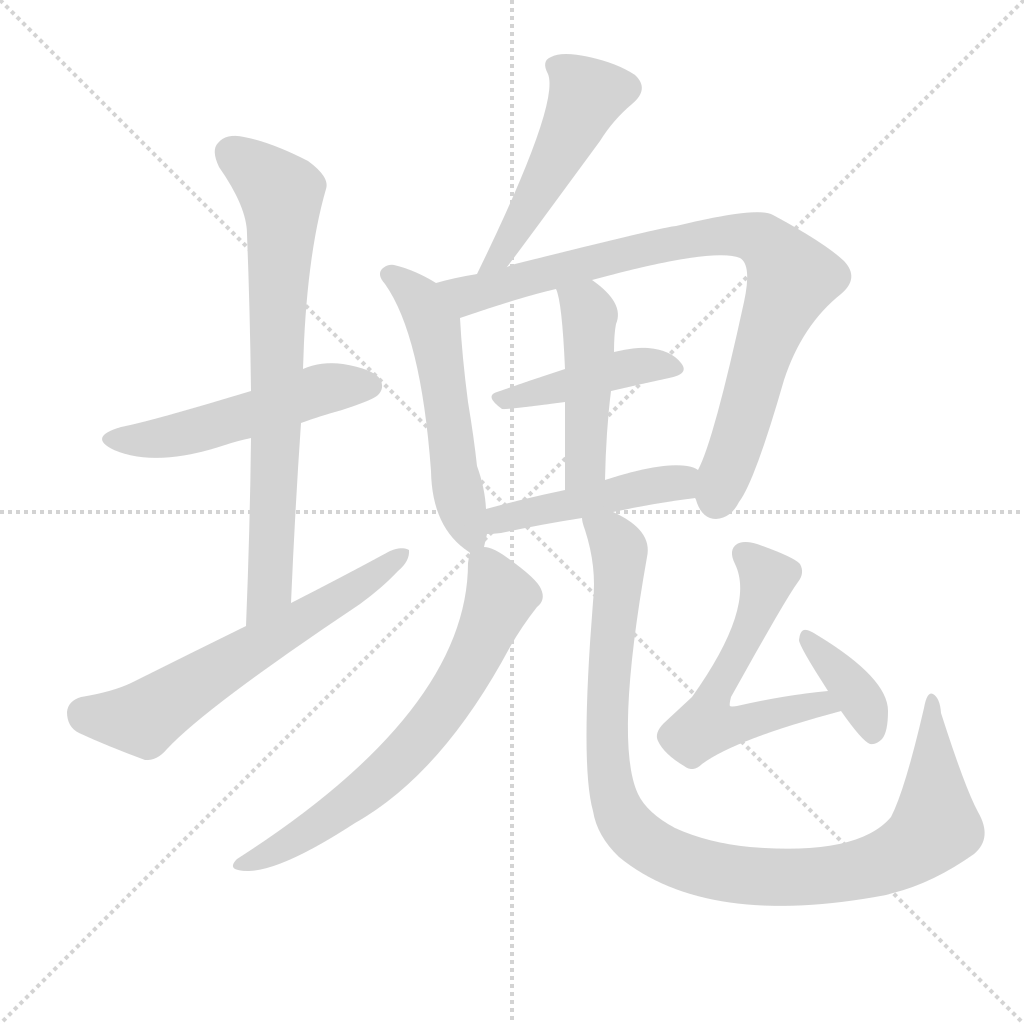
Pronounced kuai.
According to the Explanation of Words and Phrases (Shuowen Jiezi), it means a clod of earth. The Records of Diverse Matters (Bowuzhi) notes that the people of Xuzhou refer to dust and dirt as a clod.
In the Zuo Tradition (Zuozhuan), during the twenty-third year of Duke Xi, when the Jin prince Chong'er was in exile and passing through the state of Wei, the state did not treat him with proper courtesy. When he went out to the Wulu region and begged for food from a rustic peasant, the peasant gave him a clod of earth.
In the Ceremonies and Rites (Yili), in the section regarding mourning clothes, it is stated that during mourning, when residing in a temporary hut of rough timber, one should sleep on a bitter mat and use a clod of earth as a pillow.
It is also a name for the Creator, known as the Great Clod. In the Book of Zhuangzi (Zhuangzi), in the Great and Venerable Master chapter, it states that the Great Clod supports me with a physical form and tires me with life. In the Rhapsody on the River (Jiangfu) by Guo Pu, it says that it illuminates the flowing forms of the Great Clod.
It also refers to lumps or accumulated clods, representing a heart filled with grievances or resentment. In A New Account of Tales of the World (Shishuo Xinyu), it is recorded that Ruan Ji of the Jin dynasty had such lumps of frustration in his chest, which is why he required wine to wash them away.
It also refers to holding a clod of earth in the mouth, a gesture used when begging for death to express deep contrition. In the Book of Tang (Tangshu), in the Imperial Annals, it is noted that toward the end of the Tianbao era, when An Lushan rebelled and the Emperor wished to abdicate to the Crown Prince, Lady Yang held a clod of earth in her mouth and begged to die; the Emperor's resolve wavered, and he desisted.
It also means alone or solitary. Another source states that in the Chu region, people refer to themselves as kuai. In the Songs of Chu (Chuci), in the Nine Arguments (Jiubian), it says: I remain solitary and alone in this marshland, looking up at the floating clouds and sighing eternally. In Lu Ji's Rhymed Prose on Literature (Wenfu), it says: solitary and standing tall in isolation, it is not something woven by ordinary tones.
Also, according to the Classified Chapters (Leipian), it is pronounced hui. The meaning is the same. It is also interchangeable with the character kui. Cross-referenced in the entry for the character kuai.