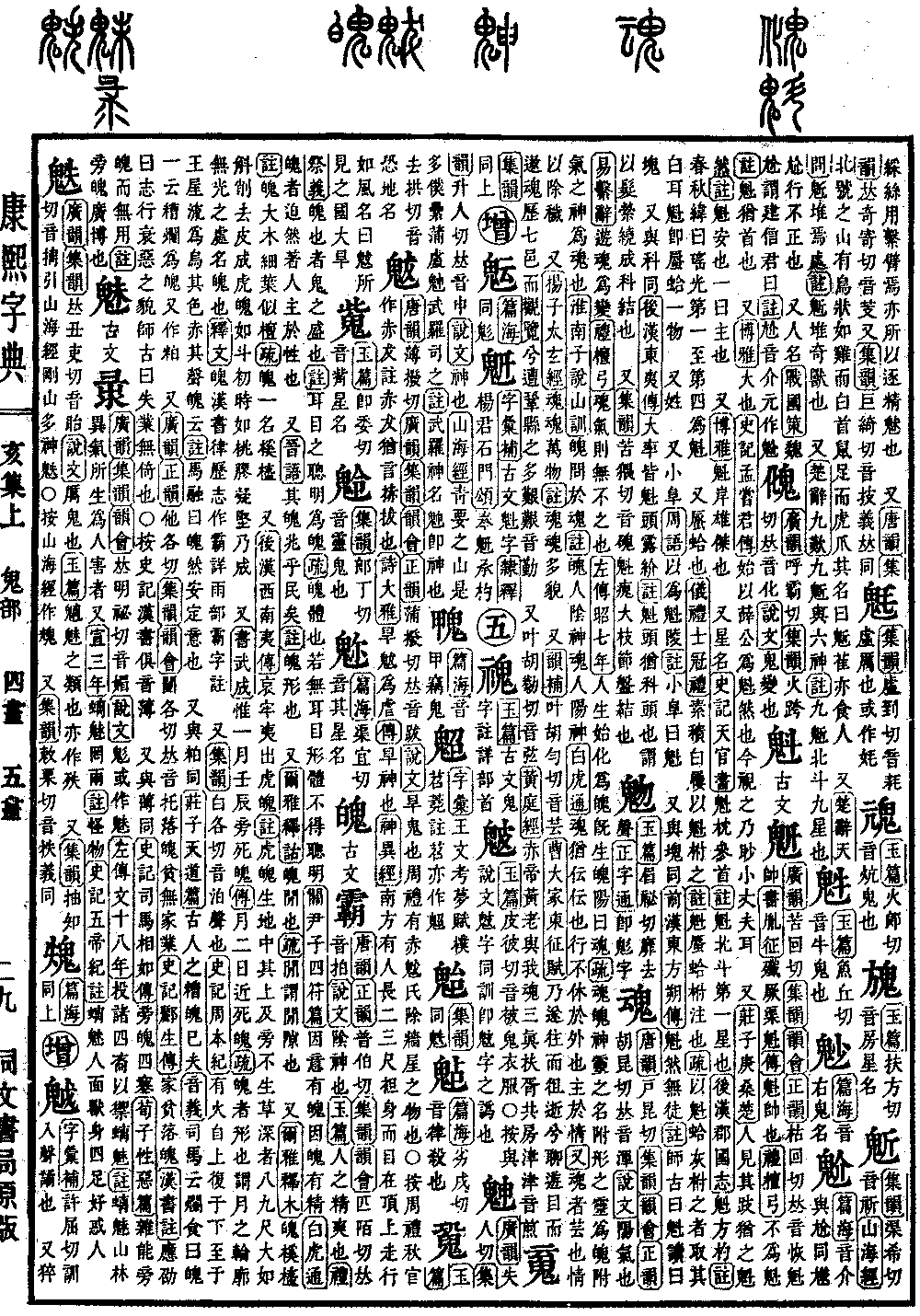
Hai Collection, Upper Volume
Radical: Ghost (guǐ)
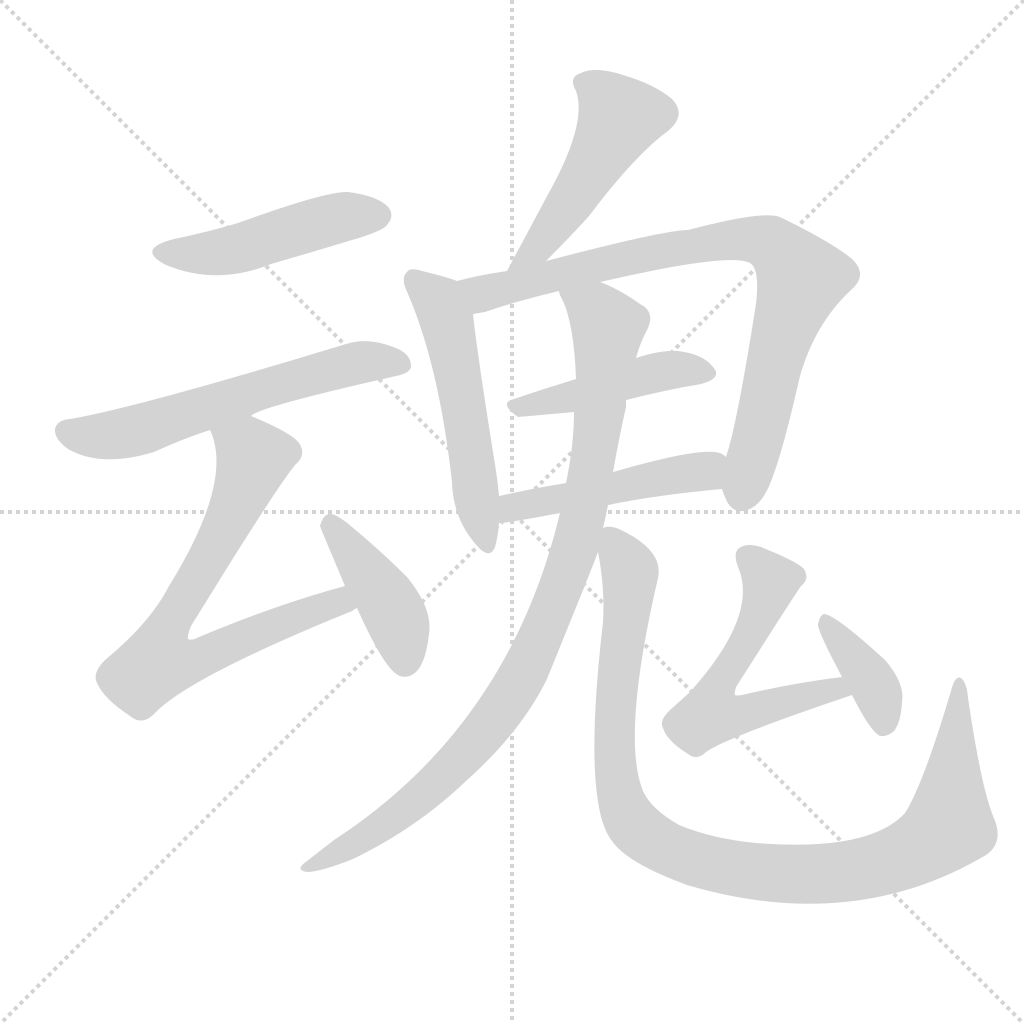
Character: hún
Kangxi Dictionary stroke count: 14
Page 1461, Entry 12
Pronounced hun.
Pronounced hun.
Read with the same sound as hun.
Shuowen Jiezi (Explanation of Graphs and Analysis of Characters) defines it as the yang essence.
I Ching (Book of Changes), Attached Verbal Commentary: Says that wandering souls undergo transformation.
Book of Rites (Liji), Tan Gong: States that the soul-spirit can reach any place.
Zuo Zhuan (Commentary of Zuo), Duke Zhao, Year 7: Records that when a person is born, the po is formed first. Once the po is generated, the yang aspect is called the hun.
Exegesis: Hun and po are names for spiritual entities. The spirit attached to the physical form is the po. The spirit attached to the breath is the hun.
Huainanzi, Suoshan Xun: Contains a record of the po questioning the hun.
Note: The po is the yin spirit of a person. The hun is the yang spirit of a person.
Baihu Tong (Comprehensive Discussions in the White Tiger Hall): Says the hun is like something constantly circulating and moving outward, governing emotions.
It further states: The hun has the meaning of the yun herb, representing the use of emotion to cleanse impurities.
Also, Yangzi, Taixuanjing (Canon of Supreme Mystery): Records that myriad things possess the hun-hun quality.
Note: Hun-hun describes a state of multitude.
Also, in Yunbu (Supplement to the Rhymes): The rhyming sound is pronounced yun.
Ban Zhao, Dongzheng Fu (Rhapsody on the Eastern Expedition): Writes, thus I depart and pass away, for now I let my gaze wander and let my soul roam. I travel through seven cities to observe, and encounter the many hardships of Gong County. The character jian is rhymed with qin.
Also rhymed with xian.
Huangtingjing (Yellow Court Scripture): Records, the Red Emperor and the Yellow Elder are with my soul, three perfected beings assist and accompany me to cross the ford pass. The character jin is rhymed with jian.