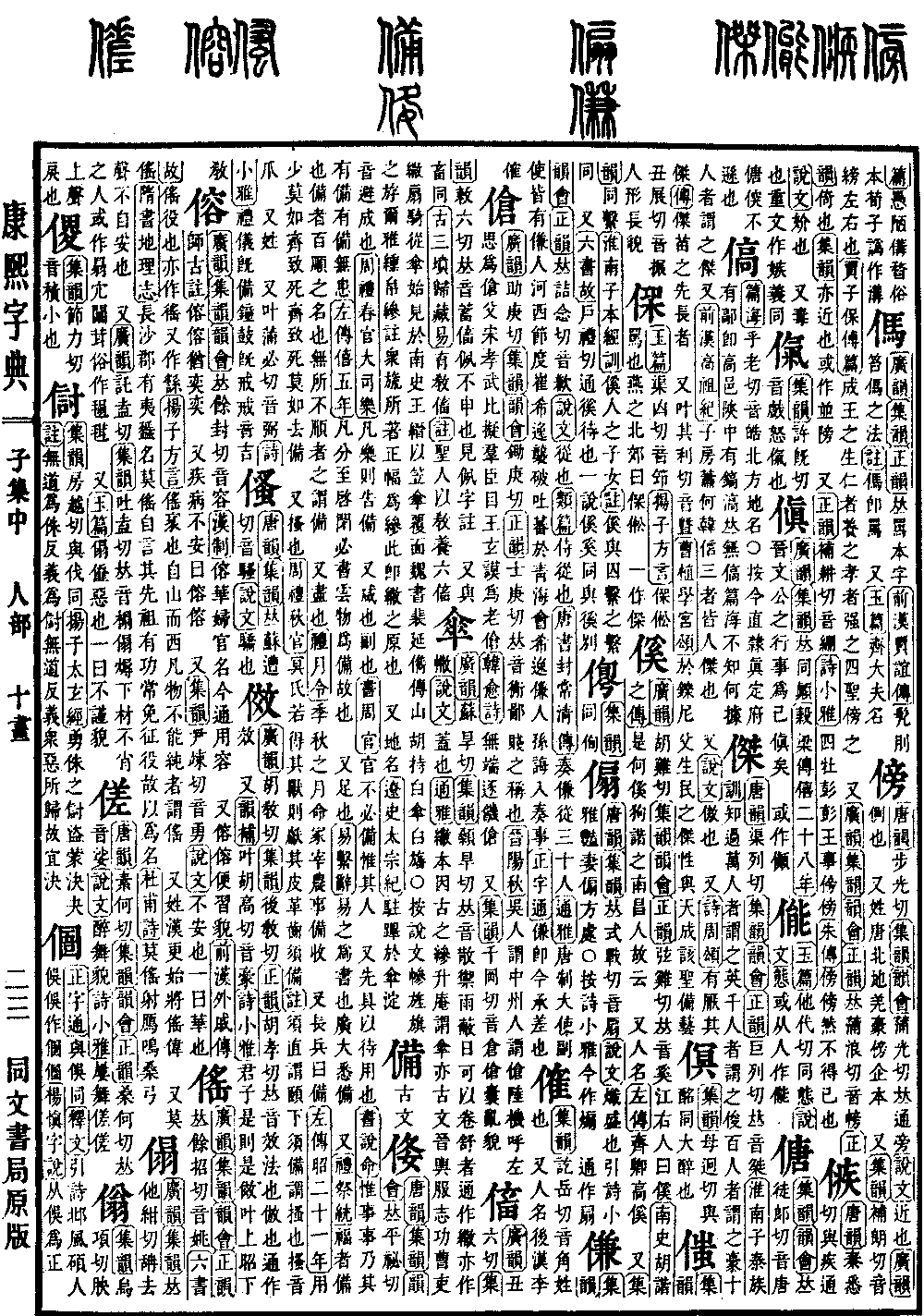
Zi Collection, Middle Volume
Radical: Person (rén)
備
Kangxi strokes: 12
Page 113, Entry 02
Ancient form. Pronounced bi (falling tone). To complete. From the Rites of Zhou (Zhouli), Office of Spring: Whenever music is completed, one announces that it is prepared. Also, to be complete or to serve as a secondary. From the Book of Documents (Shangshu), Offices of Zhou: Offices need not be fully staffed, only filled by the right people. Also, to prepare beforehand for future use. From the Book of Documents (Shangshu), Charge to Yue: In all matters, there must be preparation; where there is preparation, there is no calamity. From the Zuo Commentary (Zuozhuan), Fifth Year of Duke Xi: Whenever the equinoxes and solstices occur, and the beginnings of the seasons, one must record the clouds and vapors, this is done for the sake of preparation. Also, to be sufficient. From the Book of Changes (Yijing), Appended Statements: The book of the Changes is vast, great, and perfectly complete. Also, from the Book of Rites (Liji), Meaning of Sacrifices: Happiness means completeness. Completeness is a name for all things following their proper course. To have nothing that does not follow its course is called completeness. Also, to finish. From the Book of Rites (Liji), Monthly Ordinances: In the last month of autumn, the prime minister is ordered to ensure that the agricultural affairs are completely gathered in. Also, long weapons are called bei. From the Zuo Commentary (Zuozhuan), Twenty-First Year of Duke Zhao: In using few to attack many, none compare to the Qi forces fighting to the death; for the Qi forces to fight to the death, nothing is better than casting away their long weapons. Also, to scratch. From the Rites of Zhou (Zhouli), Office of Autumn: If the Ming-shi officer captures a beast, he offers its hide, skin, teeth, and beard (xu) to the state. The commentary states: The part under the chin is called the beard, and the act of scratching is called bei. Scratching is pronounced zhua. Also, a surname. Also, rhyming with bi (falling tone), pronounced bi (entering tone). From the Book of Odes (Shijing), Lesser Odes: The rites and music are already prepared, the bells and drums have already warned. Warned is pronounced ji. Research notes: In the Rites of Zhou (Zhouli), Office of Spring, Grand Master of Music: Whenever there is music, one announces the preparation. Corrected from the original text from Music Master to Grand Master of Music, and added the character for completed after music. In the Book of Rites (Liji), Monthly Ordinances: In the last month of autumn, ordered the prime minister, the agricultural affairs are completely gathered. Added the character for then before the word ordered according to the original text.