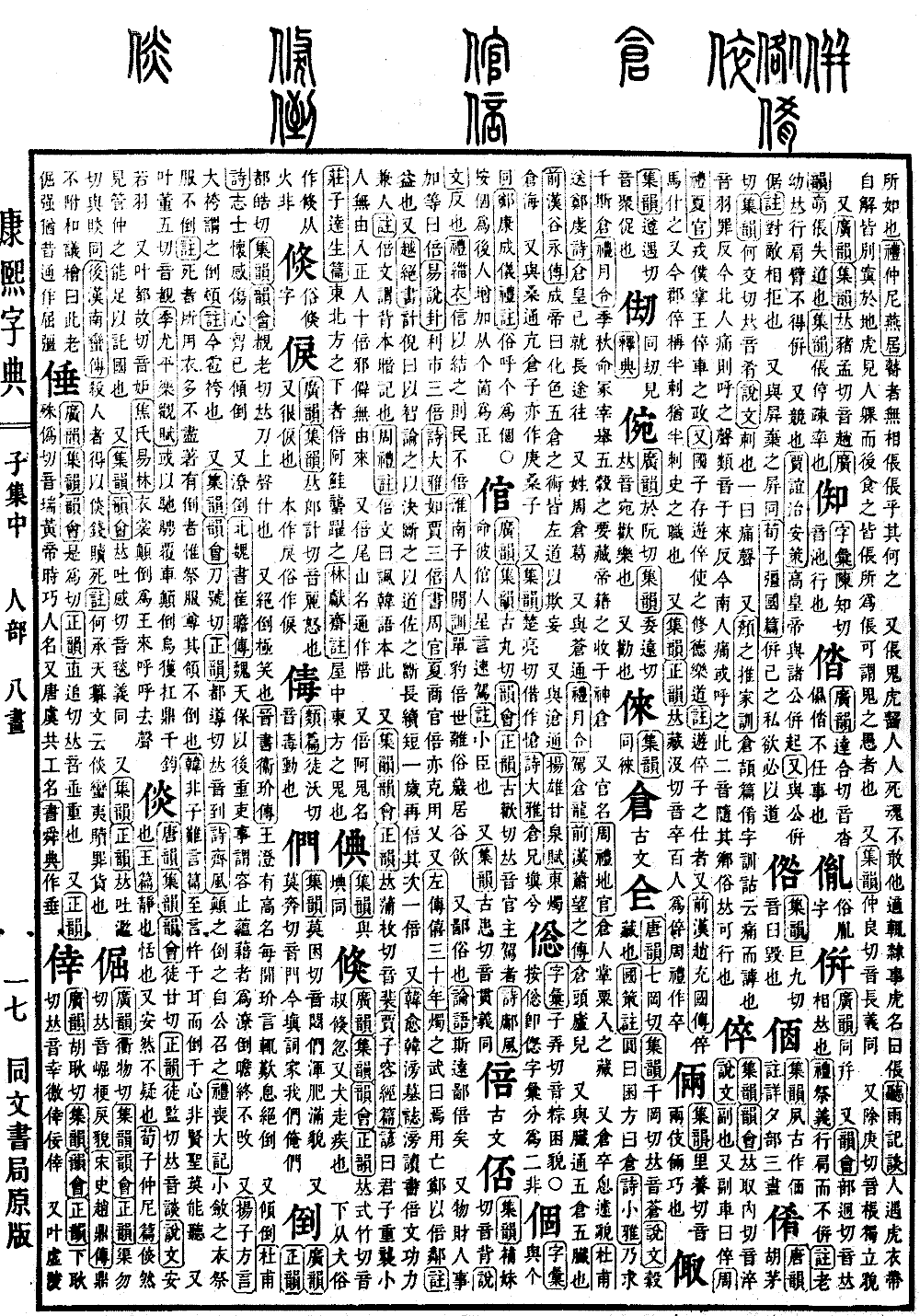
Zi Collection, Middle Volume
Radical: Person (rén)
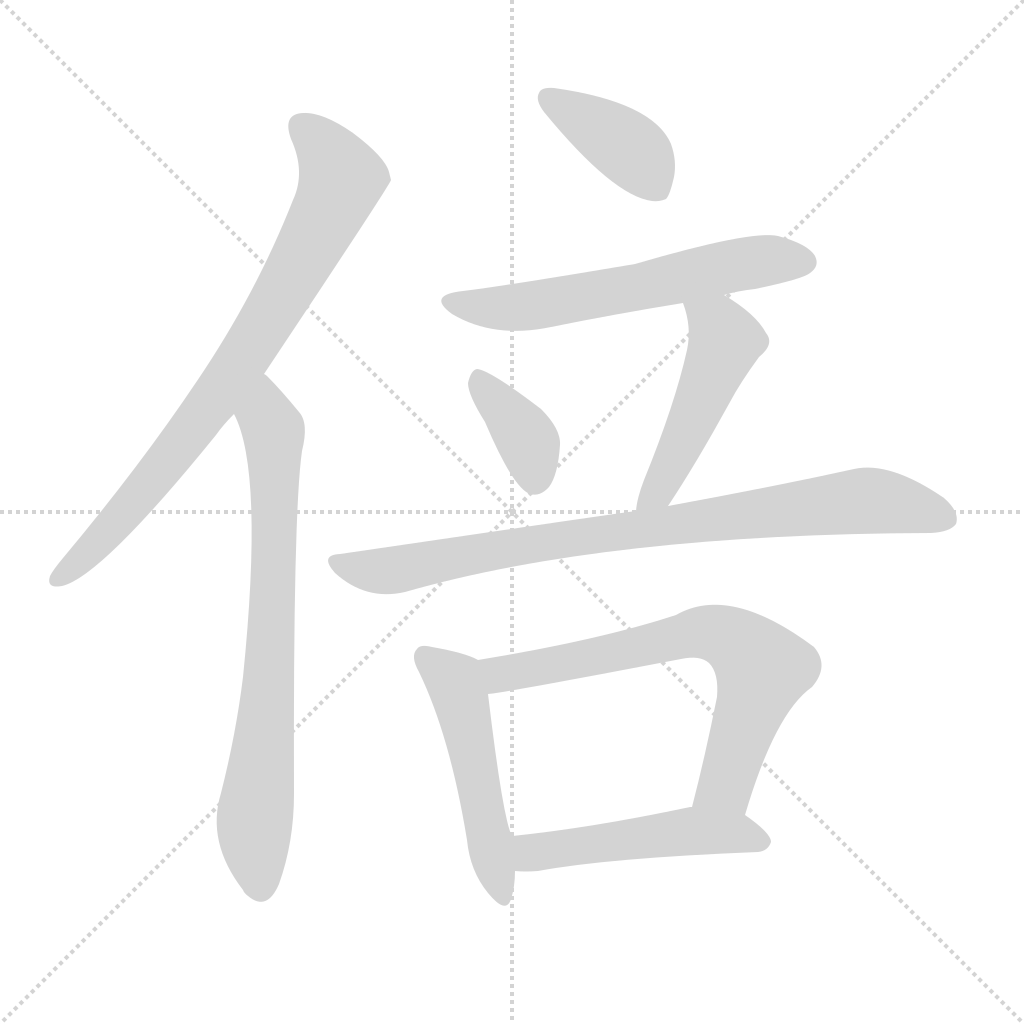
倍
Kangxi Strokes: 10
Page 107, Entry 19
Ancient form is written as 俖.
According to the Compilation of Rhymes (Jiyun), pronounced bei (falling tone).
According to the Explaining Graphs and Analyzing Characters (Shuowen), it means to go against or oppose.
Book of Rites (Liji), Black Robes (Ziyi): If trust is used to bind them, then the people will not rebel.
Huainanzi, Human Affairs Instructions (Renjian Xun): Shan Bao turned his back on the world and abandoned customs, dwelling in cliffs and drinking from valleys.
Also, it means vulgar or rustic.
Analects (Lunyu): This is to keep away from the vulgar and the base.
Also, when goods, wealth, or personnel are increased, it is called double.
Book of Changes (Yijing), Discussion of Trigrams (Shuogua): To profit in the market three times over.
Book of Odes (Shijing), Greater Odes (Daya): Like a merchant with triple profits.
Book of Documents (Shangshu), Offices of Zhou (Zhouguan): The officials of the Xia and Shang dynasties were doubled, and yet they were still able to achieve order.
Also, Zuo Tradition (Zuozhuan), Duke Xi 30th Year: Zhu Zhiwu said, why use the destruction of the Zheng state to benefit a neighbor? Commentary: It means to increase.
Also, Yuejue Shu: Ji Ni said, assess with wisdom, decide with decisiveness, and assist with the Dao; cut the long to continue the short, and within one year, it may double twice, or at the next level, double once.
Also, Han Yu, Epitaph for Han Pang: Pang read books and memorized the text, his effort surpassing others. Commentary: Doubling the text means to turn one's back on the original text and recite from memory.
Commentary on the Rites of Zhou (Zhouli Zhu): Reciting from memory is called chanting (feng); the language of Han is based on this.
Also, according to the Compilation of Rhymes (Jiyun), Rhyme Meetings (Yunhui), and Orthodox Rhymes (Zhengyun), pronounced pei (rising tone).
Jiazi, Essays on Conduct (Rongjing Pian): An old saying goes: The gentleman layers his clothing, so the small man has no way to enter. The upright man is ten times over, so the wicked and perverse have no way to emerge.
Also, Beiwei is the name of a mountain; it is interchangeably used with the character pei.
Also, Beie is the name of a ghost. Zhuangzi, Essentials of Cultivating Life (Dasheng Pian): The lower spirits of the northeast, the Beie and Guilong, leap about. Lin Xianzhai Commentary: These are the ghosts of the east within a house.