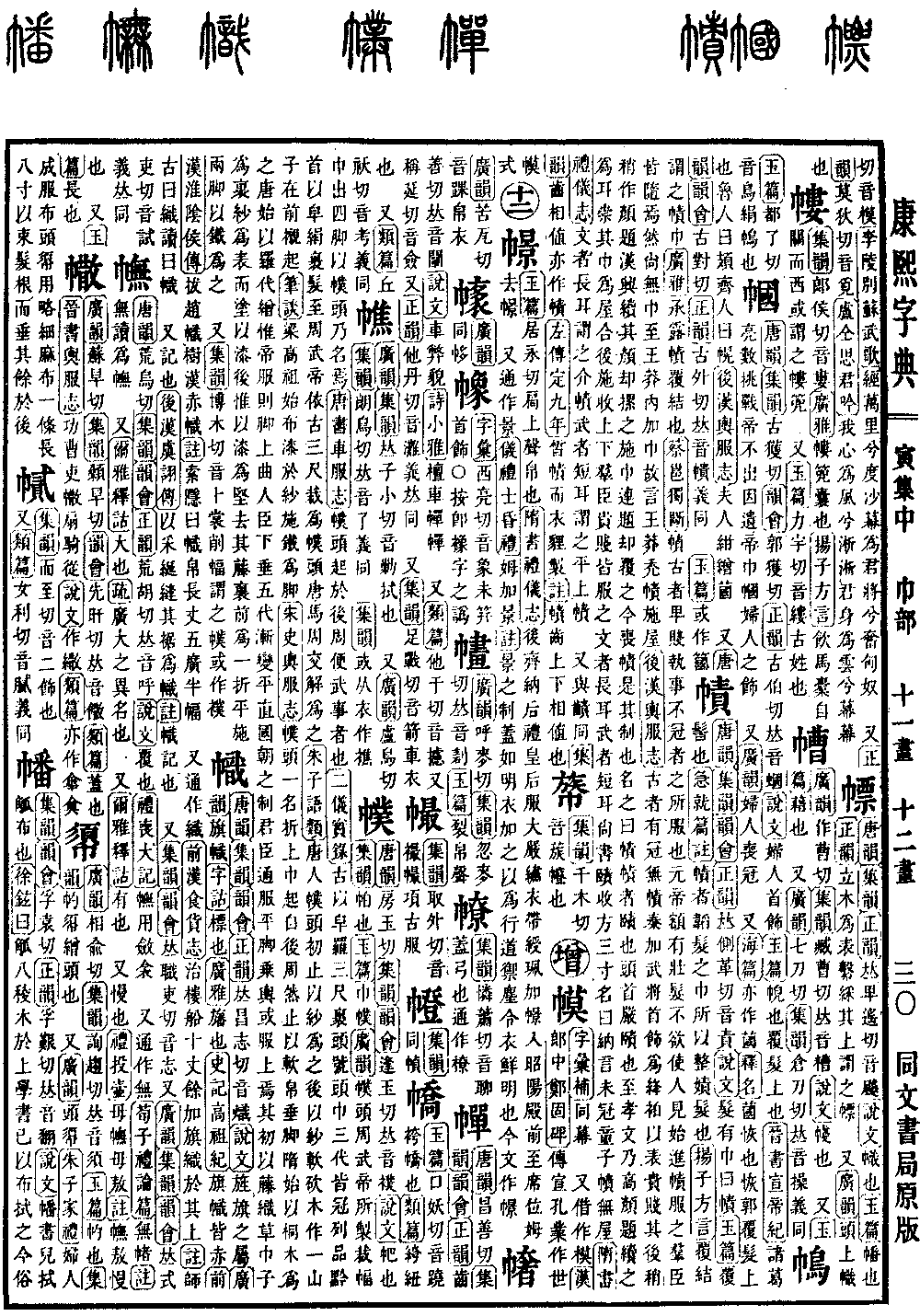
Yin Collection, Middle Volume
Radical: Cloth (jīn)
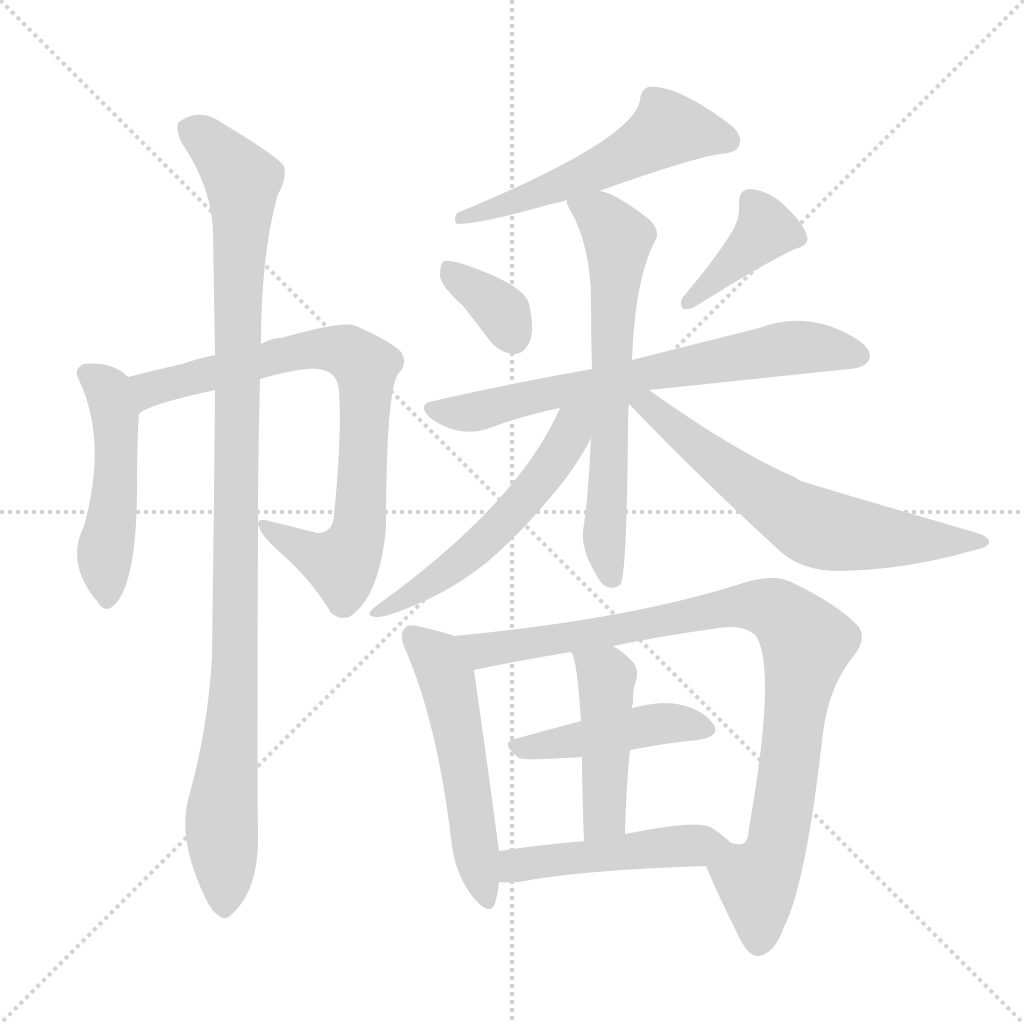
幡
Kangxi strokes: 15
Page 336, Entry 26
According to Collection of Rhymes (Jiyun) and Rhyme Anthology (Yunhui), pronounced fan; according to Correct Rhymes (Zhengyun), pronounced fan.
According to Explanation of Simple and Compound Characters (Shuowen): A cloth used for wiping a writing stylus. Xu Xuan states: A stylus is an eight-sided wooden board. After practicing writing on it, one wipes it clean with cloth. Modern common usage refers to this as fan cloth, which is what is called a cloth handkerchief (fenshui) in the Book of Rites (Liji).
Also, according to Collection of Rhymes (Jiyun): It also refers to a banner or flag. According to Ancient and Modern Notes (Gujin Zhu) by Cui Bao: A signal banner is an ancient emblem of authority, used to display official titles as a credential, hence it is called a signal banner.
In the History of the Former Han (Qian Hanshu), in the biography of Bao Xuan: Xuan was imprisoned for high disrespect; his student Wang Xian raised a banner at the Imperial Academy and declared: Those who wish to save the Bao governor gather here.
Also, the three banners: In the Rhapsody on Wandering through Tiantai (You Tiantai Fu) by Sun Chuo: Blending form and emptiness to unite the traces, suddenly existing as being, one obtains it. Explaining that the two names arise from the same source, dissolving the one non-existence into the three banners. The commentary notes: The three banners are: form is one, emptiness is two, and contemplation is three. It means that although the three banners differ, they are dissolved into one, all returning to the void. In a letter from Xi Jingyu to Xie Qingxu discussing the meaning of the three banners, he says: Recently, those discussing the three banners still largely wish to contemplate form and emptiness, then separately contemplate consciousness, all existing within a single reality while additionally positing two contemplations. This is superior in reasoning. However, in Jingyu's view, form, emptiness, and contemplation constitute the three banners, while consciousness, emptiness, and contemplation also constitute the three banners.
Also interchangeable with fan (meaning to turn or flip). In the Book of Odes (Shijing): Fluttering are the gourd leaves. The commentary states: Fluttering describes the appearance of gourd leaves. In the Mencius (Mengzi): Suddenly, he changed his ways. The commentary states: Fan means to turn back. In the Rhapsody on the Shanglin Park (Shanglin Fu) by Sima Xiangru: The drooping branches are lush, the falling blossoms are fluttering. The commentary by Shi Gu says: Fluttering describes the appearance of flying in the air.
Also, in the Book of Odes (Shijing): In demeanor he is flighty, leaving his seat and moving about. The commentary states: Flighty describes the appearance of losing one's decorum.
Also, according to Collection of Rhymes (Jiyun): Pronounced fan. Meaning is the same.