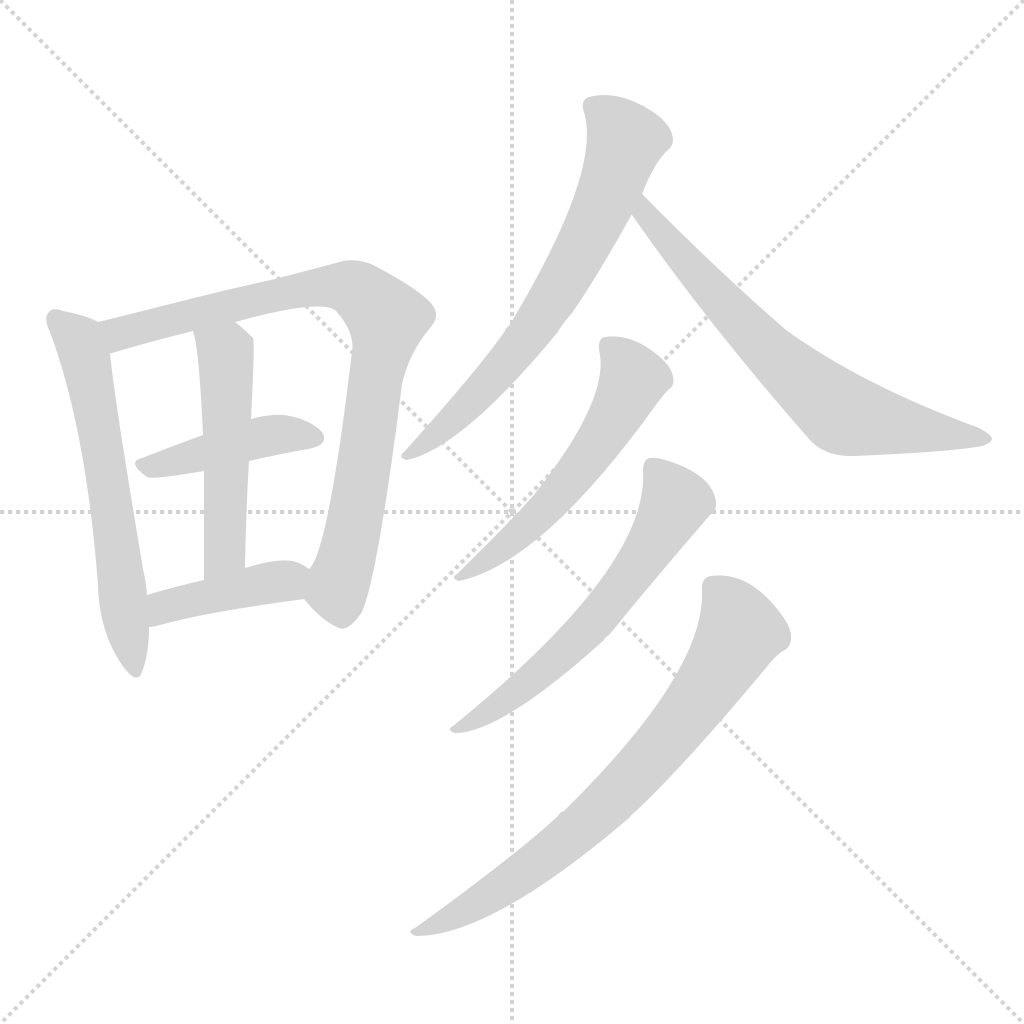
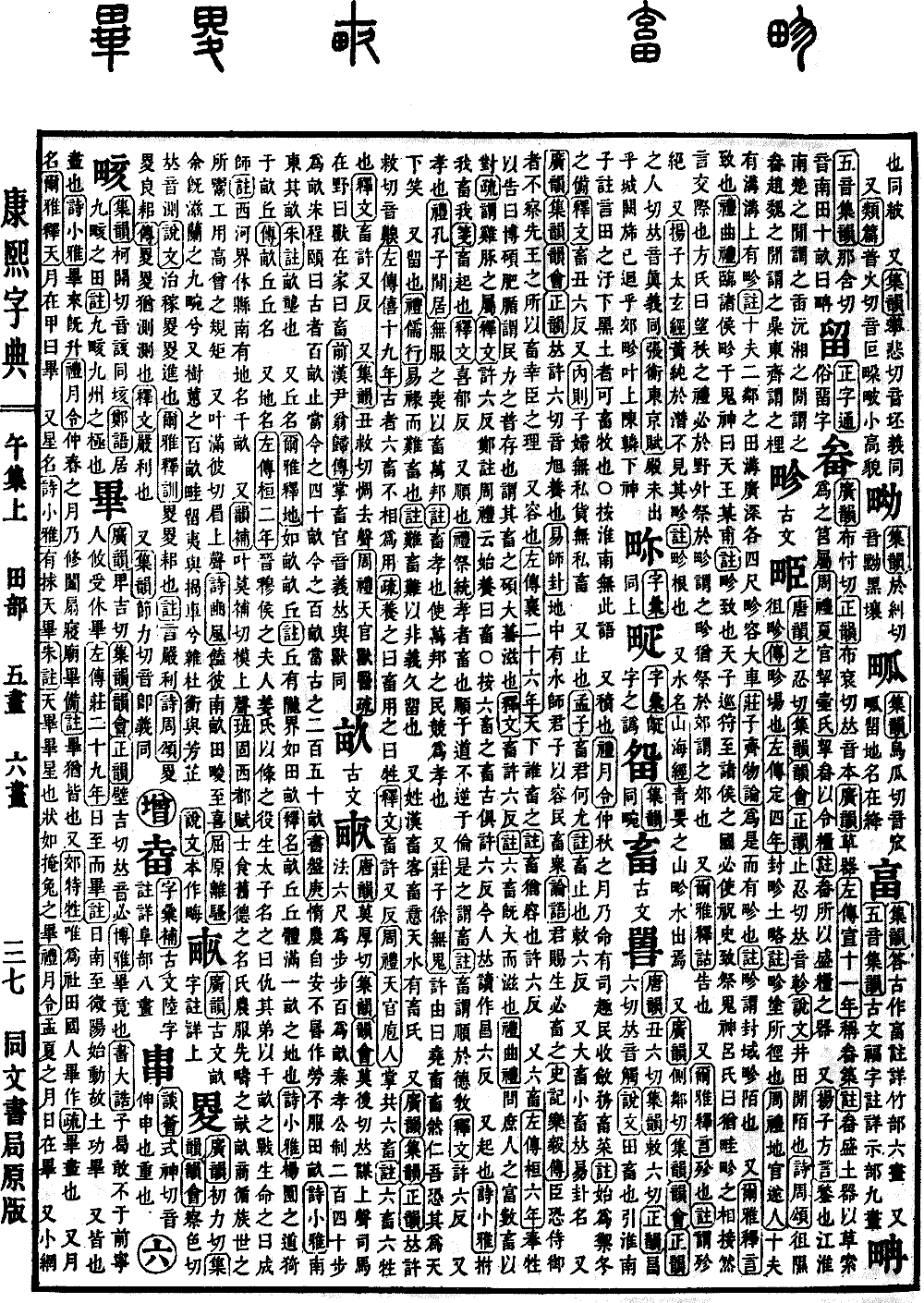
Wu Collection, Upper Volume
Radical: Field (tián)
Zhen; Kangxi stroke count: 10; Page 761, Entry 07
Ancient form. According to the Tang Rhyme (Tangyun), the Collected Rhymes (Jiyun), the Rhyme Assembly (Yunhui), and the Correct Rhymes (Zhengyun), it is pronounced zhen (rising tone).
According to the Explaining Graphs (Shuowen), it refers to the paths between well-field tracts.
Book of Odes (Shijing), Odes of Zhou: To the lowlands, to the field paths. Commentary: Zhen means a field boundary.
Zuo Tradition (Zuo Zhuan), Year 4 of Duke Ding: Marking the boundaries and the land territories. Note: Zhen refers to the paths traversed.
Rites of Zhou (Zhouli), Offices of Earth, The Overseers: Ten men have a ditch; above the ditch is a field path. Note: Ten men refers to the fields of two neighboring groups. The ditches are four feet wide and deep; the field paths are wide enough for a large carriage.
Zhuangzi, Discourse on Making All Things Equal: Because of this there are boundaries. Note: Zhen refers to the boundaries and paths of the territory.
Also, according to the Er Ya, Explanation of Words: to reach.
Book of Rites (Liji), Summary of the Rules of Propriety: When visiting a feudal lord, one makes a declaration (zhen) to the spirits: The Son of Heaven, So-and-so. Note: Zhen means to reach. When the Son of Heaven goes on a hunt to a feudal state, he must have the invocators and chroniclers offer sacrifices to the spirits. Master Lu states: It is like the edges of fields meeting; it refers to communication. Master Fang states: The ritual of offering to the spirits by rank must be performed in the wilderness at the boundaries, which is called zhen, just as sacrificing in the suburbs is called jiao.
Also, according to the Er Ya, Explanation of Names: to announce.
Also, according to the Er Ya, Explanation of Words: to destroy. Note: This refers to total extinction.
Also, according to the Tai Xuan Jing (Taixuanjing) by Yang Zi: Yellow is pure in the depths, its roots (zhen) are not seen. Note: Zhen means root.
Also, a river name. Classic of Mountains and Seas (Shanhaijing): The Qingyao Mountain is where the Zhen River originates.
Also, according to the Broad Rhymes (Guangyun), the Collected Rhymes (Jiyun), the Rhyme Assembly (Yunhui), and the Correct Rhymes (Zhengyun), it is pronounced zhen. The meaning is the same.
Zhang Heng, Eastern Capital Rhapsody (Dongjing Fu): The palace has not yet emerged from the city gates, and the banners have already turned at the suburban boundaries. It rhymes with lin below and shen.