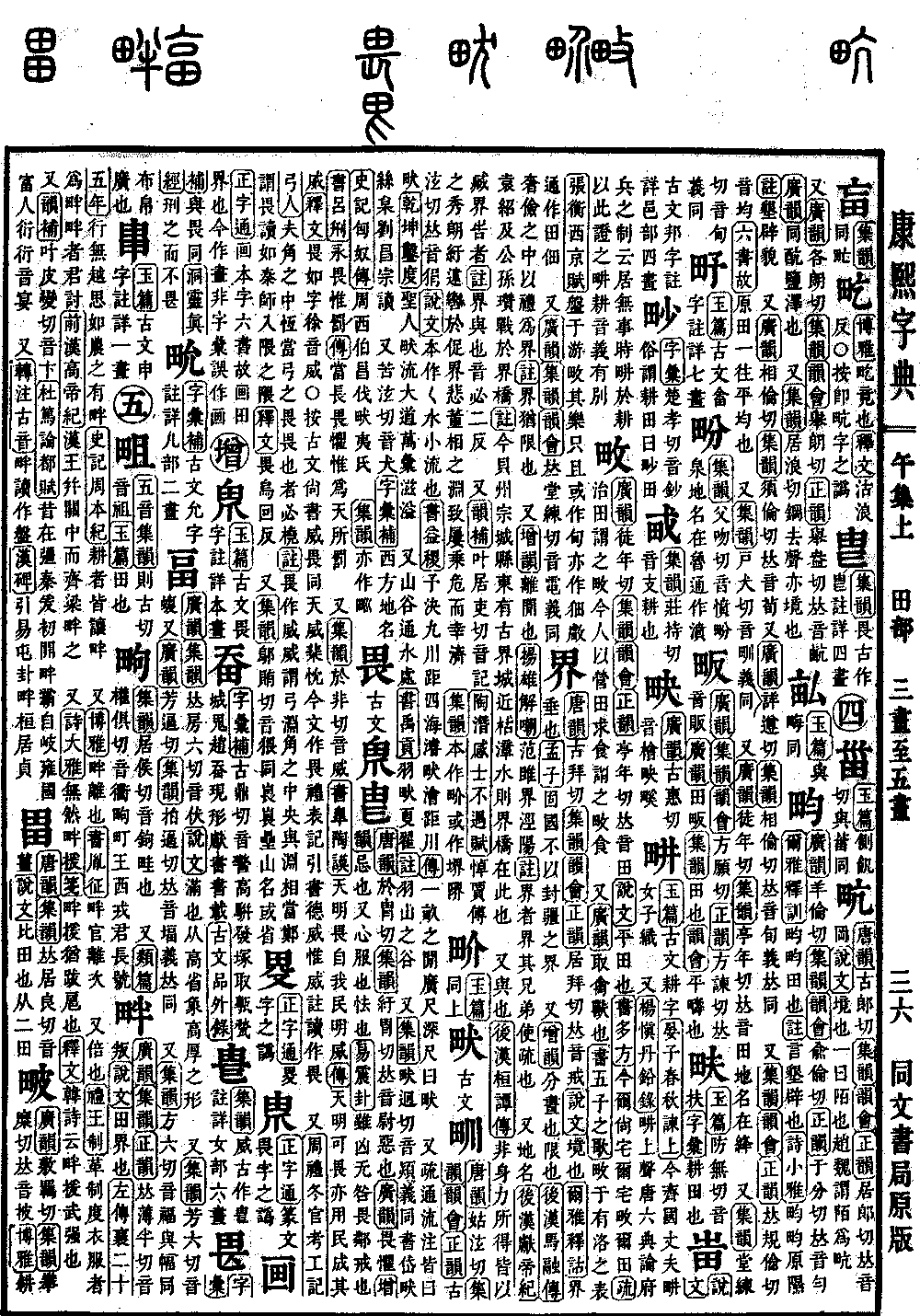
Wu Collection, Upper Volume
Radical: Field (tián)
Kangxi Strokes: 9
Page 760, Entry 18
Pronounced jie (falling tone).
According to Tang Rhymes (Tangyun), Collected Rhymes (Jiyun), Rhyme Compilation (Yunhui), and Correct Rhymes (Zhengyun), it is pronounced jie (falling tone), with a sound similar to that of the character meaning to caution (jie).
Explanation of Writing (Shuowen): Refers to a frontier or a territory.
Approaching Elegance: Explaining Ancient Words (Erya Shigu): Jie means a border region or boundary.
Mencius (Mengzi): Managing the people does not depend on the boundaries of land.
Additionally, according to Augmented Rhymes (Zengyun), it refers to a division or a limit.
History of the Later Han (Hou Hanshu), Biography of Ma Rong: Between luxury and frugality, ritual serves as the boundary. Commentary: Jie is like a restriction.
Additionally, according to Augmented Rhymes (Zengyun), it refers to estranging or causing alienation.
Yang Xiong, Ridiculing Ridicule (Jiechao): Fan Sui alienated the Lord of Jingyang. Commentary: Jie means to cause their fraternal relationship to become distant.
Also refers to a place name.
History of the Later Han (Hou Hanshu), Annals of Emperor Xian: Yuan Shao and Gongsun Zan fought at Jie Bridge. Commentary: Today, east of Zongcheng County in Beizhou, there is an ancient Jie City, near the dried-up Zhang River; Jie Bridge is located there.
It is also used interchangeably with the word for giving.
History of the Later Han (Hou Hanshu), Biography of Huan Tan: All property not obtained through one's own labor shall be given to the informant. Commentary: Jie means to give. Pronounced bi (falling tone).
Additionally, according to Supplement to the Rhymes (Yunbu), it rhymes as ji (falling tone), with a sound similar to the character meaning record (ji).
Tao Qian, Lamenting the Unmet Scholar (Gan Shi Bu Yu Fu): Mourning the outstanding talent of Jia Yi, yet proceeding through winding paths in a narrow official career; lamenting the profound scholarship of Dong Zhongshu, yet repeatedly finding himself in dangerous situations only to be saved by good fortune.
Collected Rhymes (Jiyun): Originally written as a variant form (jie). Sometimes also written as a variant form (jie).
Textual Research: In the citation from Mencius, the original text used the phrase consolidating the state; this has been corrected to managing the people.