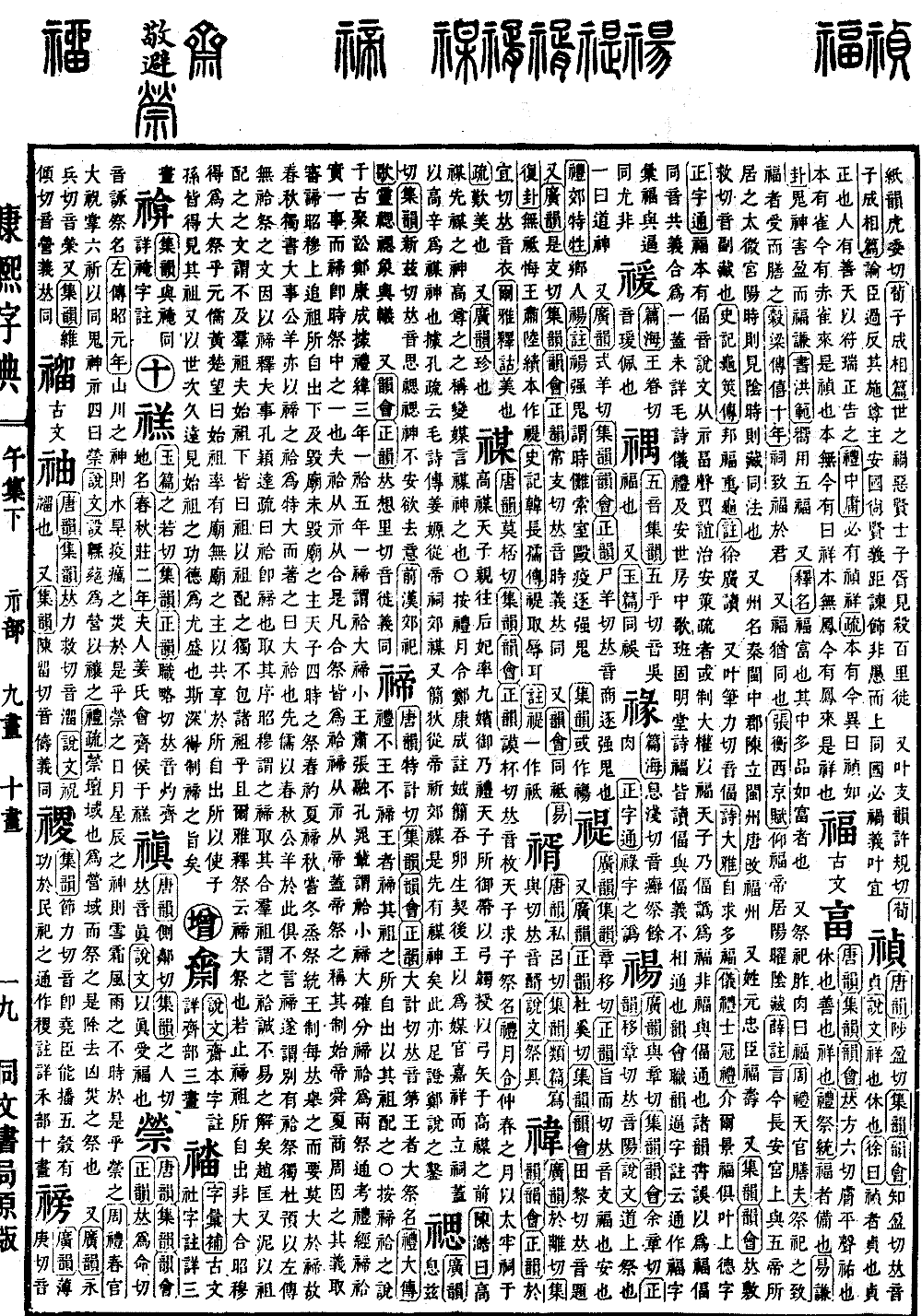
Wu Collection, Lower Volume
Radical: Spirit (shì)
Fu
Kangxi stroke count: 14
Page 845, Entry 02
Ancient character form: fu
Pronounced fu (entering tone)
Blessing, prosperity, goodness, auspiciousness.
Book of Rites (Liji): A blessing is the state of being prepared.
Book of Changes (Yijing): Spirits and gods harm the arrogant but bring blessings to the humble.
Book of Documents (Shujing): Applying the five blessings.
Also, according to the Explaining Names (Shiming): A blessing is wealth; it implies having many kinds of possessions like a wealthy person.
Also, sacrificial meat is called a blessing.
Rites of Zhou (Zhouli): Those who receive the blessed sacrificial meat shall prepare it for meals.
Guliang Commentary (Guliang Zhuan): Performing sacrifices to present blessings to the ruler.
Also, a blessing means to be the same.
Zhang Heng, Western Capital Rhapsody (Xijing Fu): Looking up at the blessings of the imperial residence, where the sun shines and the shade hides.
Xue Commentary: This says that the current palace in Chang'an, like the Taiwei Palace where the five emperors dwell, appears when it is sunny and hides when it is shady, following the same pattern.
Also, the name of a prefecture. In the Qin dynasty it was Minzhong Commandery, later established as Min Prefecture, and renamed Fuzhou in the Tang dynasty.
Also, a surname. Mentioned is the Yuan dynasty loyal minister Fushou.
Also, pronounced fu (falling tone). To store.
Records of the Grand Historian (Shiji): The blessings of the state rely on the tortoise shell.
Commentary: Xu Guang reads it this way.
Also, rhymes with the sound bi (entering tone).
Book of Odes (Shijing): Seeking for oneself many blessings.
Book of Etiquette and Ceremonial (Yili): Granting you great blessings.
Both rhyme with the character for virtue.
Correct Character Treasury (Zhengzitong): The character for blessing originally has the sound bi. According to the Analytical Dictionary of Characters (Shuowen), it is composed of the radical for spirit and the sound fu. In Jia Yi's Essay on Governance (Zhi'an Ce), it is written that distant relatives might seize great power to coerce the Son of Heaven. The character for coerce was mistakenly transcribed as the character for blessing; it is not the case that the two are interchangeable. Various rhyme dictionaries mistakenly consider them to have the same sound and meaning, merging them, because they did not examine the Book of Odes, the Book of Etiquette and Ceremonial, the Anshi Fangzhong Ge, or Ban Gu's Mingtang poem, where the character for blessing is always read as the sound bi, with which it shares no meaning. The Rhyme Compilation (Yunhui) under the rhyme zhi lists the character for press, noting that it is interchangeably written as the character for blessing. The Character Collection (Zihui) states the character for blessing and the character for press are the same, which is even more incorrect.
Textual correction: The Tang Rhyme (Tangyun), Collection of Rhymes (Jiyun), and Rhyme Compilation (Yunhui) note the pronunciation as fu (entering tone). Note that the character for blessing is an entering tone word; the level tone has been corrected to entering tone.