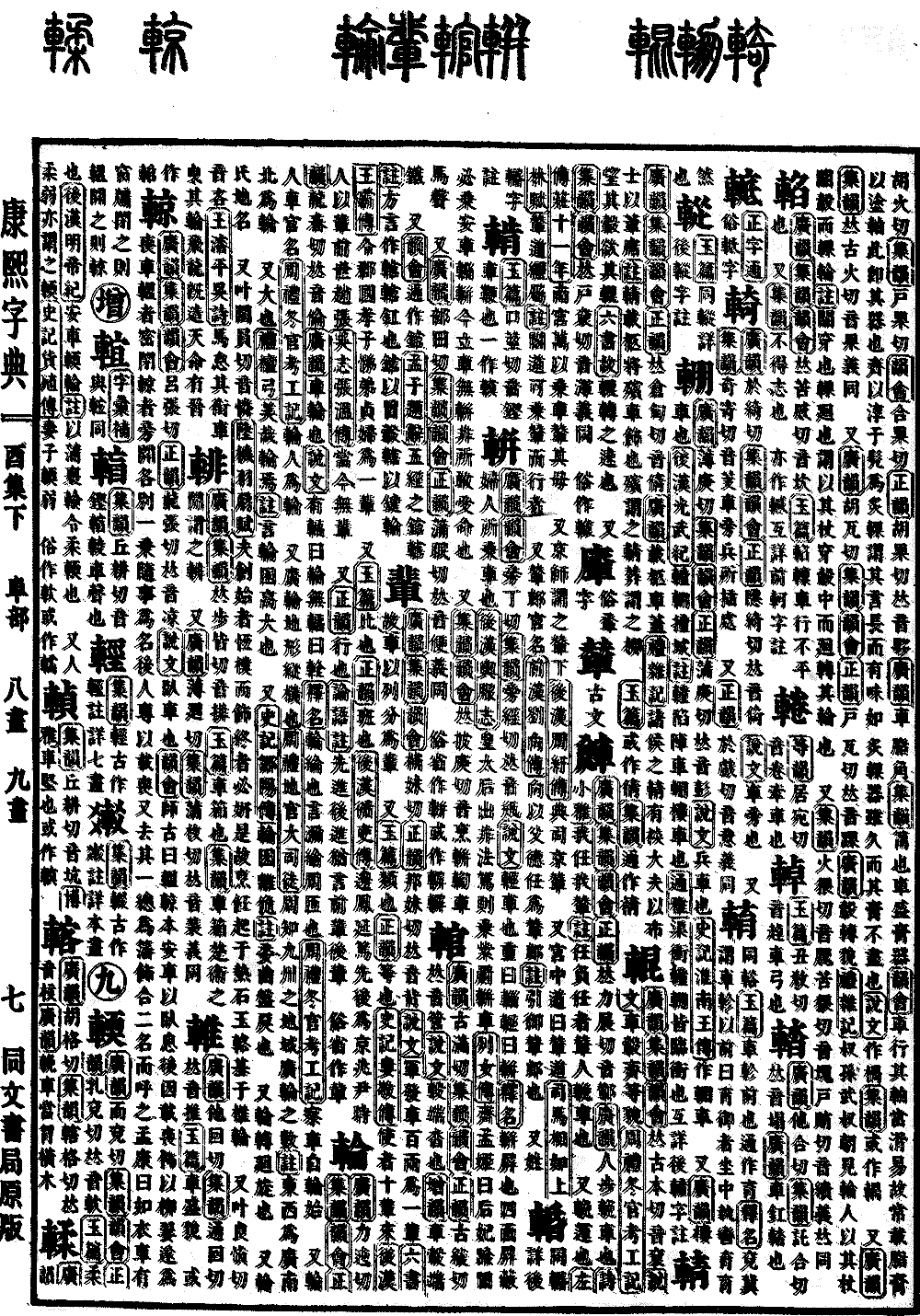
You Collection, Lower Volume
Radical: Carriage (chē)
輩
Kangxi stroke count: 15
Page 1245, Entry 01
Pronounced bèi
According to the Explaining Graphs and Analyzing Characters (Shuowen), one hundred carriages traveling in a military formation is referred to as a bei. The Six Writings Explained (Liushugu) states that carriages organized into ranks are called bei.
Additionally, in the Jade Chapters (Yupian), it denotes a category. In the Correct Rhymes (Zhengyun), it refers to a rank or grade. In the Records of the Grand Historian (Shiji), Biography of Lou Jing, it refers to ten groups of envoys arriving in succession. In the History of the Later Han (Houhanshu), Biography of Wang Ba, it refers to grouping together filial sons, fraternal brothers, and chaste women.
Also, in the Jade Chapters (Yupian), it means to compare. In the Correct Rhymes (Zhengyun), it refers to the order of arrangement. In the History of the Later Han (Houhanshu), Biography of Upright Officials, it mentions that Bian Feng and Yan Du served successively as Governors of the Capital; people of that time compared them to Zhao and Zhang of the previous era. In the Records of Wu (Wuzhi), Biography of Zhang Wen, it states there is no one nowadays who can compare.
Furthermore, in the Correct Rhymes (Zhengyun), it refers to a rank or file. In the Commentary on the Analects (Lunyu zhu), it notes that terms such as those who advance earlier or later are spoken of as predecessors or successors (qianbei, houbei).
The common variant form is written as 軰.