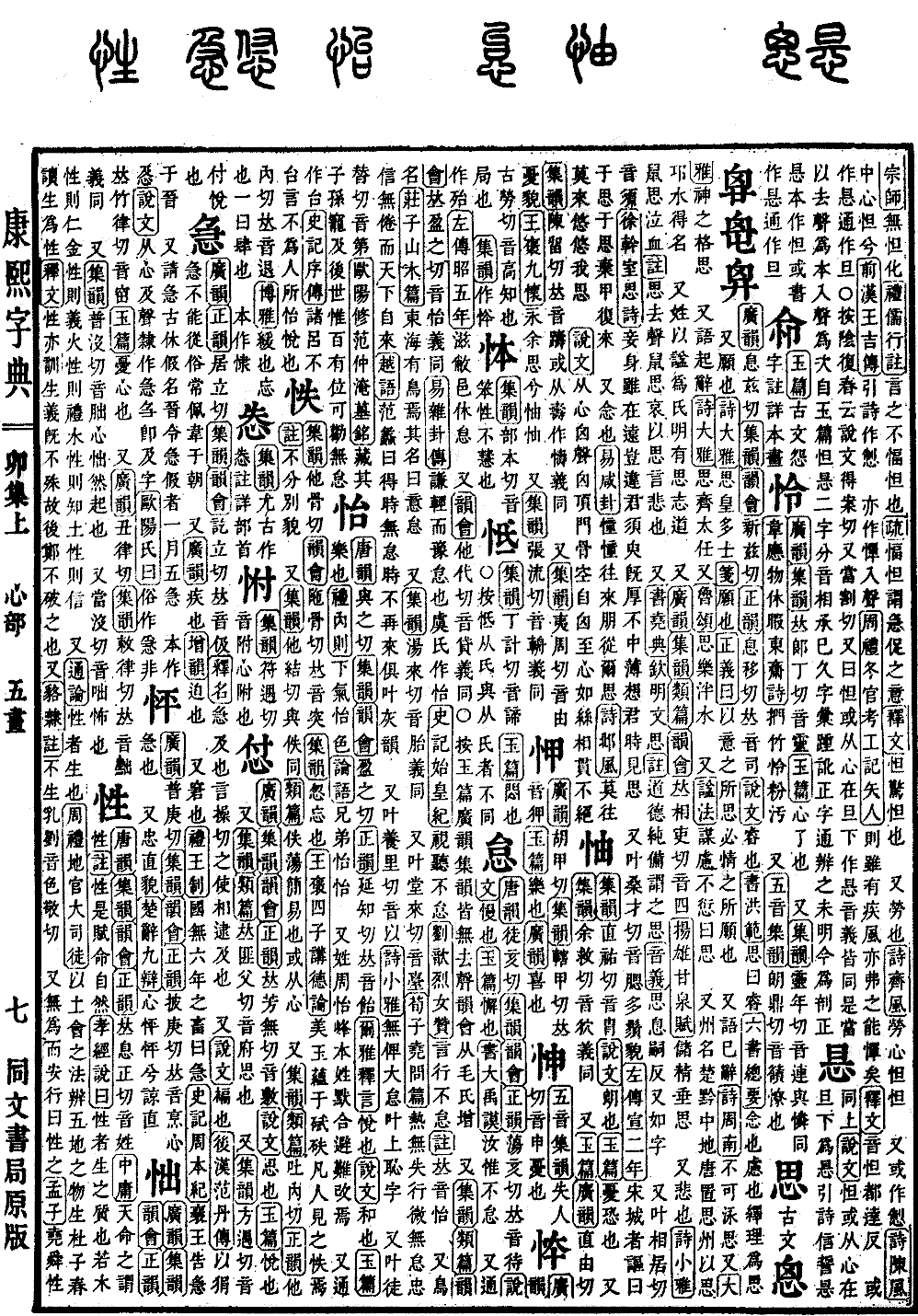
Mao Collection, Upper Volume
Radical: Heart (xīn)
Kangxi Dictionary strokes: 9
Page 381, Entry 04
The ancient script is written as si. Pronounced si. Pronounced xin. Pronounced xi. Pronounced si. Shuowen Jiezi (Explanation of Writing and Analysis of Characters) defines it as being intelligent and wise. Book of Documents (Shujing), Great Plan (Hongfan) states: To think is called being sagacious. The Six Books Essential (Liushu Zongyao) explains: Thoughts and considerations, and investigating the principles of things is called si. It also denotes a wish. Book of Odes (Shijing), Greater Odes (Daya) states: Thinking of the many excellent scholars. Zheng Xuan’s commentary explains si as a wish. Kong Yingda’s sub-commentary states: What the heart considers must be what the emotions desire. It is also used as a sentence-final particle. Book of Odes (Shijing), Airs of Zhou (Zhounan) states: One cannot swim across, alas. Also, in the Greater Odes (Daya) it appears as: The spirits arrive, alas. It is also used as an introductory particle at the beginning of a sentence. Book of Odes (Shijing), Greater Odes (Daya) states: Thinking of the virtuous Tai Ren. Also, in the Odes of Lu (Lusong): Thinking of the joy at the semi-circular pool. According to the Canon of Posthumous Names (Shifa), to have planning and deliberation without error is called si. It is also the name of a prefecture. In the Chu state, the Qianzhong region was established as Si Prefecture during the Tang Dynasty, named after the Siqiong River. It is also a surname. Derived from a posthumous title, there was a person named Si Zhidao in the Ming Dynasty. Pronounced si. In Yang Xiong’s Rhapsody on the Sweet Springs (Ganquan Fu): Gathering essence and letting thoughts descend. It also indicates sorrow. Book of Odes (Shijing), Lesser Odes (Xiaoya) states: Thinking and weeping blood. The commentary states: Si is read in the departing tone; si means to be sorrowful and to think, meaning to be grieved. Book of Documents (Shujing), Canon of Yao (Yaodian) states: Respectful, intelligent, and accomplished in thought. The commentary states: Moral integrity is called si. The Sound and Meaning (Yinyi) states: Si is pronounced si. It can also be read like the original character. It also rhymes as xu. Xu Gan’s Poem on Longing in the Chamber (Shisi Shi): Although my body is in a distant place, how could I ever disobey you for a moment? Since our deep affection will not fade halfway, I think you must often long for me. It also rhymes as sai. It describes the appearance of having a thick beard. Zuo Tradition (Zuozhuan), Second Year of Duke Xuan: The builders of the Song state walls sang: Oh, the long-bearded one, oh, the long-bearded one, you threw away your armor and helmet and ran back. It also denotes longing. Book of Changes (Yijing), Xian Hexagram: With a mind not fixed, going and coming, friends will follow your longing. Book of Odes (Shijing), Airs of Bei (Beifeng): Do not come and do not go, let me long for you悠悠 (yōuyōu). Shuowen Jiezi (Explanation of Writing and Analysis of Characters) states: The character is formed from the heart radical and the sound of the character xin. Xin is the cranial suture; from the fontanelle to the heart, it is like a silk thread connected and continuous without end.