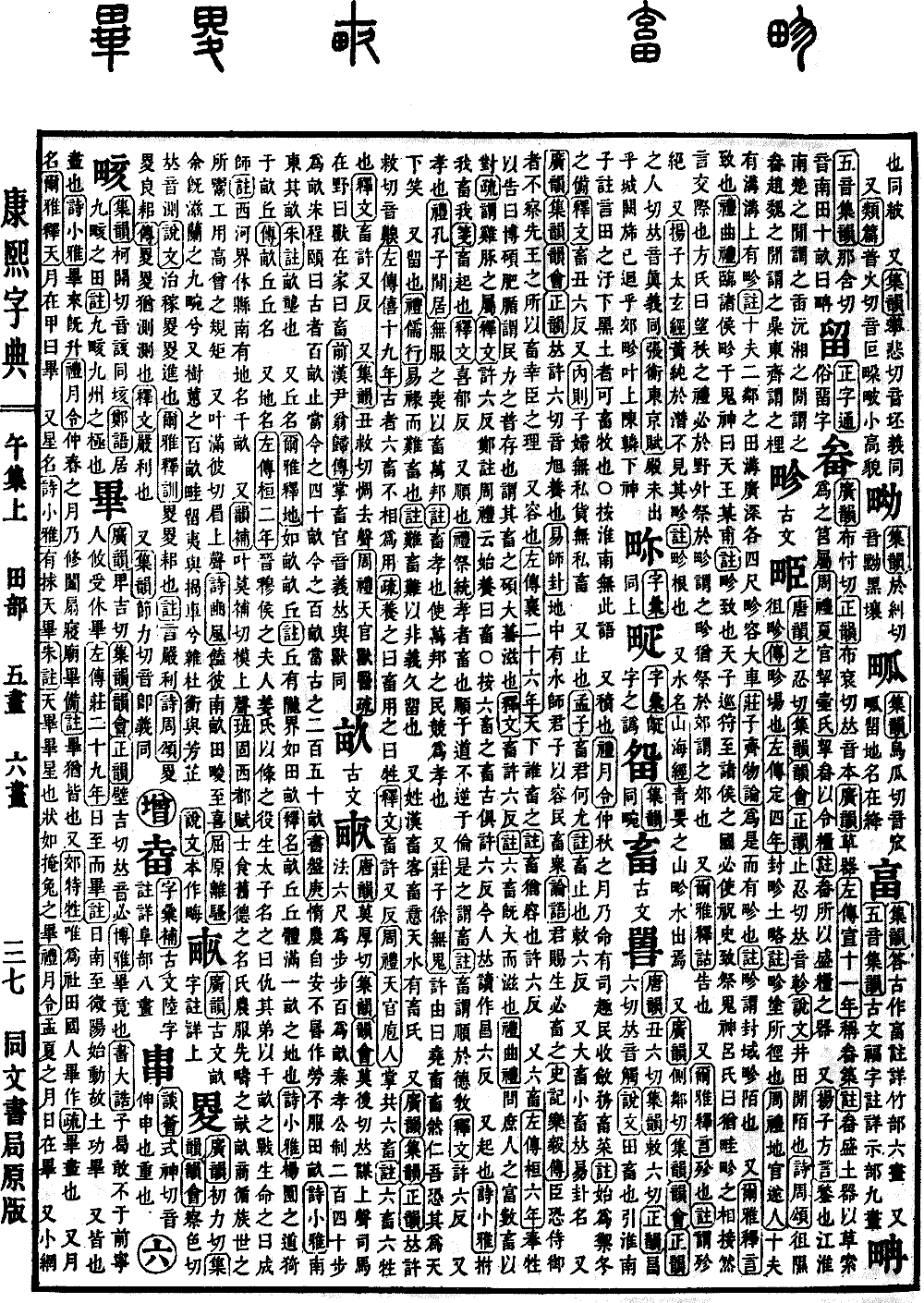
Wu Collection, Upper Volume
Radical: Field (tián)
Kangxi Strokes: 10
Page 761, Entry 12
In ancient writing, it is written as a variant form (chù).
Pronounced chu. According to the Tang Rhyme (Tangyun), the Jiyun, and the Zhengyun, the pronunciation is similar to chu.
Explanations in the Analytical Dictionary of Characters (Shuowen Jiezi) state it refers to field animals. A note referencing the Huainanzi says: low-lying, moist, black soil fields can be used to graze livestock. However, upon verification, this sentence does not exist in the Huainanzi.
It also means to accumulate.
Book of Rites (Liji), Monthly Ordinances (Yueling): In the middle of autumn, officials are ordered to urge the people to harvest and store, ensuring that vegetables are accumulated.
Note: Beginning preparations for winter.
Exegesis: Pronounced chu.
Also, in the Book of Rites (Liji), Internal Rules (Neize): A son and his wife may not possess private wealth or have private accumulations.
It also means to restrain.
Mencius says: What is wrong with restraining a ruler from error?
Note: It means to restrain. Pronounced chu.
There are also the terms Great Accumulation (Da Chu) and Small Accumulation (Xiao Chu), which are the names of hexagrams in the Book of Changes (Zhouyi).
According to the Guangyun, Jiyun, Yunhui, and Zhengyun, it is pronounced xu. It means to nurture.
Book of Changes (Zhouyi), Shi Hexagram: Earth containing water represents the Shi hexagram; the superior person, therefore, encompasses the people and nurtures the masses.
The Analects (Lunyu) says: If a ruler grants living livestock, one must feed them.
Records of the Grand Historian (Shiji), Biography of Yue Yi, says: I fear that those who serve you do not understand the reason why the former king employed and favored me.
It also means to accommodate.
Zuo Tradition (Zuo Zhuan), 26th Year of Duke Xiang, says: Who in the world can accommodate him?
Note: It means to accommodate. Pronounced xu.
There is also the term six domestic animals.
Zuo Tradition (Zuo Zhuan), 6th Year of Duke Huan, records: When offering sacrifices, one prays: The livestock are fat and strong, which shows the financial resources of the people are generally sufficient. This refers to these livestock growing large and multiplying in great numbers.
Exegesis: Pronounced xu.
Note: The six domestic animals are both fat and multiplying in great numbers.
Book of Rites (Liji), Summary of the Rules of Propriety (Qu Li): When asking about the wealth of a commoner, one counts the livestock they raise to answer.
Commentary: This refers to animals like chickens and pigs.
Exegesis: Pronounced xu. Zheng Xuan, in his commentary on the Rites of Zhou (Zhouli), says: The beginning of raising is called xu.
Note: For the xu in six domestic animals, in ancient times it was always pronounced xu, but contemporary people pronounce it chu.
It also means to rise.
Book of Odes (Shijing), Lesser Odes (Xiao Ya), says: Comfort me, support me.
Annotation: It means to rise.
Exegesis: Pronounced xu.
It also means to obey.
Book of Rites (Liji), Records of Sacrifice (Jitong), says: Filial piety is xu. Obeying moral principles and not violating human ethics is called xu.
Note: It means to submit to moral edification.
Exegesis: Pronounced xu.
It also means the way of filial piety.
Book of Rites (Liji), Kongzi Xianju, says: There are no mourning rites in the form of mourning garments used to make the countries of the world practice filial piety.
Note: It means filial piety, causing the people of the countries of the world to compete in practicing filial piety.
In Zhuangzi, Xu Wugui, it is recorded: Xu You said: Yao diligently practices benevolent governance, and I fear he will be mocked by the people of the world.
It also means to detain.
Book of Rites (Liji), Conduct of Scholars (Ruxing), says: (The scholar) does not value salary and is difficult to be detained (through improper means).
Note: Difficult to be detained, meaning it is difficult to use improper ways to detain him for a long time.
There is also a surname. In the Han dynasty, there were people named Chu Ke and Chu Yi; in the Tianshui region, there was the Chu surname.
According to the Guangyun, Jiyun, and Zhengyun, it is pronounced xiu.
Zuo Tradition (Zuo Zhuan), 19th Year of Duke Xi, says: In ancient times, the six types of livestock were not used as sacrifices for one another.
Commentary: When raised, it is called xu; when used as a sacrifice, it is called sheng.
Exegesis: Pronounced xiu.
Rites of Zhou (Zhouli), Heaven's Officials, Chef: Records: Overseeing the supply of the six domestic animals.
Note: The six domestic animals are the six sacrificial animals.
Exegesis: Pronounced xiu.
According to the Jiyun, it is pronounced chu.
Rites of Zhou (Zhouli), Heaven's Officials, Veterinarian Commentary, says: Those in the wild are called shou (beasts), and those raised at home are called chu (livestock).
History of the Former Han (Qian Hanshu), Biography of Yin Wengui, records: The officials in charge of livestock, their pronunciation and meaning are the same as shou.