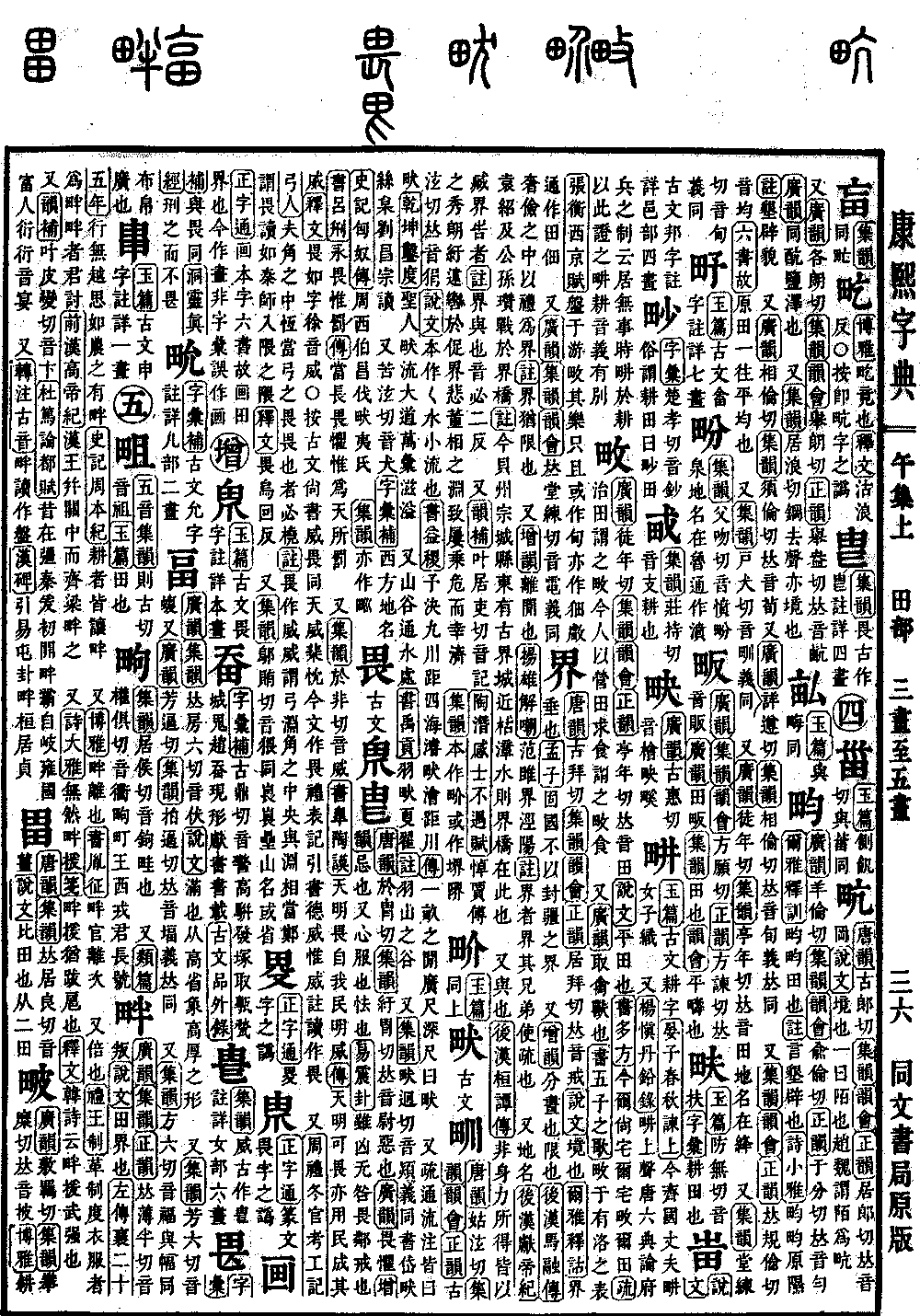
Wu Collection, Upper Volume
Radical: Field (tián)
Entry: 9 strokes
Page 760, Entry 22
Ancient form. Pronounced wei (falling tone). Pronounced wei (falling tone). The pronunciation is the same as wei (falling tone). Meaning is to detest. In the Expanded Rhymes of Broadly Collected Rhymes (Guangyun), it refers to fear. In the Additions to the Rhymes (Zengyun), it refers to apprehension. It also refers to internal submission or respect. It also refers to cowardice. Book of Changes (Yijing), Hexagram Zhen: Even if there is danger, there will be no calamity; this is because one fears the warnings of neighbors and is thus on guard. Book of Documents (Shangshu), Marquis of Lu on Punishments: One must maintain long-term reverence, because one may be punished by Heaven. Commentary: One should maintain fear for a long time, because one may be punished by Heaven. Also, in Collected Rhymes (Jiyun), it is pronounced wei (level tone), with the same sound as wei (level tone). Book of Documents (Shangshu), Counsels of Gao Yao: The bright mandate of Heaven is to be feared; it also follows the clear virtues and stern punishments of the people. Commentary: The bright mandate of Heaven is to be feared, and it relies on the people to achieve its majesty. Explanations of Texts (Shiwen): The character for fear is read with its original sound. Xu Miao annotates the sound as wei (level tone). Note: In the Ancient Text Book of Documents (Guwen Shangshu), the characters for majesty and fear are used interchangeably; for example, in the phrase regarding Heaven's majesty being inconsistent, the modern text writes it as fear. Record of Rites (Liji), Record on Example: The majesty of virtuous conduct lies in making people feel reverent. Annotation: Read as fear. Also, Zhou Rites (Zhouli), Winter Offices, Artificer's Record, Bow Maker: The central part of the animal horn always corresponds to the bow's middle section, and the middle section must bend. Du Zichun stated that the character for fear should be written as the character for majesty. Majesty refers to the curved part of the bow; the center of the horn corresponds to the bow's curve. Zheng Xuan considered the character for fear to be pronounced like the word for the bend in the Qin army's entry. Explanations of Texts (Shiwen): Fear is pronounced as hui (level tone). Also, in Collected Rhymes (Jiyun), it is pronounced as wei (rising tone), with the same sound as the character for cowardly. It is the same as the character for mountainous. Mountainous implies the name of a mountain. Some variant forms omit the radical.
Textual Research: Zhou Rites (Zhouli), Winter Offices, Artificer's Record, Bow Maker: The center of the horn always corresponds to the bow's middle section, and the middle section must bend. Annotation: The character for fear is written as majesty. We have strictly followed the original text to change the annotation from "fear is written as majesty" to "Du Zichun stated that fear should be written as majesty."