Wu Collection, Upper Volume
Radical: Field (tián)
Kangxi Strokes: 12
Page 763, Entry 05
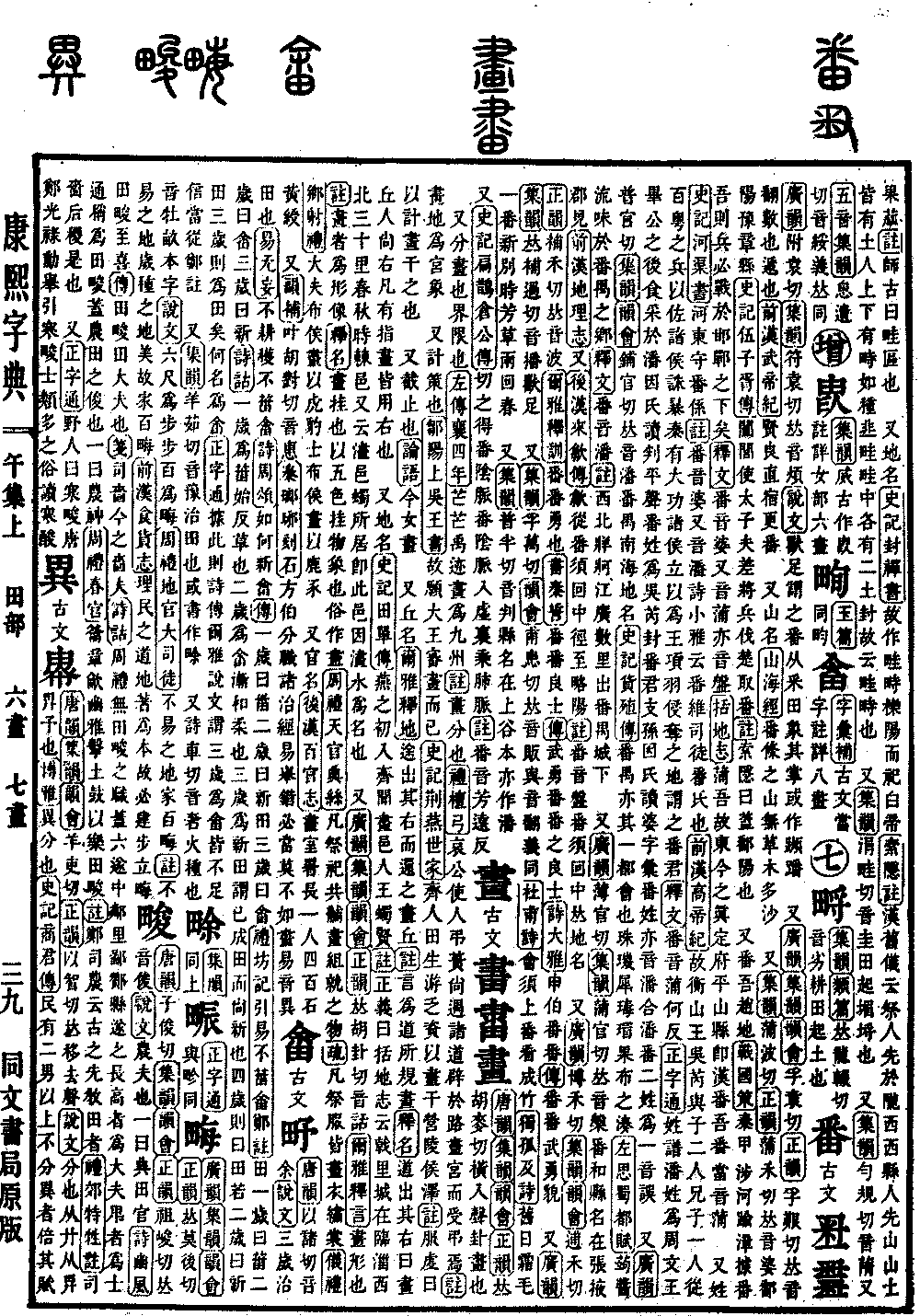
According to Extensive Dictionary of Chinese Characters (Guangyun), pronounced fan. According to Collective Dictionary of Chinese Characters (Jiyun), pronounced fan. The pronunciation is the same as the character meaning to annoy (fán). According to Explaining Graphs and Analyzing Characters (Shuowen Jiezi), the footprint of a wild beast is called fan. The character structure is derived from the radical for field (tián), which resembles the animal's paw. A variant form exists (zhuàn).
Also, according to Extensive Dictionary of Chinese Characters (Guangyun), Collective Dictionary of Chinese Characters (Jiyun), and Rhyme Compilation (Yunhui), pronounced fan. According to Corrected Rhymes (Zhengyun), pronounced fan. The pronunciation is the same as the character for to flip (fān). It means instances, rotation, or replacement. Records of the Grand Historian: Biographies of Emperor Wu of the Western Han (Qianhan Wudiji) state: Worthy and talented scholars served in rotation at the eastern guards.
Also the name of a mountain. The Classic of Mountains and Seas (Shanhaijing) states: Fantiaoshan mountain has no grass or trees and consists mostly of sand.
Also, according to Collective Dictionary of Chinese Characters (Jiyun), pronounced po. According to Corrected Rhymes (Zhengyun), pronounced po. Refers to Poyang in Yuzhang county. Records of the Grand Historian: Biography of Wu Zixu (Shiji Wuzixuzhuan) states: Helu sent Crown Prince Fuchai to lead troops to attack the State of Chu and seized the territory of Fan. The commentary (Suoyin) says: This is likely Poyang.
Also refers to Fanu, a place name in the State of Zhao. Strategies of the Warring States (Zhanguoce) states: If the Qin army crosses the Yellow River and goes beyond the Zhang River to occupy Fanu, then war will inevitably occur beneath the walls of Handan. In the Interpretation of Classics (Shiewen), it is noted that Fan is pronounced po, also pronounced pu, and also pronounced pan. The Geography of the World (Kuodizhi) states: Punu is the former Dongyuan, which is the current Pingshan county of Zhending prefecture, and it is the Fanu of the Han dynasty. Fan should be pronounced pu.
Also a surname. Records of the Grand Historian: Book of the River and Canal (Shiji Hequshu) mentions the Governor of Hedong Commandery, Fan Xi. The commentary states: Fan is pronounced po, also pronounced pan. The Book of Odes (Shijing) says: Fan is the Minister of Instruction. Fan is a surname. The History of the Western Han (Qianhan Gaochidi) states: The former King of Hengshan, Wu Rui, along with his two sons and one nephew, led the troops of Baiyue to help the feudal lords overthrow the tyrannical Qin and performed great deeds. The feudal lords crowned him king, but Xiang Yu seized his land and titled him Lord of Fan. The Interpretation of Classics (Shiewen) states: Fan is pronounced pu. The Dictionary of Standard Forms (Zhengzitong) notes that the Book of Surnames records that the Pan surname descended from Bi Gong, son of King Wen of Zhou, who held land in Pan and therefore adopted Pan as his surname; it is pronounced in the level tone. The Fan surname originated when Wu Rui was enfeoffed as the Lord of Fan, and his descendants adopted Fan as their surname; it is pronounced po. The Compilation of Characters (Zihui) annotates the Fan surname as Pan, which confuses the pronunciations of the Pan and Fan surnames. This is incorrect.
Also, according to Extensive Dictionary of Chinese Characters (Guangyun), pronounced pan. According to Collective Dictionary of Chinese Characters (Jiyun) and Rhyme Compilation (Yunhui), pronounced pan. Refers to Fanyu, a place name in Nanhai Commandery. Records of the Grand Historian: Biographies of the Money-makers (Shiji Huozhizhuan) states: Fanyu is also a major metropolis. It is a distribution center for pearls, rhinoceros horn, hawksbill, fruit, and textiles. Zuo Si’s Rhapsody on the Capital of Shu (Shudufu) writes: The delicious flavor of fermented bean paste spreads to the region of Fanyu. The Interpretation of Classics (Shiewen) states: Fan is pronounced pan. The commentary states: The Zangke River in the northwest is several li wide and flows past the city of Fanyu.
Also, according to Extensive Dictionary of Chinese Characters (Guangyun), pronounced pan. According to Collective Dictionary of Chinese Characters (Jiyun), pronounced pan. Refers to Fanhe, a county name in Zhangye Commandery. Found in the History of the Western Han: Treatise on Geography (Qianhan Dilizhi).
Also, the History of the Eastern Han: Biography of Lai Xi (Houhan Laixizhuan) states: Lai Xi took a side path from Fanxu and Huizhong to go directly to Lueyang. The commentary states: Fan is pronounced pan. Fanxu and Huizhong are place names.
Also, according to Extensive Dictionary of Chinese Characters (Guangyun), pronounced bo. According to Collective Dictionary of Chinese Characters (Jiyun) and Rhyme Compilation (Yunhui), pronounced bo. According to Corrected Rhymes (Zhengyun), pronounced bo. The Erya: Explaining Teachings (Erya Shixun) explains: Fan-fan means the appearance of martial valor. The Book of Documents (Shujing): Oaths of Qin (Qinshi) states: Valiant and good scholars. The commentary explains: Valiant and martial Fan-fan scholars. The Book of Odes (Shijing): Major Odes (Daya) states: Shen Bo is Fan-fan. The commentary explains: Fan-fan is the appearance of martial courage.
Also, according to Extensive Dictionary of Chinese Characters (Guangyun) and Collective Dictionary of Chinese Characters (Jiyun), pronounced bo. Refers to an animal's foot.
Also, according to Collective Dictionary of Chinese Characters (Jiyun), pronounced fan. According to Rhyme Compilation (Yunhui), pronounced fan. The meaning is the same as the pronunciation of fan. Du Fu’s poetry writes: One must take a turn (meaning a rotation) to guard the bamboo. Du Guji’s poetry writes: Old gray hairs once again renewed, while parting flowers have bloomed for two springs.
Also, according to Collective Dictionary of Chinese Characters (Jiyun), pronounced pan. A county name in Shanggu Commandery. It was originally also written as Pan.
Also, Records of the Grand Historian: Biographies of Bian Que and Cang Gong (Shiji Bianque Canggongzhuan) states: Upon checking the pulse, the Fan-yin pulse was obtained; the Fan-yin pulse enters the void and joins with the lung pulse. The commentary states: Fan is pronounced fang-yuan.