Chen Collection, Lower Volume
Radical: Compare (bǐ)
Page 591, Entry 06
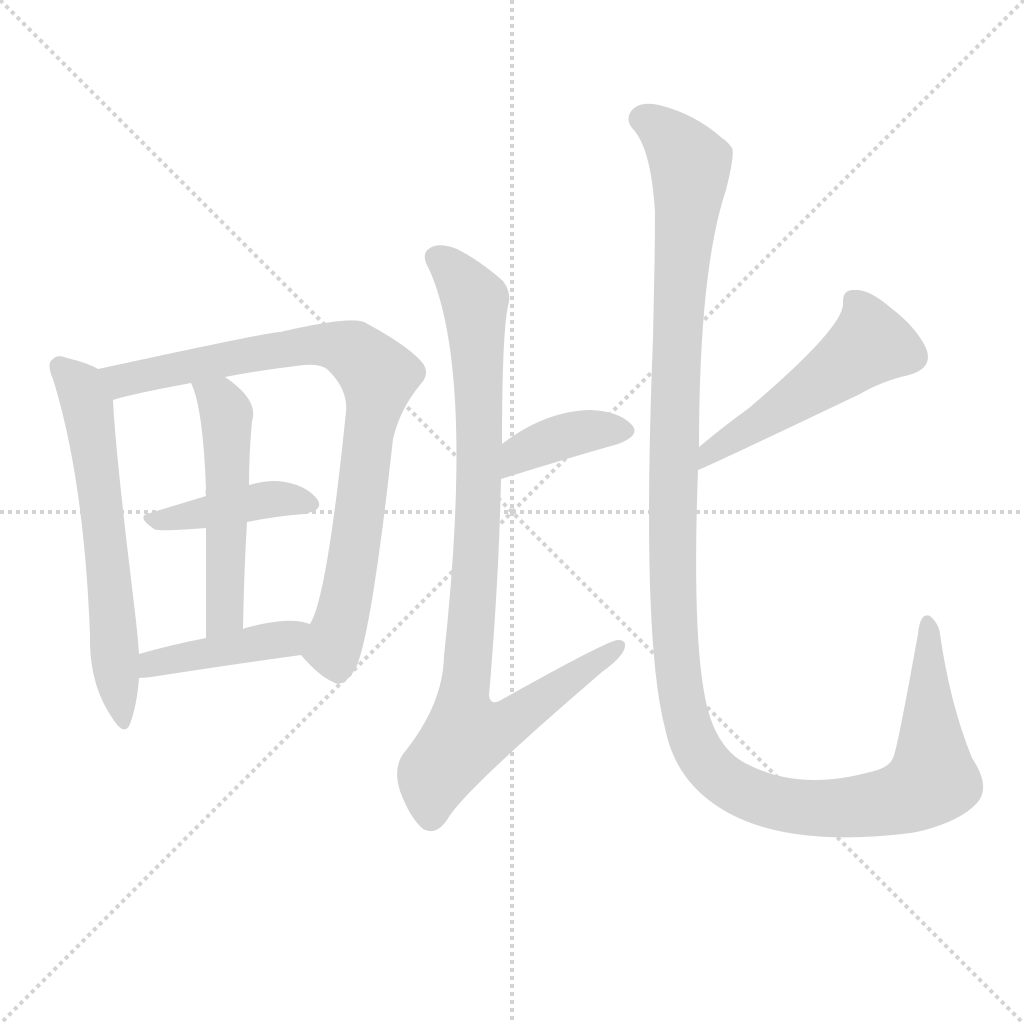
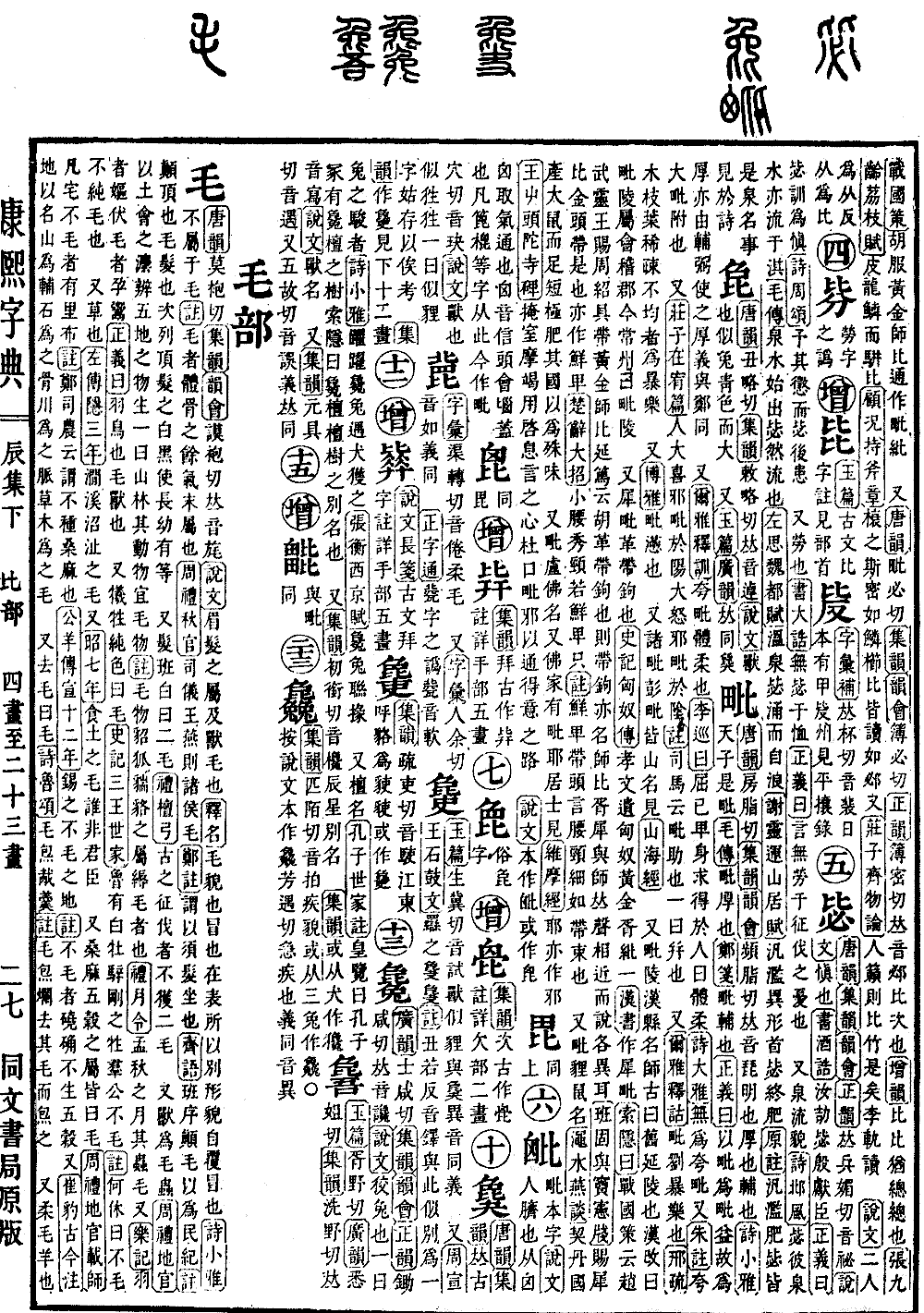
Pronounced pi. Bright, heavy, and assisting. Book of Odes (Shijing), Lesser Odes (Xiao Ya): "The Son of Heaven is assisted." Mao Commentary explains: Pi means heavy or substantial. Zheng Commentary explains: Pi means to assist. The Correct Meaning states: Pi signifies increase, hence it is interpreted as heavy; it also refers to making something substantial through assistance, which is consistent with the interpretation by Zheng Xuan.
Also, in Er Ya, Explanation of Instructions (Shixun): "Kua pi" refers to a compliant physical demeanor. Li Xun says: To humble oneself in order to please others is called compliant. Book of Odes (Shijing), Greater Odes (Da Ya): "Do not be compliant." Zhu Commentary explains: Kua means large. Pi means to depend upon.
Also, Zhuangzi, In the Realm of Nature (Zai You): "Excessive joy assists the yang, excessive anger assists the yin." Commentary: Sima Biao says: Pi means to assist or foster. Another interpretation is to merge.
Also, in Er Ya, Explanation of Words (Shigu): "Pi liu" refers to sparse and uneven. Xing Subcommentary: This refers to the sparse and uneven state of tree branches and leaves.
Also, in Guangya: Pi means troubled or vexed.
There are also the names of mountains: Zhupi and Pengpi, appearing in Classic of Mountains and Seas (Shanhaijing).
There is Piling, a county name from the Han dynasty. Shigu says: It was originally Yanling. The Han dynasty renamed it Piling, which belonged to Kuaiji Commandery. The present-day Changzhou is called Piling.
There is also xipi, a hook on a belt. Records of the Grand Historian (Shiji), Account of the Xiongnu: The Han Emperor Wen gave the Xiongnu "gold-ornamented belt hooks." Book of Han (Hanshu) writes it as xipi. Suoyin says: Strategies of the Warring States (Zhanguo Ce) states: King Wuling of Zhao bestowed upon Zhou Shao "a belt equipped with gold shibi." Yan Du says: It is a belt hook of the Hu people, so belt hooks are also called shibi. Xu, xi, and shi are similar in sound, but the interpretations differ. Ban Gu, Letter to Dou Xian: "Bestowed with a gold-headed xipi belt" refers to this. It is also written as xian. Songs of Chu (Chu Ci), Great Summons (Da Zhao): "Small waist and slender neck, like a belt hook." Commentary: Xian refers to a belt hook, meaning the waist and neck are as slender as if constrained by a belt.
There is also pili, the name of a type of rat. Mianshui Yantan records: The Khitan state produces a large rat with short legs and is very fat. That country considers it a special delicacy.
There is also Pilu, the name of a Buddha. Also, in Buddhism, there is the layman Piye, seen in the Vimalakirti Sutra (Weimo Jing). Ye is also written as xie. Wang Chu, Stele Inscription for the Tou陀 Temple: "Shut the room at Magadha, to open the heart of ceasing words. Keep silent at Piye, to clear the path of obtaining the meaning."
Shuowen Jiezi originally wrote it as pi. It is also written as pi.