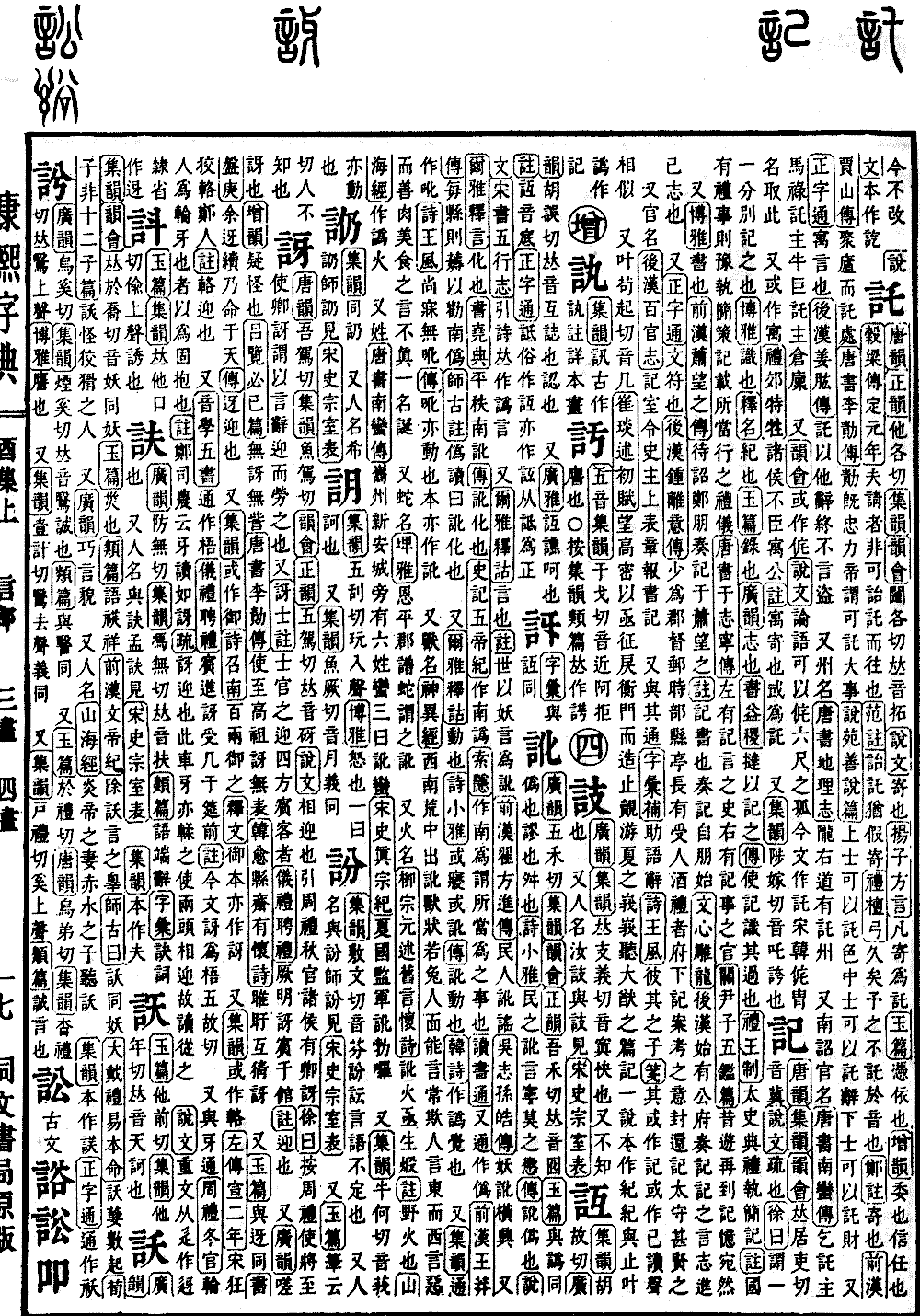
You Collection, Upper Volume
Radical: Speech (yán)
訟
Kangxi stroke count: 11
Page 1149, Entry 18
Ancient form: 吅
Pronounced song (falling tone)
Shuowen Jiezi (Dictionary of Graphic Definitions): To dispute.
Liushu Gu (Principles of the Six Writings): To contend over right and wrong before officials or authorities.
Also, in the commentary to the Dispute (Song) hexagram in the Book of Changes (Yijing): In general, in cases of dispute, when things do not harmonize with sentiments, one contends and thereby initiates a dispute. Commentary: To argue.
Also, in the Miscellaneous Hexagrams (Zagua): Dispute means lack of intimacy.
Book of Rites (Zhouli), Earth Offices, Grand Minister of Instruction: Regarding all the ten thousand people who do not submit to instruction and have cases or disputes, hear and adjudicate them. Commentary: Contending over crimes is called yue (lawsuit), contending over property is called song (dispute). Sub-commentary: This is in the case of contrastive phrasing. If the two are not contrasted, then contending over property may also be called yue.
Also, when public opinions differ and are confused or contradictory. History of the Later Han (Hou Hanshu), Biography of Cao Bao: Those who gather to discuss rites are called a gathering of disputes. Commentary: This means they are arguing without reaching a settlement.
Also, to submit a petition to clear someone of injustice is called song. History of the Former Han (Qian Hanshu), Biography of Wang Mang: Officials and the common people who submitted petitions to clear injustices regarding Wang Mang numbered in the hundreds.
Also, to blame. Analects (Lunyu): I have never seen one who can see his own faults and internally blame himself. Commentary: Song is synonymous with ze (to blame).
Also, public. Records of the Grand Historian (Shiji), Annals of Empress Lu: Not yet daring to speak publicly of putting them to death. Commentary: Song means public. It is synonymous with speaking clearly.
Yunhui Xiaobu (Supplement to the Rhyme Compendium): Interchangeable with song (recite). Former Han History (Qian Hanshu), Annals of Empress Lu, commentary by Deng Zhan: Song yan means public speech.
Zhengzitong (Comprehensive Dictionary of Characters): Song also has the pronunciation gong. Interchangeable with gong (public).
Also, in the Yunhui (Rhyme Compendium), interchangeable with song (hymn). Shuowen Jiezi: To sing and chant. Xu Xuan remarked: In ancient editions of the Book of Odes (Shijing), the character for Ya-Song (Elegance and Hymns) is often written as song.
Also, pronounced song (level tone). Also refers to legal disputes. Book of Odes (Shijing), Shao Nan: Why hasten our dispute? (Rhymes with yong and cong). Mao says: The commentary on the Book of Changes says: Song means to dispute, to speak of it before the public. It is composed of speech and public, which is a conceptual compound. It also borrows the sound of public, which is why in the Book of Odes it rhymes with cong, while in the Book of Changes it is uniquely read in the falling tone, which may not be entirely accurate. It should conform to the pronunciation in the Book of Odes, where the two rhymes are used interchangeably.
Also, pronounced rong. To argue or remonstrate. Classic of History (Shangshu), Canon of Yao: Can the boastful and argumentative be permitted? Ma Rong used the character yong.
Also, to tolerate. Records of the Grand Historian (Shiji), Biography of King Bi of Wu: When officials from other commanderies and kingdoms wished to come and arrest fugitives, they tolerated it, prohibited them, and did not hand them over. Commentary: Song is pronounced rong. This means they tolerated each other, prohibited the arrests, and did not hand them over.
Also, rhyming with gu dong (gong). Pan Yue, Guan Zhong Poem: Having verified your words, again I settle your disputes. If they are correct, then clarify the facts; if not, then prove the emptiness.
Also, rhyming with cu lang (cang). Wei Wudi, Dui Jiu Qu: The prime minister and his subordinates are all loyal and good, all are courteous and yielding, and the people have no disputes.