Chou Collection, Upper Volume
Radical: Mouth (kou)
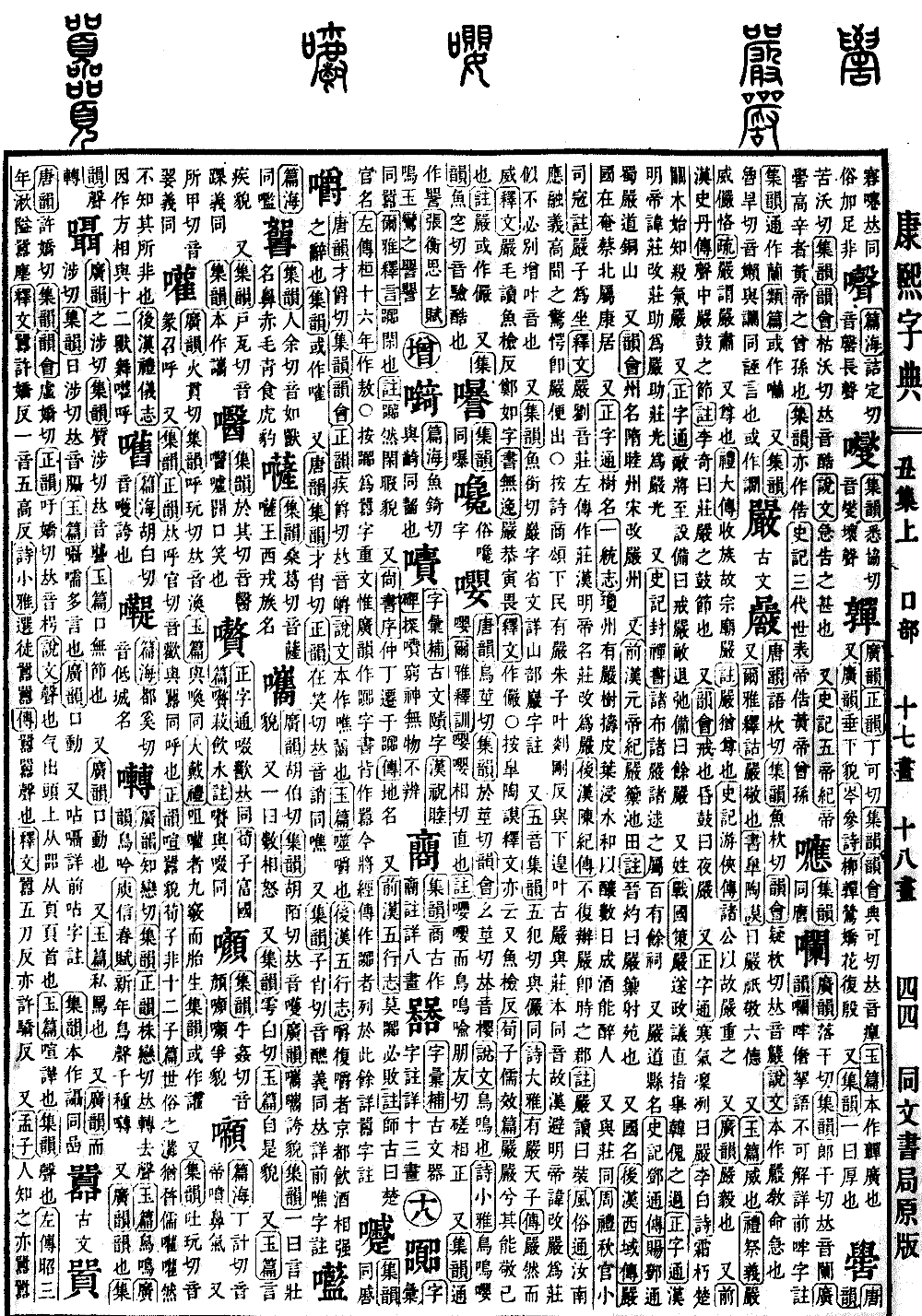
Yan; Kangxi stroke count: 20; Page 214
Ancient script form.
In the Tang Dynasty Rhymes (Tangyun), the phonetic fanqie is yu and xian; in the Collected Rhymes (Jiyun), it is yu and xian; in the Rhyme Assembly (Yunhui), it is yi and xian; pronounced like the character yan. Explaining Graphs and Analyzing Characters (Shuowen Jiezi) states it was originally written in an ancient form meaning urgent instructions or orders. Also, Approaching the Refined (Erya), Explaining Words states yan means respect. The Book of Documents (Shangshu), The Counsel of Gao Yao states daily show respect and reverently honor the six virtues. Also, the Jade Chapters (Yupian) states it means majesty. The Book of Rites (Liji), Meaning of Sacrifices states majestic, awe-inspiring, solemn, and respectful. The Commentary (Shu) states yan refers to being solemn. Also, it means honorable. The Book of Rites (Liji), Great Record states gathering the clan members, therefore the ancestral temple is honored. The Note states yan is like honorable. The Records of the Grand Historian (Shiji), Biographies of the Wandering Knights states because of this, the various lords treated him with great respect and gravity. Also, the Expanded Rhymes (Guangyun) states yan means resolute. Also, the Book of Han (Hanshu), Biography of Shi Dan states the sound matched the rhythm of the solemn drums. Li Qi's note states it refers to the rhythm of solemn and majestic drums. Also, the Rhyme Assembly (Yunhui) states it means a warning or alert. The evening drum is called the night alert (yeyan). Also, Correcting Character Errors (Zhengzitong) states when the cold air is piercing, it is called yan. A poem by Li Bai states frost decays the trees of the Chu passes, only then does one know the severity of the killing air. Also, Correcting Character Errors (Zhengzitong) states when an enemy is about to arrive, preparing defenses is called martial law (jieyan). When the enemy retreats and defenses are relaxed, it is called lifting martial law (jieyan). Also, a surname. The Strategies of the Warring States (Zhan Guo Ce) states Yan Sui’s political proposal directly pointed out the faults of Han Kui. Correcting Character Errors (Zhengzitong) states because Emperor Ming of Han had the taboo name Zhuang, the name Zhuang Zhu was changed to Yan Zhu, and Zhuang Guang was changed to Yan Guang. Also, the Records of the Grand Historian (Shiji), Treatise on the Feng and Shan Sacrifices states among the various Bu, Yan, and Qiu groups, there were over a hundred shrines. Also, Yan Dao is the name of a county. The Records of the Grand Historian (Shiji), Biography of Deng Tong states Deng Tong was bestowed with the copper mountain of Yan Dao in Shu. Also, the Rhyme Assembly (Yunhui) states it is the name of a prefecture. It was Mu Prefecture in the Sui dynasty and changed to Yan Prefecture in the Song dynasty. Also, the Book of Han (Hanshu), Annals of Emperor Yuan states the Yan Yu ponds and fields. Jin Zhuo's note states Yan Yu refers to an archery park. Also, the name of a country. The Book of the Later Han (Houhanshu), Biographies of the Western Regions states the Kingdom of Yan was north of Yan Cai and belonged to Kangju. Also, Correcting Character Errors (Zhengzitong) states it is the name of a tree. The Comprehensive Gazetteer of the Great Ming (Yitongzhi) states Qiongzhou has the yan tree; pounding its bark and leaves, soaking them in water, and mixing them for fermentation produces wine in a few days that can intoxicate people. Also, the same as the character zhuang. The Rites of Zhou (Zhouli), Offices of Autumn, Note on the Lesser Minister of Justice states Zhen Yanzi acted as the seat. The Textual Explanation (Shiwen) states yan is pronounced zhuang by Liu; it is written as zhuang in the Zuo Commentary (Zuozhuan). Because Emperor Ming of Han’s name was Zhuang, it was changed to Yan. The Book of the Later Han (Houhanshu), Annals and Biographies states without further preparing luggage, he immediately went to the commandery. The note states yan is read as zhuang, meaning luggage. The Common Meanings of Customs (Fengsu Tong) states Ying Rong of Runan was of high righteousness; hearing this, he was startled and immediately packed and left. Note that in the Book of Odes (Shijing), Sacrificial Odes of Shang, it says the common people are in awe. Master Zhu Xi provides a rhyming pronunciation (xie) of yan and gang to match the word huang below. Anciently, yan and zhuang were originally homophones; therefore, the Han dynasty avoided Emperor Ming’s taboo name by changing zhuang to yan, so it seems unnecessary to add a separate rhyming pronunciation. Also, the Collected Rhymes (Jiyun) states the phonetic fanqie is yu and xian. It is an abbreviated form of the character yan meaning cliff. See the entry for yan under the Radical: Mountain (shan). Also, the Five-Tone Collected Rhymes (Wuyin Jiyun) states the phonetic fanqie is wu and fan. It is the same as the character yan meaning majestic. The Book of Odes (Shijing), Greater Odes states majestic is the Son of Heaven. The Commentary (Zhuan) states solemn and awe-inspiring. The Textual Explanation (Shiwen) states for yan, Mao reads it as a phonetic fanqie of yu and jian, while Zheng reads it according to the standard character. The Book of Documents (Shangshu), Against Luxurious Ease states majestically respectful and reverently fearful. The Textual Explanation (Shiwen) writes it as the character yan meaning majestic. Note that the Textual Explanation for The Counsel of Gao Yao also says it is pronounced with the phonetic fanqie of yu and jian. Xunzi states how majestic he is, able to respect himself. The note states yan is sometimes written as the character yan meaning majestic. Also, the Collected Rhymes (Jiyun) states the phonetic fanqie is yu and bian, pronounced like yan. It means harsh or cruel. Textual Criticism: Correcting Character Errors (Zhengzitong) states when an enemy is about to arrive, preparing defenses is called jieyan. When the enemy retreats and defenses are relaxed, it is called yuyan. Following the original text, the word yu is corrected to jie, meaning lifting. Also, the Rites of Zhou (Zhouli), Offices of Autumn, Note on the Lesser Minister of Justice states Yanzi acted as the seat. Following the original text, the character zhen is added before Yanzi.