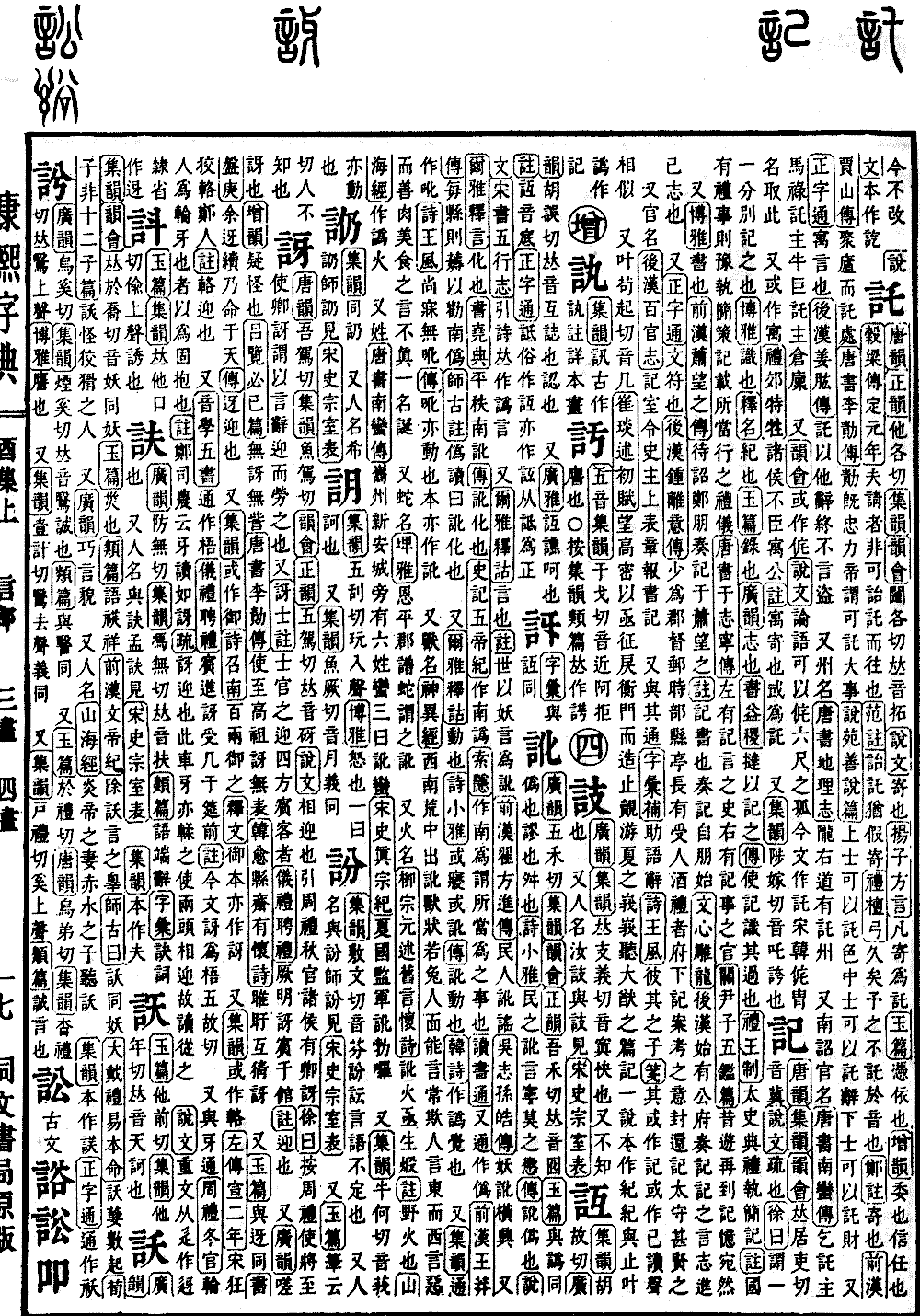
You Collection, Upper Volume
Radical: Speech (yán)
託
Kangxi stroke count: 10
Page 1149, Entry 01
Pronounced tuo.
Shuowen Jiezi (Shuowen): To entrust.
Yang Xiong, Dialect (Fangyan): All forms of depositing are called tuo.
Yupian (Yupian): To lean on or to rely upon.
Zengyun (Zengyun): To commission or entrust; also signifies trust.
Guliang Zhuan (Guliang Zhuan), First Year of Duke Ding: That which is requested is not something for which one can borrow the name of an entrustment to proceed.
Fan Note: Yi-tuo is like borrowing an entrustment.
Book of Rites (Liji), Tangan: For a long time, I have not entrusted my emotions to music.
Zheng Note: Meaning to entrust.
History of the Former Han (Qian Hanshu), Biography of Jia Shan: To gather houses together and reside by way of an entrustment.
History of the Tang (Tangshu), Biography of Li Ji: Since Li Ji was loyal and devoted his efforts, the Emperor believed he could entrust major affairs to him.
Garden of Stories (Shuoyuan), Chapter on Good Persuasion: Superior men can be entrusted through facial expressions, middling men can be entrusted through words, and inferior men can be entrusted through material goods.
Also, Zhengzitong (Zhengzitong): Words used as a pretext.
History of the Later Han (Hou Hanshu), Biography of Jiang Gong: Used other words to offer a pretext, never revealing the matter of the robbers.
Also, name of a prefecture.
History of the Tang (Tangshu), Treatise on Geography: In the Longyou Circuit, there is Tuo Prefecture.
Also, official title in Nanzhao.
History of the Tang (Tangshu), Record of the Southern Barbarians: Qituo managed horses, Lutuo managed cattle, and Jutuo managed warehouses and grain stores.
Also, Yunhui (Yunhui): Sometimes written as 侂.
Shuowen (Shuowen): Analects of Confucius (Lunyu) states, one who can be entrusted with an orphan of six feet. The modern text is written as 託. The Song dynasty figure Han Tuozhou took his name from this meaning.
Also, sometimes written as yu (to reside temporarily).
Book of Rites (Liji), Jiaotesheng: The feudal lords do not take a ruler of a destroyed state who is residing temporarily as a minister.
Note: Yu means to reside temporarily. Sometimes written as 託.
Also, Jiyun (Jiyun): Pronounced zha. To boast or show off.