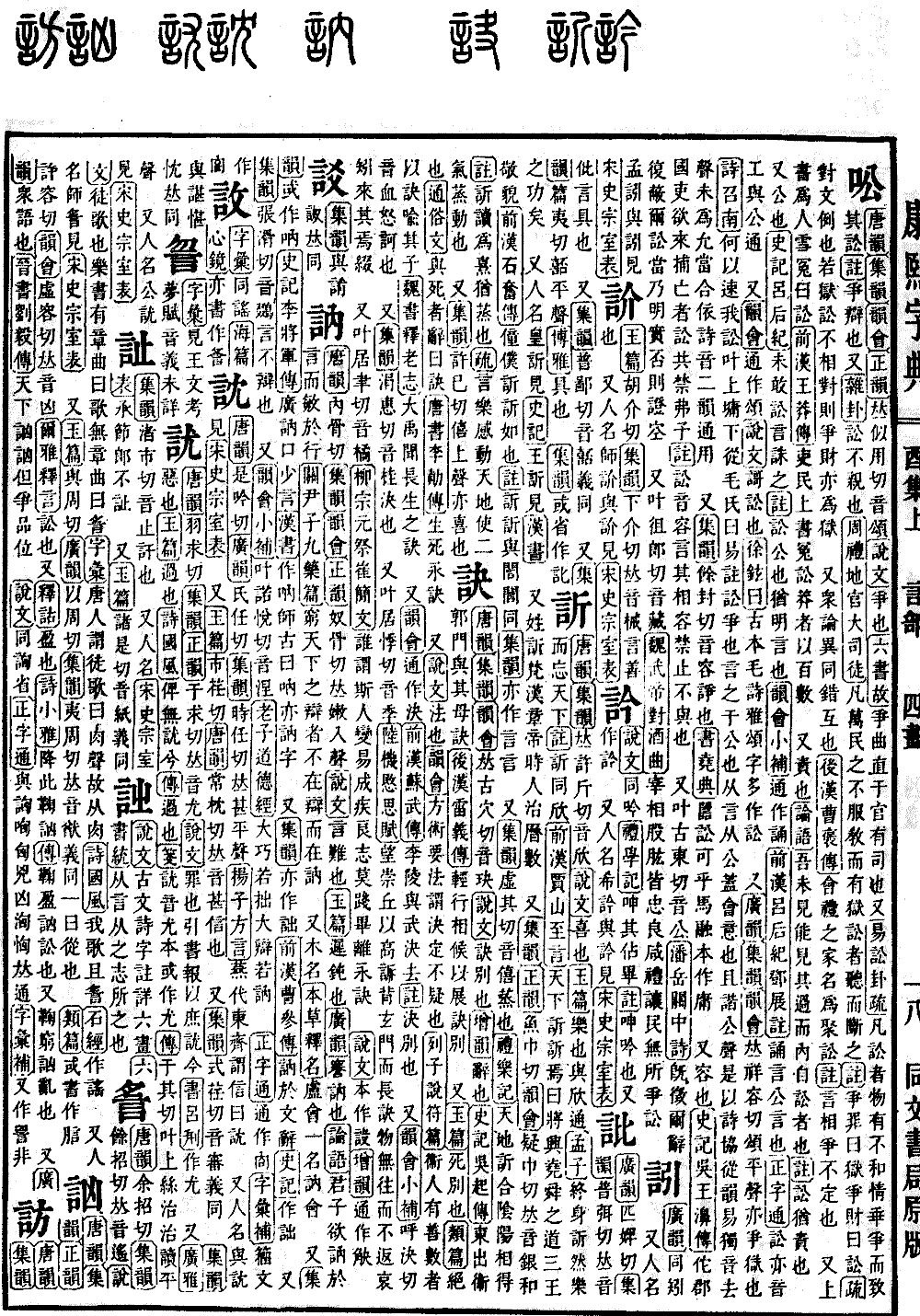
You Collection, Upper Volume
Radical: Speech (yán)
Kangxi Strokes: 11
Page 1150, Entry 18
Pronounced fang (falling tone).
Shuowen Jiezi (Shuowen): To seek opinions extensively is called fang.
Xu Shen says: The extensive seeking of opinions mentioned here refers to asking others broadly.
Erya (Erya): To plan.
Yupian (Yupian): To inquire.
Book of Documents (Shujing): The king went to inquire of Jizi.
Commentary: This refers to going to ask him.
Rites of Zhou (Zhouli): To receive and report on solicited opinions in order to instruct the king to listen to governance.
Commentary: To offer strategies to the king.
Also signifies to deliberate.
Discourses of the States (Guoyu): Instruct him in the laws, and allow him to deliberate on the affairs of the hundred officials.
Commentary: Fang means to deliberate.
Also signifies to involve or to meet.
Zihui (Zihui): To have an audience with.
Also signifies just now.
Book of Han (Hanshu): Just because of the Lu clan, the world was almost thrown into chaos.
Commentary: Fang is like fang (just now).
Zihuibu (Zihuibu): Identical in meaning to fang (beginning).
Also refers to an official title.
History of Liao (Liaoshi): In the third year of the Huitong era, Emperor Taizong ordered Gu Lin to serve as the Cailfang (investigation and interview) Commissioner.
Also serves as a surname. During the Tang dynasty, there was a scholar named Fang Shi.
Pronounced fang (rising tone). The meaning remains the same. Zhitong (Zhitong) states that the Zihui (Zihui) is too rigid in following the Shuowen, and that Sun Mian’s classification of the pronunciation solely as falling tone is incorrect.
Pianhai (Pianhai): Also written as a variant form.