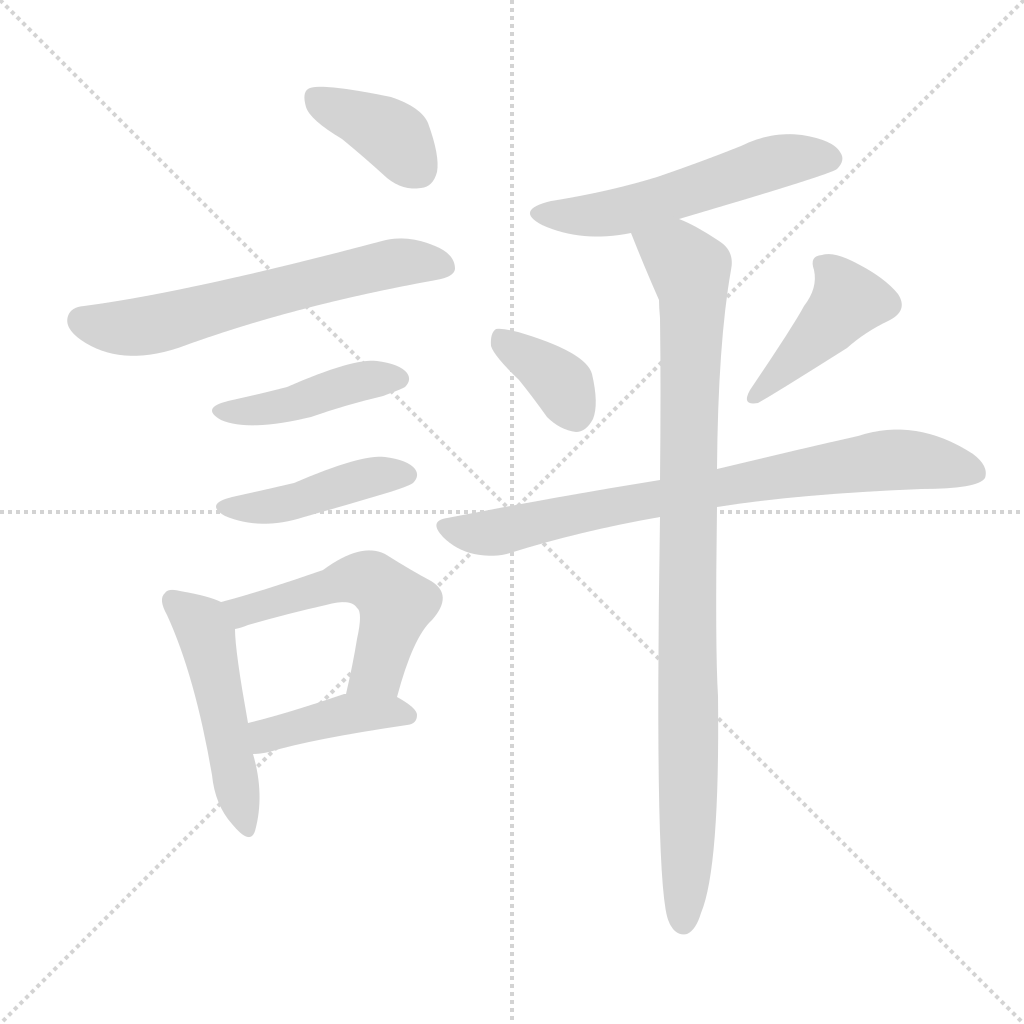
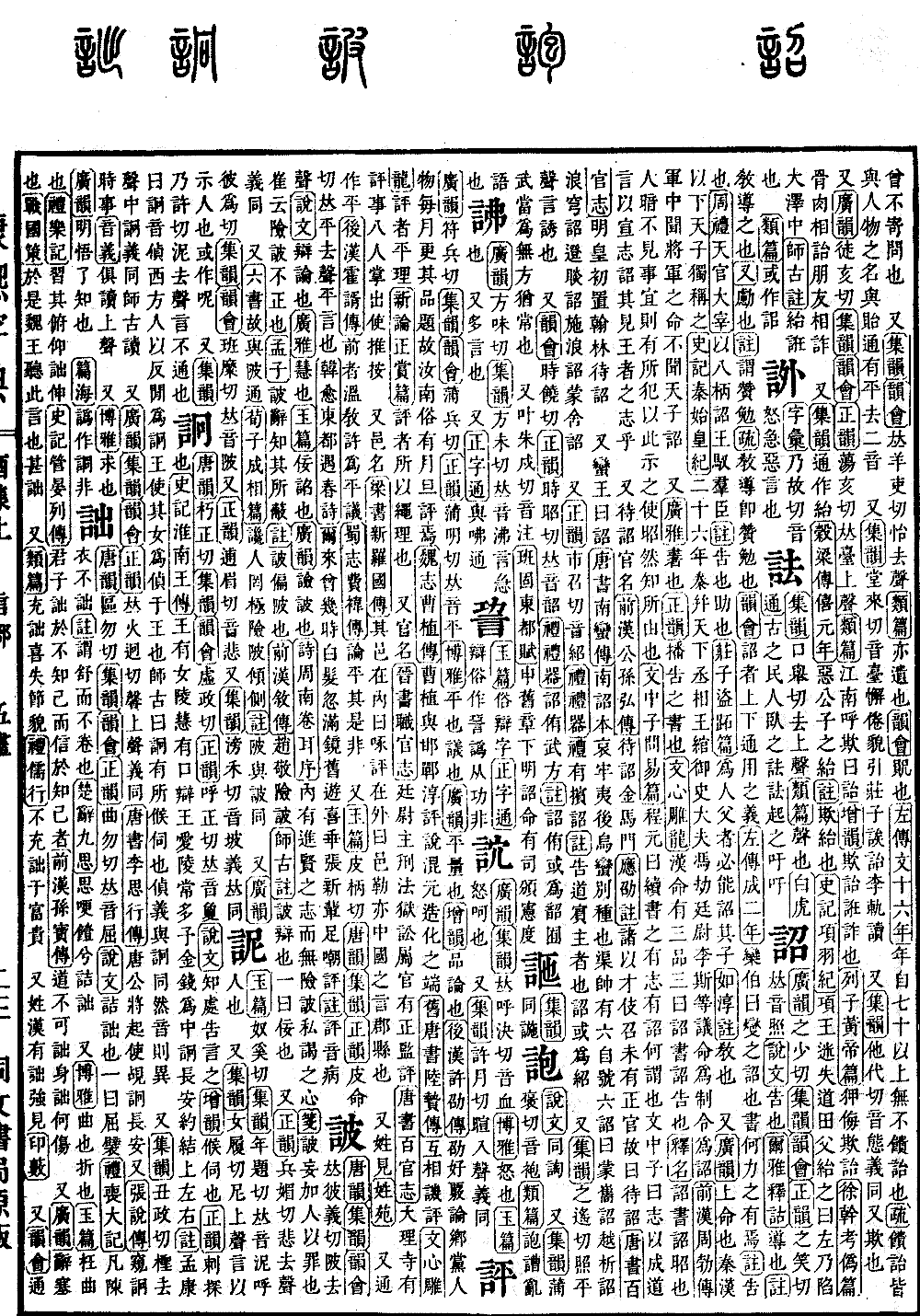
You Collection, Upper Volume
Radical: Speech (yán)
Kangxi Strokes: 12
Page 1155, Entry 09
Guangyun (Broad Rimes): Pronounced píng.
Jiyun (Collection of Rimes), Yunhui (Collection of Rimes): Pronounced píng.
Zhengyun (Correct Rimes): Pronounced píng.
Defined in Guangya (Expanse of Elegance) as to level or to discuss.
Defined in Guangyun (Broad Rimes) as to assess or measure.
Defined in Zengyun (Augmented Rimes) as to judge or evaluate.
History of the Later Han (Hou Hanshu), Biography of Xu Shao: Shao enjoyed investigating and discussing the people of his local district, changing his assessments every month, thus the custom in Runan of the Month-Beginning Assessment (yuedan ping).
Records of the Three Kingdoms (Sanguozhi), Biography of Cao Zhi: Cao Zhi and Handan Chun discussed the origins of cosmic creation.
Old Book of Tang (Jiu Tangshu), Biography of Lu Zhi: To criticize or comment on one another.
The Literary Mind and the Carving of Dragons (Wenxin Diaolong): To assess means to level principles.
New Treatise (Xinlun), Chapter on Proper Rewards: Assessments are the means by which principles are regularized.
Also a government official title.
Book of Jin (Jinshu), Treatise on Official Titles: The commandant of justice oversaw legal cases; subordinate officials included supervisors and assessors.
Book of Tang (Tangshu), Treatise on Officials: The Court of Judicial Review had eight assessment officers who were tasked with traveling to conduct investigations.
Also a city name.
Book of Liang (Liangshu), Biography of the Silla Kingdom: Their cities located inside were called Zhuoping, and those outside were called Yile, which are equivalent to the commanderies and counties of China.
Also a surname, see Source of Surnames (Xingyuan).
Also written interchangeably with the character for level (píng).
History of the Later Han (Hou Hanshu), Biography of Huo Xu: Previously, Master Wen allowed for a level discussion.
Records of the Three Kingdoms (Sanguozhi), Biography of Fei Yi: Discussing and leveling their right and wrong.
Also according to Yupian (Jade Chapters): Pronounced bìng.
Tangyun (Tang Rimes), Jiyun (Collection of Rimes), Zhengyun (Correct Rimes): Pronounced bìng (falling tone).
To speak of level matters.
Han Yu, Poem on Meeting Spring in the Eastern Capital: How much time has passed since then, white hair suddenly fills the mirror. Old acquaintances like to argue, while the new generation is full of mocking critiques.
Annotation: Here, pronounced bìng. Refers to being eccentric or perverse.