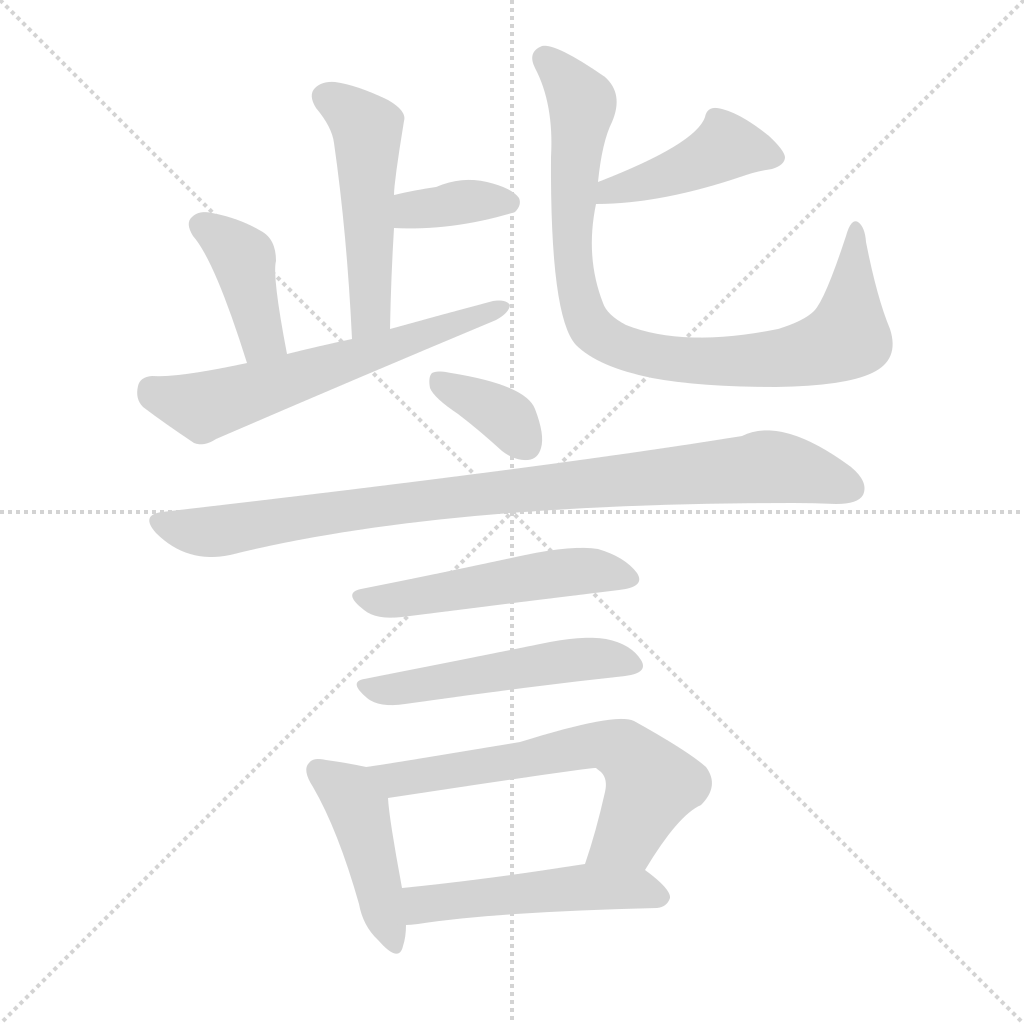
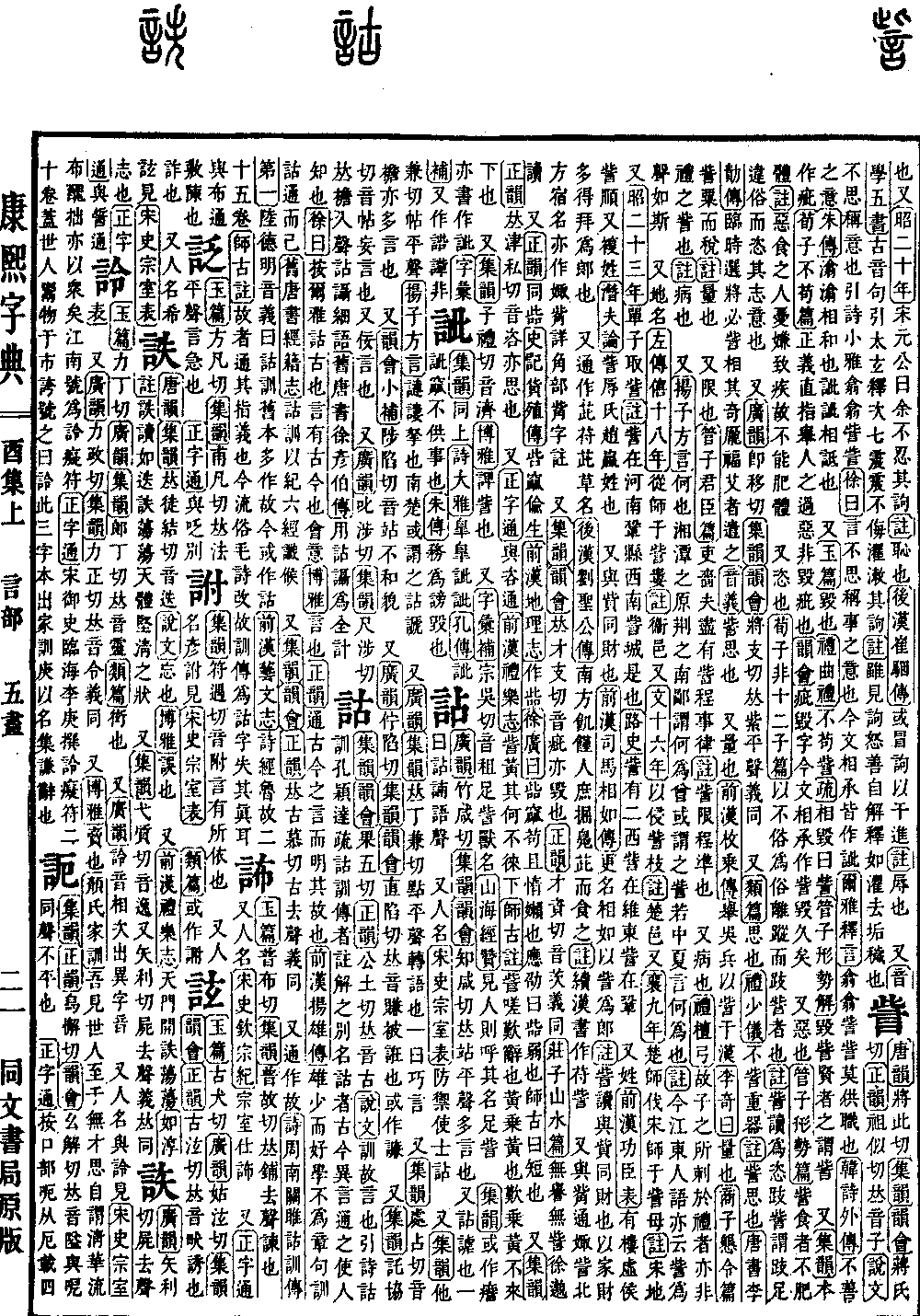
You Collection, Upper Volume. Radical: Speech (yán). Character: 訾. Kangxi strokes: 12. Page 1153, Entry 01.
Pronounced zi (rising tone).
Shuowen Jiezi (Explanation of Simple and Compound Characters): To indicate inner dissatisfaction or disagreement. Cites Book of Odes (Shijing), Lesser Odes of the Kingdom: To act in harmony or to disparage. Xu states: It refers to being dissatisfied with affairs in one's heart. Modern circulating texts all write this as zi (a variant form). Erya (Approaching Elegance), Interpretation of Teachings: To act in harmony or to disparage, refers to (a subordinate) failing to perform their duties. The Shijing (Book of Odes) and its interpretation notes cite the Han Poetry (Hanshi) as meaning evil intent. The Zhu Commentary states: Xi-xi means to agree with one another; zi-zi means to slander one another.
Also, Yupian (Jade Chapters): To slander. Book of Rites (Liji), Songs of the Bowmen (Quli): Do not slander lightly. Commentary: Mutual slander is called zi. Guanzi (Master Guan), Explanations of Situations: To slander a worthy person is called zi.
Also, Jiyun (Collection of Rhymes): Originally written as ci (a variant form). Xunzi, On Not Being Slothful: To point out the faults of others based on righteousness is not to slander or nitpick. Rhyme Compendium (Yunhui): The word ci (meaning to slander or damage) is long-established in current texts as being written with the character zi (to slander).
Also, to loathe. Guanzi, Situations: Those who loathe food will not be physically healthy. Commentary: Those who loathe food suffer from illness due to worry and aversion, therefore they cannot be healthy.
Also, to indulge. Xunzi, Against the Twelve Philosophers: To make non-conformity one's norm, departing from the correct path and standing on tiptoe to indulge one's own will. Commentary: Zi is read as zi (to indulge). Zhi-zi means to stand on tiptoe to defy worldly customs and indulge one's will.
Also, Pronounced zi (level tone). Same meaning.
Also, Leipian (Classified Chapters): To ponder, to consider. Book of Rites, Lesser Ceremonial (Shaoyi): Do not weigh or assess valuable objects. Commentary: Zi means to ponder. Old History of Tang (Jiu Tangshu), Biography of Li Ji: When selecting generals on the spot, one must carefully observe those with impressive appearances and good fortune to dispatch. Pronunciation and Meaning: Zi means to ponder.
Also, to weigh, to measure. Former Han History (Hanshu), Biography of Mei Cheng: Mobilize the troops of Wu to test strength against the Han Dynasty. Li Qi says: To weigh. Shangzi (Book of Lord Shang), Chapter on Reclaiming Land: To measure grain for taxation. Commentary: To measure.
Also, a limit. Guanzi, On Ruler and Subject: The officials and clerks operate entirely according to established regulations and laws. Commentary: Zi means a limit. Cheng means a standard.
Also, a flaw or defect. Book of Rites, Tan Gong: Therefore, the parts of the rites you criticize are not flaws in the rites themselves. Commentary: Bing means a flaw.
Also, Yang Xiong's Dialects (Fangyan): What. In the Xiangtan area and the southern border regions of Jingzhou, the word he (what) is called ceng or called zi. It is like the Central Plains saying he wei (why/what for). Commentary: Nowadays, people in Jiangdong also say zi wei, pronounced like si.
Also, a place name. Zuo Tradition (Zuozhuan), 18th Year of Duke Xi: Thereafter the army camped at Zilou. Commentary: A city-state of the Wei state.
Also, 16th Year of Duke Wen: To invade Zizhi. Commentary: A city-state of the Chu state.
Also, 10th Year of Duke Xiang: The Chu state attacked the Song army at Zimu. Commentary: A place name in the Song state.
Also, 23rd Year of Duke Zhao: The Shan family occupied Zi. Commentary: Zi is located at Zicheng, southwest of Gong County in Henan. The History of the Way (Lushi) says: There are two Zi locations: West Zi in the Wei territory and East Zi in the Gong territory.
Also, a surname. Former Han History, Table of Meritorious Officials: Includes Louxu Marquis Zi Shun.
Also, a compound surname. Qianfulun (Commentary of the Hidden Man): The Ziru clan, which is of the Ying surname of the Zhao state.
Also, identical to zi (a variant form). Wealth. Former Han History, Biography of Sima Xiangru: He changed his name to Xiangru and used wealth to purchase an official position as a Lang officer. Commentary: Zi is read the same as zi (wealth). Because he had much family wealth, he was able to be appointed as a Lang officer.
Also, synonymous with zi (a variant form). Fuzi, a type of grass. Later Han History (Hou Hanshu), Biography of Liu Shenggong: During a famine in the south, the people dug up fuzi to eat. Commentary: The Sequel to the History of the Later Han (Xu Hanshu) writes it as fuzi.
Also, synonymous with zi (a variant form). Juzi, the name of a northern constellation. Also written as juzi. See the notes under the Horn (Jiao) radical for the character zi.
Also, Pronounced ci (level tone). This also means to slander. Pronounced ci (level tone). Same meaning. Zhuangzi, Mountain Tree (Shanmu): Without praise and without slander. Xu Miao reads it this way.
Also, identical to ci (a variant form). Records of the Grand Historian (Shiji), Biographies of Money-makers: Lazy and indolent, living a life of ease. Former Han History, Treatise on Geography: Written as ci. Xu Guang says: Ci-yu means lazy and indolent. Ying Shao says: Ci means weak. Shi Gu says: Short.
Also, Pronounced zi (level tone). This also means to ponder.
Also, Zijing Tong (General Compendium of Characters): Synonymous with zi (a variant form). Former Han History, Treatise on Rites and Music: Zi Huang, why do you not descend? Shi Gu Commentary: Zi is an exclamation particle. Huang is Cheng Huang (the name of a divine horse). An exclamation lamenting that Cheng Huang does not descend.
Also, Pronounced ji (level tone). Boya (Broad Elegant): To slander.
Also, Zihui Bu (Supplement to the Collection of Characters): Pronounced zu (level tone). Zuzi, name of a beast. Classic of Mountains and Seas (Shanhaijing) Eulogy: A beast that calls its own name when it sees people. Jiyun: Sometimes written as zi (a variant form), also written as zi (a variant form). Zihui Bu: Also written as zi (a variant form), which is incorrect.