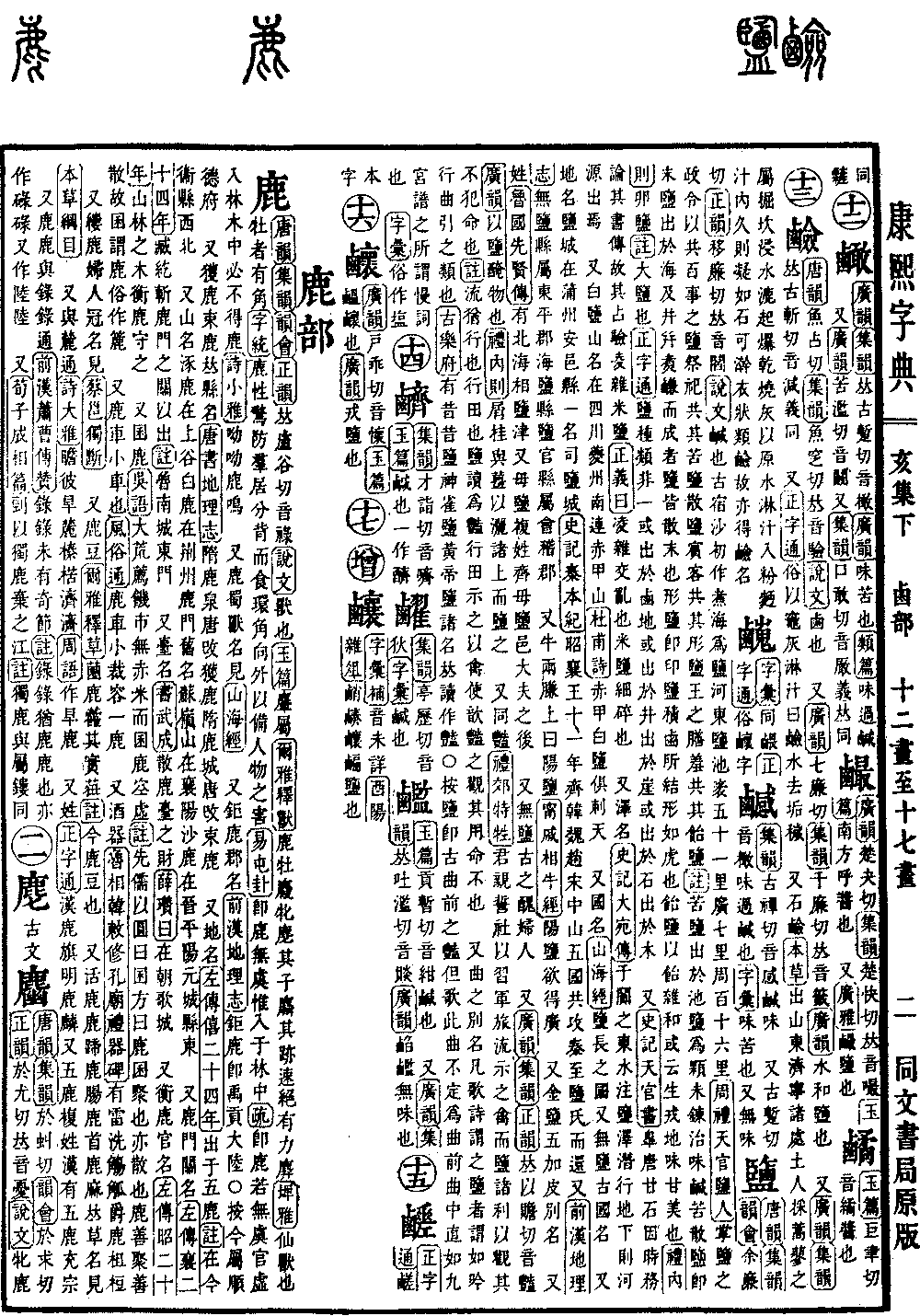
Hai Collection, Lower Volume
Radical: Salt (lǔ)
Page 1508, Entry 24
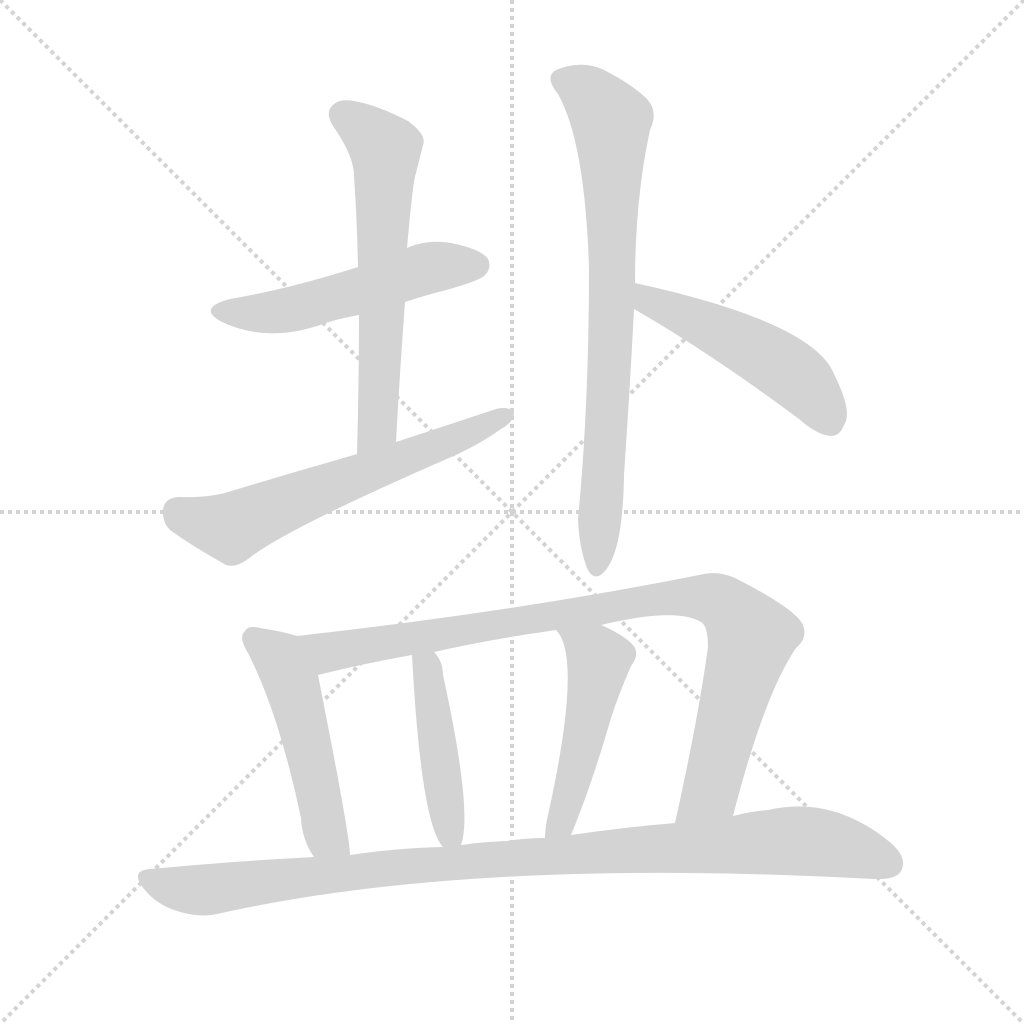
Pronounced yan (level tone).
Shuowen Jiezi (Dictionary of Explaining Graphs): Salty. In ancient times, Sushao first made it by boiling sea water into salt. The Salt Lake in Hedong is fifty-one li long, seven li wide, and one hundred sixteen li in circumference.
Rites of Zhou (Zhouli), Heaven Officials, Salt Officer: Administers the government decrees for salt, supplying salt required for various affairs; for sacrificial rites, supplies bitter salt and loose salt; for guests, supplies shaped salt and loose salt; for the king’s fine cuisine and delicacies, supplies sweet salt.
Commentary: Bitter salt comes from salt lakes; it is granulated and unrefined, with a bitter and salty taste. Loose salt is powdered salt, produced from the sea or wells, all created by boiling brine, resulting in fine, loose particles. Shaped salt is molded salt, formed by the accumulation and solidification of brine into shapes resembling tigers. Sweet salt is mixed with maltose or, as some say, comes from the Rong region, with a sweet and delicious taste.
Book of Rites (Liji), Inner Rules: Egg salt.
Commentary: Coarse salt.
Zhengzitong (Comprehensive Compilation of Characters): There is more than one type of salt; some come from salt-rich land, some from wells, some from mountain cliffs, some from rocks, and some from trees.
Also, Records of the Grand Historian (Shiji), Book of the Celestial Officials: Gao Tang and Gan Shi wrote their traditions based on current affairs, so their divinations were accurate, though they were complex and detailed like rice and salt.
Zhengyi (Correct Meaning): Lingza means intertwined and chaotic. Mi-yan means fine and fragmented.
Also, the name of a marsh. Records of the Grand Historian (Shiji), Account of Dayuan: East of Yutian, water flows into a salt marsh and travels underground; thus, the source of the Yellow River emerges from there.
Also, White Salt, a mountain name. Located in Kuizhou, Sichuan, connecting to Red Armor Mountain in the south.
Du Fu’s Poetry: Red Armor and White Salt both thrust straight into the sky.
Also, a country name. Classic of Mountains and Seas (Shanhaijing): The country of Yanchang.
Also, Wuyan, an ancient country name.
Also, a place name. Yancheng, located in Anyi County, Puzhou. Also known as Siyancheng.
Records of the Grand Historian (Shiji), Annals of Qin: In the eleventh year of King Zhaoxiang, five states—Qi, Han, Wei, Zhao, Song, and Zhongshan—joined forces to attack Qin and turned back when they reached Yanshi.
Also, History of the Former Han (Hanshu), Treatise on Geography: Wuyan County, under Dongping Commandery; Haiyan County and Yanguan County, under Kuaiji Commandery.
Also, the upper part of the two flanks of an ox is called yang-yan.
Ning Qi’s Classic on Judging Oxen: The yang-yan should be broad.
Also, gold salt is an alias for Acanthopanax (wujiapī).
Also, a surname. Chronicles of the Worthies of Lu: There was a Beihai administrator named Yanjin.
Also, Wuyan, a compound surname. Descendants of the magistrate of Wuyan in the Qi state.
Also, Wuyan, an ancient ugly woman.
Also, pronounced yan (falling tone).
Guangyun (Broad Rhymes): To pickle food with salt.
Book of Rites (Liji), Inner Rules: Make cassia and ginger into fine powder to sprinkle on top, then pickle with salt.
Also, the same as the word for beautiful or alluring (yàn).
Book of Rites (Liji), Jiao Te Sheng: The monarch personally swears an oath at the altar of the soil to drill the troops, displaying captured animals during the hunt to use profit as bait and observe if they resist orders.
Commentary: Liu means to move. Examining the hunt. Yan is read as yan; during the field drill, display animals to them, make them admire the catch, and observe if they follow orders.
Also, an alias for a musical melody. All songs and poems called yan are similar to recitations, travel songs, melodies, or preludes.
Ancient Music Bureau (Yuefu) has titles such as Xixi Yan, Shenque Yan, and Huangdi Yan. Read as yan. Note: Yan is equivalent to the ancient prelude before a melody. However, singing this melody does not necessarily occur before or during the main piece; it is simply what the Jiugong Score calls a slow lyric.
Zihui (Lexicon): Commonly written as a variant form.
Textual Research: "For guests, supply shaped salt; for the king’s fine cuisine and delicacies, supply sweet salt." Strictly following the original text of the Rites of Zhou, "loose salt" is added after "shaped salt." The character for "its" (qí) is omitted before "sweet salt."