You Collection, Upper Volume
Radical: Speech (yán)
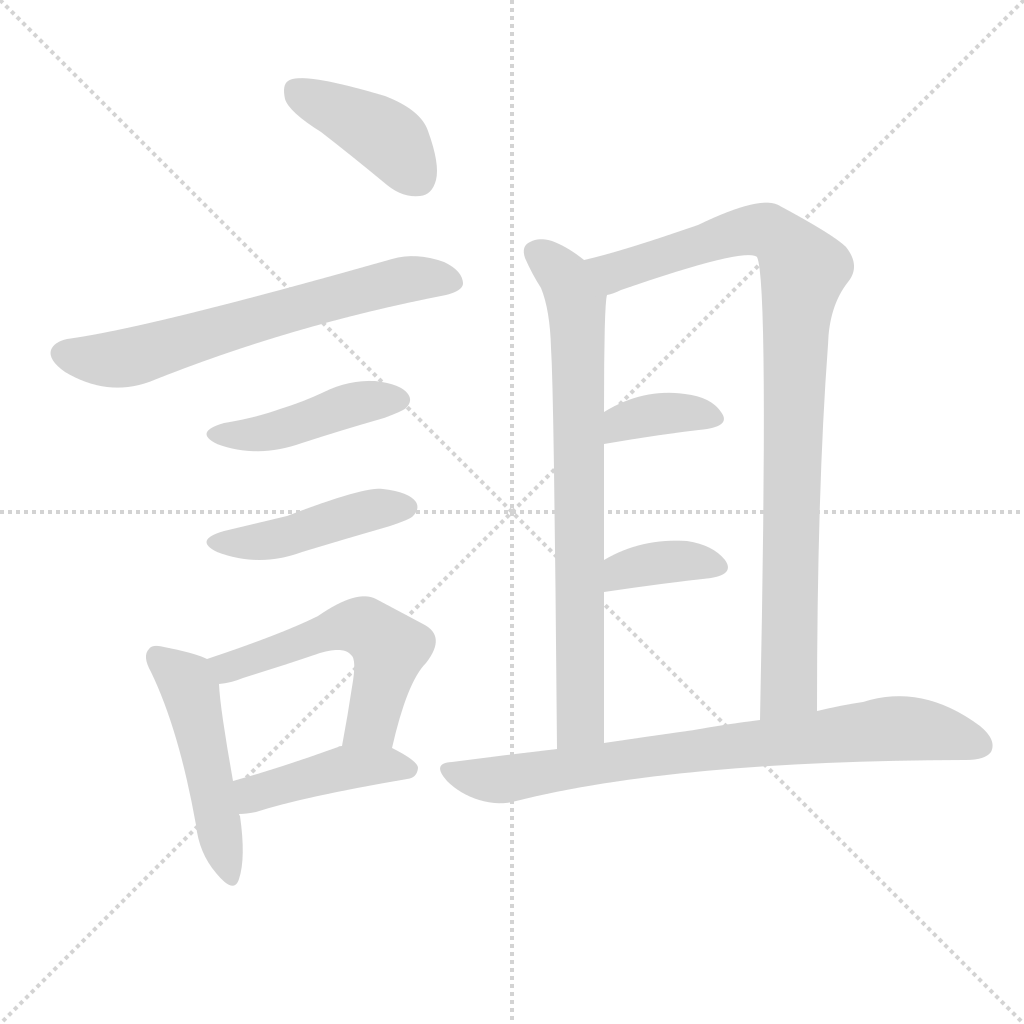
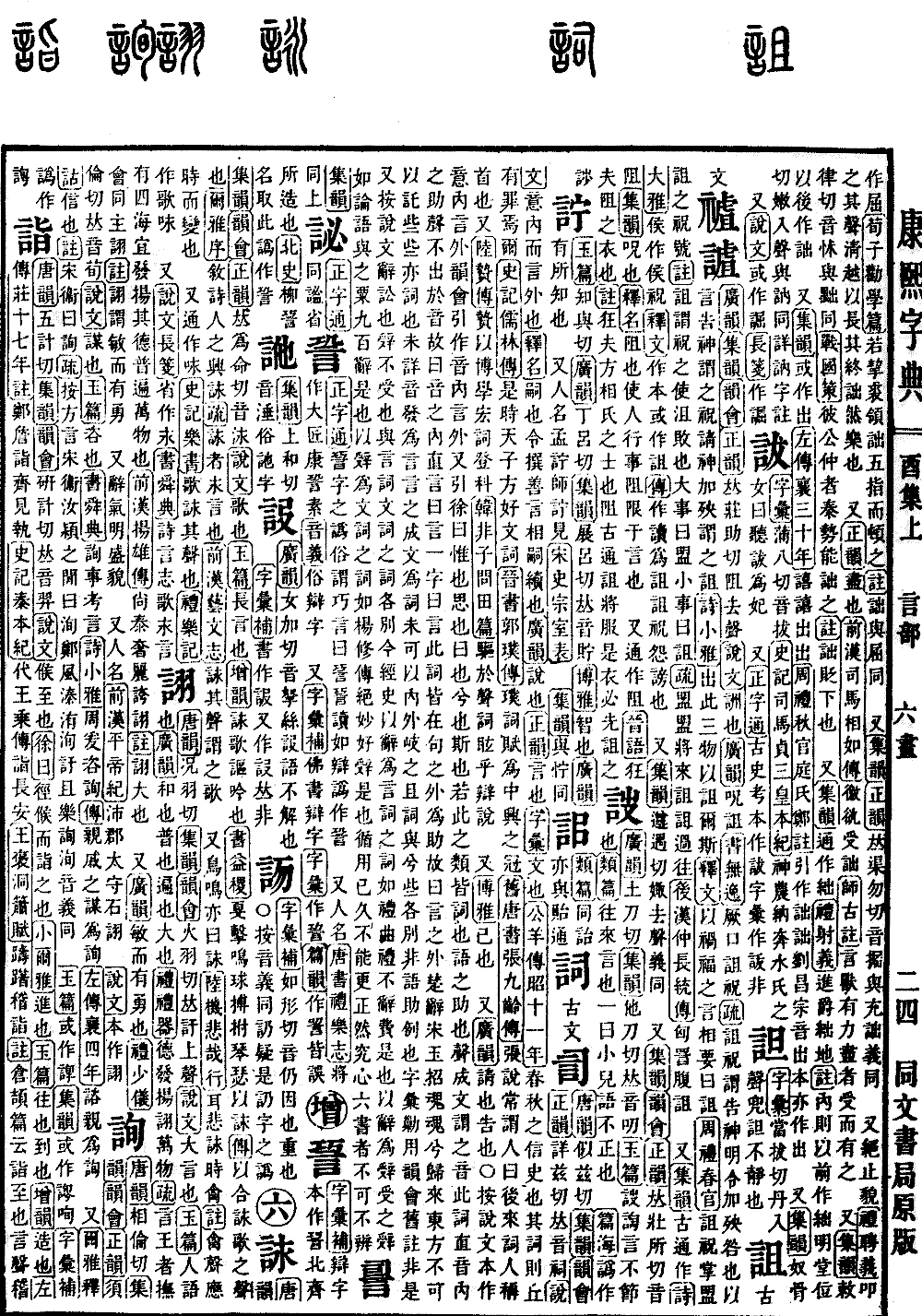
詛
Kangxi stroke count: 12
Page 1156, Entry 03
Ancient form: 謯
According to the Broad Rhymes (Guangyun), Collected Rhymes (Jiyun), Rhyme Meetings (Yunhui), and Correct Rhymes (Zhengyun), the pronunciation is zhu (falling tone).
According to the Explaining Graphs and Analyzing Characters (Shuowen), it means to pledge or to vow.
According to the Broad Rhymes (Guangyun), it means to curse or to imprecate.
Book of Documents (Shangshu), chapter "No Ease (Wuyi)": Their mouths curse and pray.
Commentary: Cursing and praying refers to reporting to the deities, requesting that they impose misfortune or blame. To report to the gods through speech is called praying (zhu). To request the gods to impose misfortune is called cursing (zu).
Book of Odes (Shijing), Lesser Odes of the Kingdom (Xiaoya): Presenting these three items, to curse you thus.
Explanation of the Text (Shiwen): Using words of misfortune or blessing to bind one another is called cursing (zu).
Rites of Zhou (Zhouli), Office of Spring (Chunguan): The curses and prayers officials manage the invocations of covenants and curses.
Note: Cursing (zu) means to pray for someone to be defeated or ruined. Major matters are called covenants (meng); minor matters are called curses (zu).
Commentary: Covenants (meng) apply to the future; curses (zu) apply to the past.
History of the Later Han (Hou Hanshu), Biography of Zhongchang Tong: Cursing and abusing, harbor resentment and imprecations.
Also, according to the Collected Rhymes (Jiyun), anciently interchangeable with the character written as a radical of speech with the character for ancestor.
Book of Odes (Shijing), Greater Odes of the Kingdom (Daya): Often acting, often praying.
Explanation of the Text (Shiwen): The character acting, originally was sometimes written as cursing (zu).
Zhu Xi's Commentary (Zhu zhuan): The character acting is read as cursing (zu). Cursing and praying refers to resentment and slander.
Also, according to the Collected Rhymes (Jiyun), the Collected Rhymes (Jiyun), Rhyme Meetings (Yunhui), and Correct Rhymes (Zhengyun), the pronunciation is zun and yu (combined), falling tone. The meaning is the same.
Also, according to the Collected Rhymes (Jiyun), Rhyme Meetings (Yunhui), and Correct Rhymes (Zhengyun), pronunciation is zhuang and suo (combined), pronounced zu.
According to the Collected Rhymes (Jiyun), it means to curse.
Explanation of Names (Shiming): It means to obstruct (zu). It refers to causing someone's actions to be obstructed by words.
Also commonly written as the character for obstructed (zu).
Discourses of the States (Jin yu): The madmen obstructed (zu) his clothing.
Note: The madmen refers to the officers of the Fangxiang (a ritual exorcist role). Obstructed (zu) is anciently interchangeable with cursing (zu). Before wearing this clothing, one must first curse (zu) it.
Textual Research: Book of Odes (Shijing), Greater Odes of the Kingdom (Daya): Often acting, often praying. Explanation of the Text (Shiwen): The character acting, originally was sometimes written as cursing (zu). Commentary: Acting, read as cursing (zu). We have carefully added the character Zhu to the commentary citation in accordance with the original text.