You Collection, Upper Volume
Radical: Speech (yán)
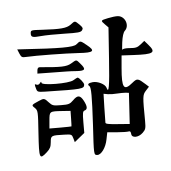
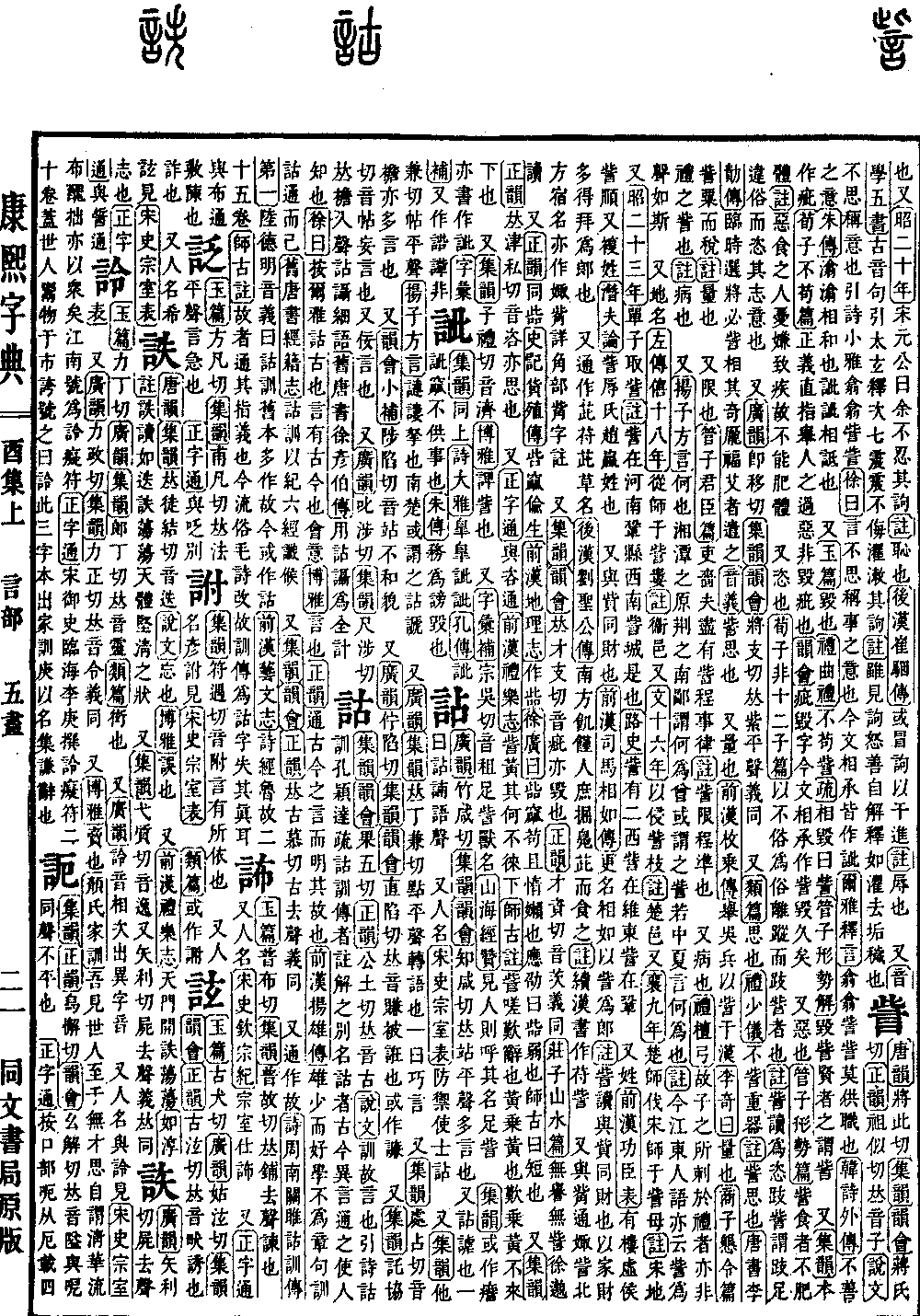
詀
Kangxi stroke count: 12
Page 1153, Entry 03
Broad Rimes (Guangyun) says pronounced zhan (level tone). Collected Rimes (Jiyun) and Rime Collection (Yunhui) say pronounced zhan (level tone). It is read as the level tone of the character zhan. It means talkative.
It also refers to zhan, meaning to joke or play. Another interpretation is zhannan, which refers to the sound of speech.
It is also used in personal names. History of Song (Songshi), Table of the Imperial Clan, records the Defense Commissioner Shi Zhan.
Also, Collected Rimes (Jiyun) says pronounced tie (level tone). It is read as the level tone of the character tie. Yang Xiong’s Dialects (Fangyan) records that lianlou means confused and contentious. In the southern Chu region, this is sometimes called zhanti.
Also, Broad Rimes (Guangyun) and Collected Rimes (Jiyun) say pronounced dian (level tone). It is read as the level tone of the character dian. It refers to a shift in speech. Another interpretation is flowery, deceptive language.
Also, Collected Rimes (Jiyun) says pronounced chan. This also means talkative.
Also, Rime Collection Supplement (Yunhui Xiaobu) says pronounced zhan. It refers to a disharmonious appearance.
Also, Broad Rimes (Guangyun) says pronounced zhuan (falling tone). Collected Rimes (Jiyun) and Rime Collection (Yunhui) say pronounced zhuan (falling tone). It is read as the falling tone of the character zhuan. It refers to being deceived. Sometimes written in a variant form (qian).
Also, Collected Rimes (Jiyun) says pronounced tie. It refers to nonsense. It also refers to fawning or flattering words.
Also, Broad Rimes (Guangyun) says pronounced che (entering tone). Collected Rimes (Jiyun) says pronounced che (entering tone). It is read as the entering tone of the character chan. Zhanzhe refers to whispering. Old Book of Tang (Jiu Tangshu), Biography of Xu Yanbo, records using zhanzhe as a strategy for comprehensiveness.