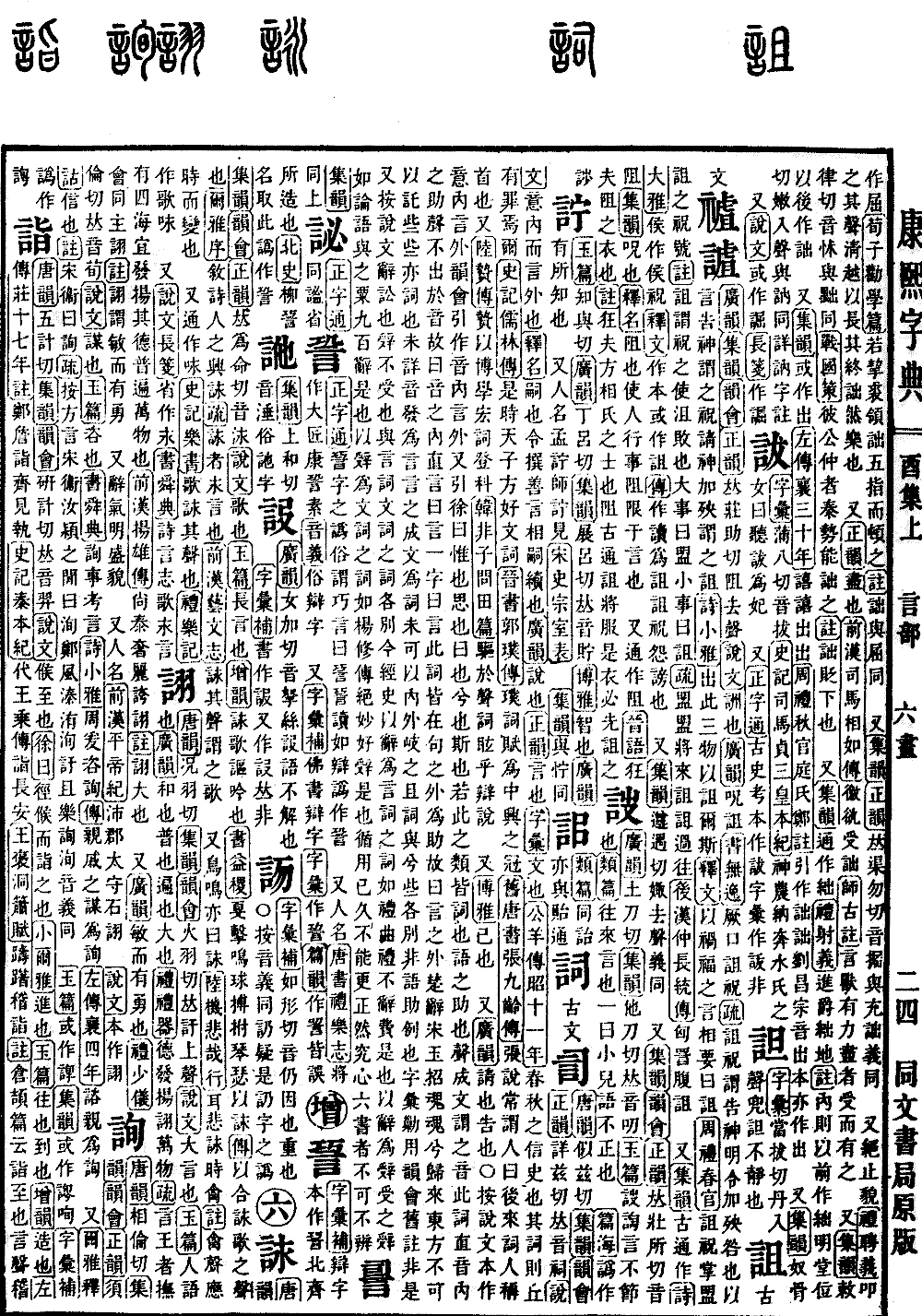
You Collection, Upper Volume
Radical: Speech (yán)
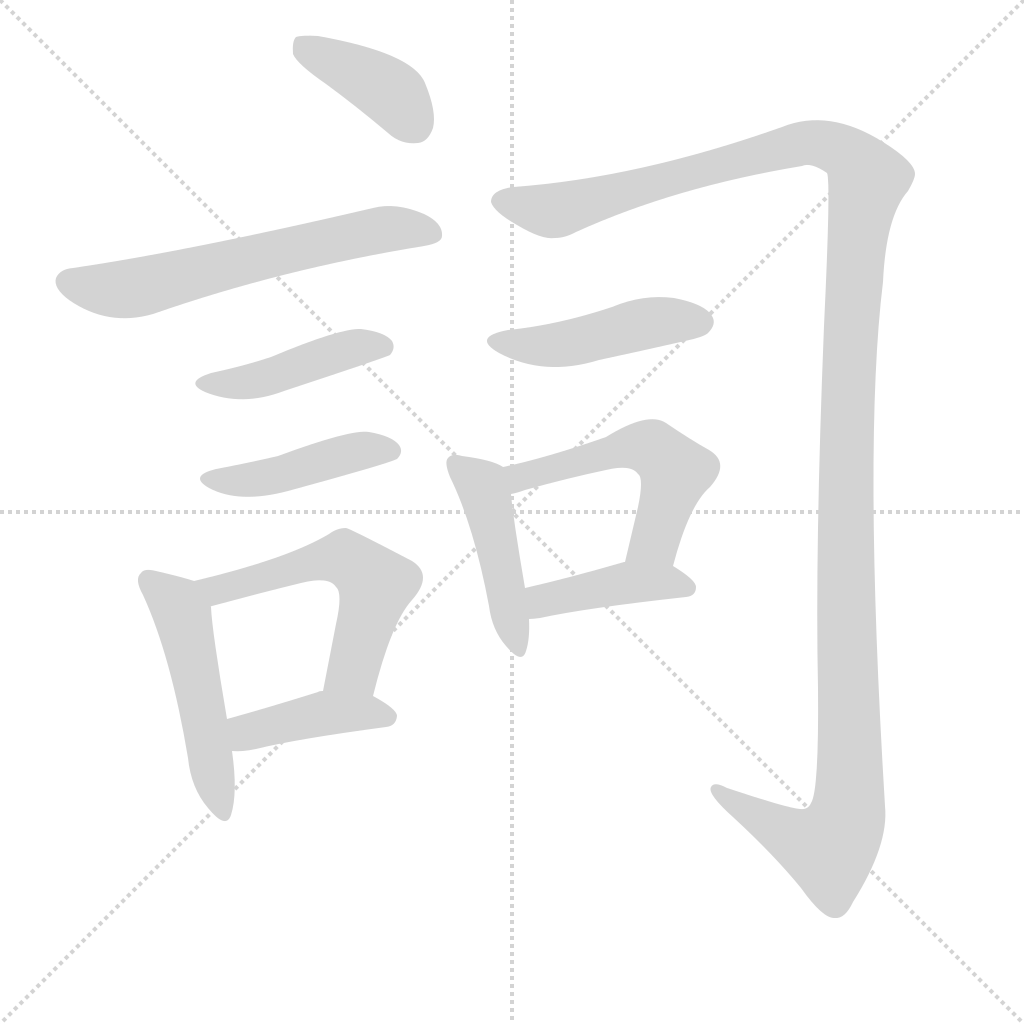
词
Kangxi stroke count: 12
Page 1156, Entry 09
Ancient script form. According to Tang Rhymes (Tangyun), pronounced ci; according to Collected Rhymes (Jiyun), Rhyme Anthology (Yunhui), and Orthodox Rhymes (Zhengyun), pronounced xiang ci; the sound is ci.
According to Explanation of Script and Elucidation of Characters (Shuowen Jiezi), it refers to thoughts contained within that are expressed externally through speech.
According to Explanation of Names (Shiming), it means to inherit. It refers to having someone compose beautiful language so that these words may continue on successively.
According to Broad Rhymes (Guangyun), it means to narrate.
According to Orthodox Rhymes (Zhengyun), it means speech.
According to Collection of Characters (Zihui), it means literary composition.
Gongyang Commentary on the Spring and Autumn Annals (Gongyang Zhuan), 11th year of Duke Zhao: The Spring and Autumn Annals (Chunqiu) is a truthful and credible historical record. If one speaks of its literary composition, then I, Kong Qiu, am at fault.
Records of the Grand Historian (Shiji), Biography of Confucian Scholars: At this time, the Emperor was fond of literary composition.
Book of Jin (Jinshu), Biography of Guo Pu: The rhapsodies (fu) of Guo Pu are the finest since the restoration of the Jin dynasty.
Old Book of Tang (Jiutangshu), Biography of Zhang Jiuling: Zhang Shuo often said to others that Zhang Jiuling was the leader among the younger generation of writers.
Also, in the Biography of Lu Zhi: Lu Zhi passed the imperial examination by means of the examination for broad learning and grand literary composition.
Han Feizi, Questions on Fields: Driven by reputation and words, and deluded by clever theories.
Also, according to General Dictionary (Boya), it means to stop.
Also, according to Broad Rhymes (Guangyun), it means to request or to tell.
Note: In the original text of the Explanation of Script and Elucidation of Characters (Shuowen Jiezi), it is written as thoughts internal and words external. The Rhyme Anthology (Yunhui) cites it as sounds internal and words external. It further cites the words of Xu Xuan, stating that particles such as wei, si, yue, xi, and si are all auxiliary words; they are the auxiliary components of language. When sounds combine to form a melody, they are called sound (yin); these words are merely auxiliary elements within the sound, and the sound does not exceed the scope of the yin, hence they are described as internal to the sound. To speak directly is called speech (yan); a single character is also called speech; these words function as auxiliaries outside the sentence, hence they are described as external to the speech. In the Chu Elegies (Chuci), Song Yu’s Summoning of the Soul, it is written: Oh soul, return; the east cannot be inhabited. The particle xie is also such a word. It does not explain in detail that when sounds are produced they become speech, and when speech is organized into literary brilliance it becomes composition (ci); one cannot mechanically distinguish these using internal and external, and ci, xi, and xie each have their differences; they cannot all be treated as examples of auxiliary words. The Collection of Characters (Zihui) copies the old annotations of the Rhyme Anthology (Yunhui), which is incorrect.
Also note: According to the Explanation of Script and Elucidation of Characters (Shuowen Jiezi), the character ci means litigation. The character ci means to decline or refuse to accept. These are different from ci, which refers to literary language. Nowadays, in the classics and historical records, ci is used for the literary language ci; for instance, in the Book of Rites (Liji), Chapter on Detailed Rules of Propriety (Quli), the phrase do not decline to speak (bu ci fei) is an example of this. Ci is used for the refusal to accept, such as in the Analects (Lunyu), where it is written that when given nine hundred measures of grain, he declined (ci). The character ci is used for literary composition, such as in the Biography of Yang Xiu, where it refers to an exquisite and beautiful composition (ci). This usage has continued for a long time and cannot be corrected, but those who study the Six Writings (Liushu) carefully must be able to distinguish between them.