Wei Collection, Middle Volume
Radical: Beard (ér)
Kangxi stroke count: 9
Page 962, Entry 01
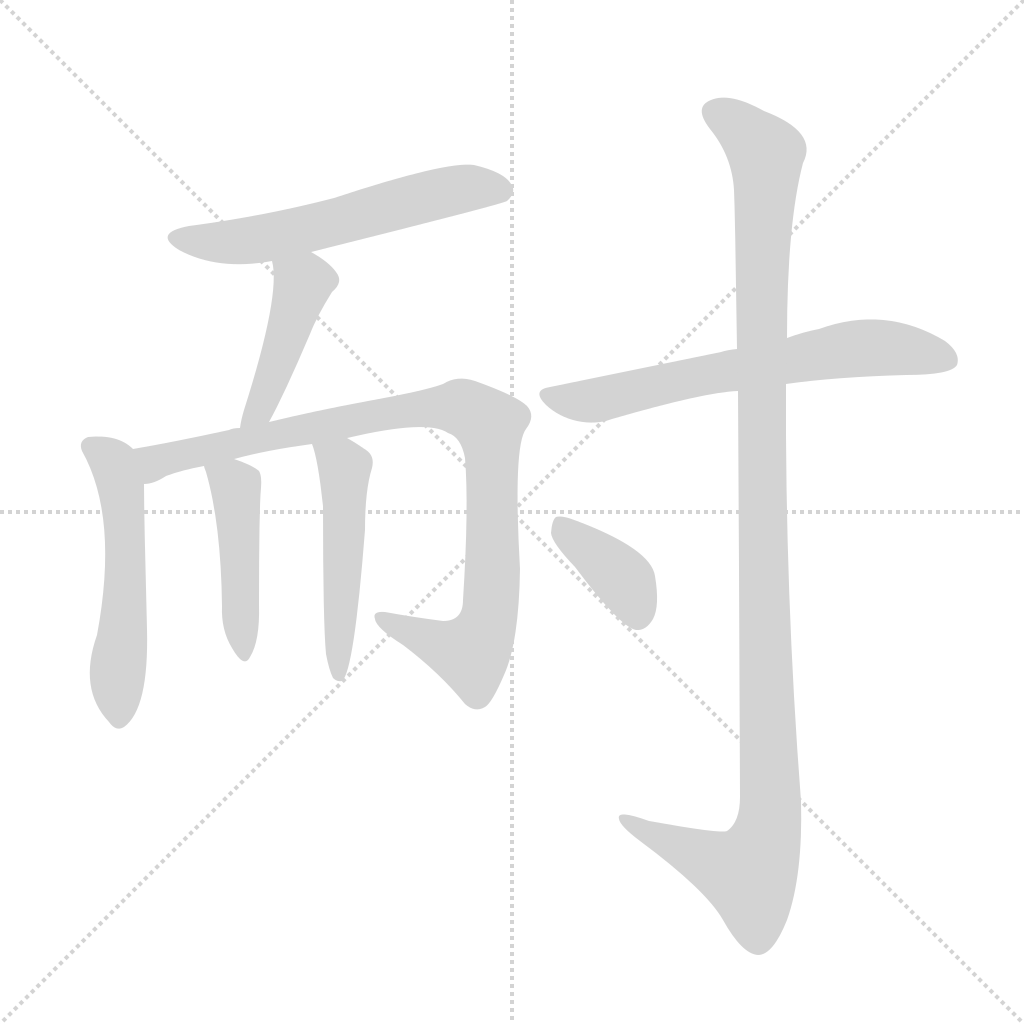
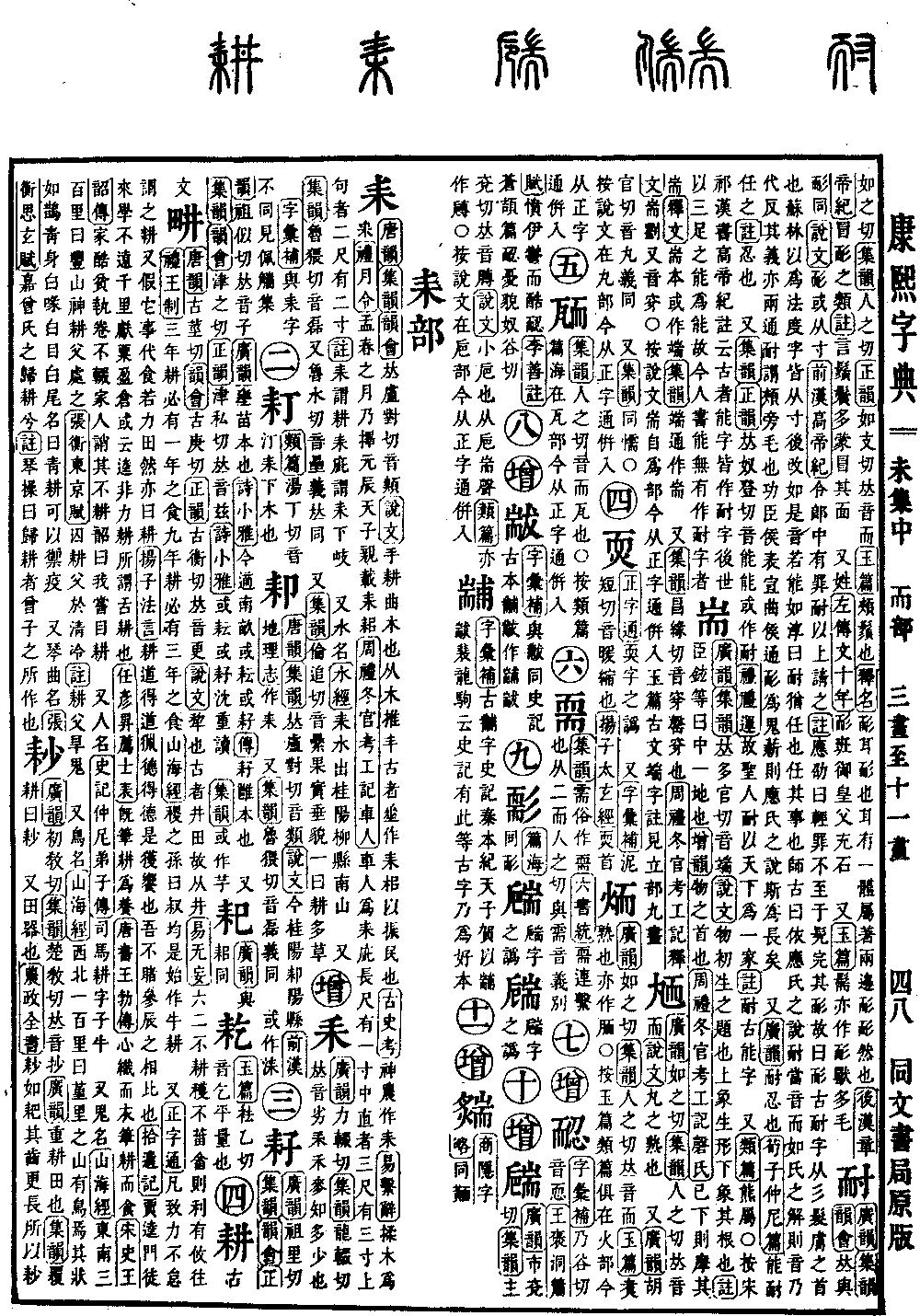
Guangyun (Broad Rimes), Jiyun (Collected Rimes), and Yunhui (Collection of Rimes) all state it is the same as the character for sideburns. According to the Shuowen Jiezi (Explanation of Script and Analysis of Characters), the character for sideburns may also be written with the inch radical. In the Chronicle of Emperor Gao in the Book of Han (Hanshu), it is written that if a palace attendant had committed a crime of the severity of nai or above, they were to be reported. The commentary by Ying Shao states: For light crimes that did not warrant the shaving of the hair, the sideburns were retained, thus it is called nai, which is the ancient form of the word for endure, written with the triple-stroke component to indicate hair and skin. Su Lin believes that characters related to legal standards all use the inch radical, and it was later changed to this form, with a pronunciation similar to the character for like. Ru Chun states: Nai is the same as to bear. It means to bear that matter. Yan Shigu states: Following the explanation of the Ying family, nai should be pronounced like er; following the explanation of the Ru family, it is pronounced like nai dai (rising tone). Both meanings are valid. Nai refers to the hair on the side of the cheeks. The Table of Meritorious Officials notes that the Marquis of Xuanqu, Tong, was punished with the penalty of laboring as a woodcutter; thus, the explanation of the Ying family is more appropriate here.
Also, according to Guangyun, nai means to endure or tolerate. In the Xunzi, Zhongni Chapter, it states: Able to endure and take it on. The commentary notes: It means to tolerate.
Also, according to Jiyun and Zhengyun (Orthodox Rimes), pronounced neng. The character for ability is sometimes written as nai. In the Book of Rites (Liji), Rites Evolution chapter, it states: Therefore, the sage is able to treat the world as one family. The commentary notes: Nai is the ancient form of the character for ability.
Also, according to the Leipian (Classified Dictionary), a type of bear. Note: Song Qi, in his commentary to the Chronicle of Emperor Gao in the Book of Han, states: In ancient times, the character for ability was always written as nai; later generations used the character with the three-footed animal component to represent ability, so nowadays people do not write the character for ability as nai.