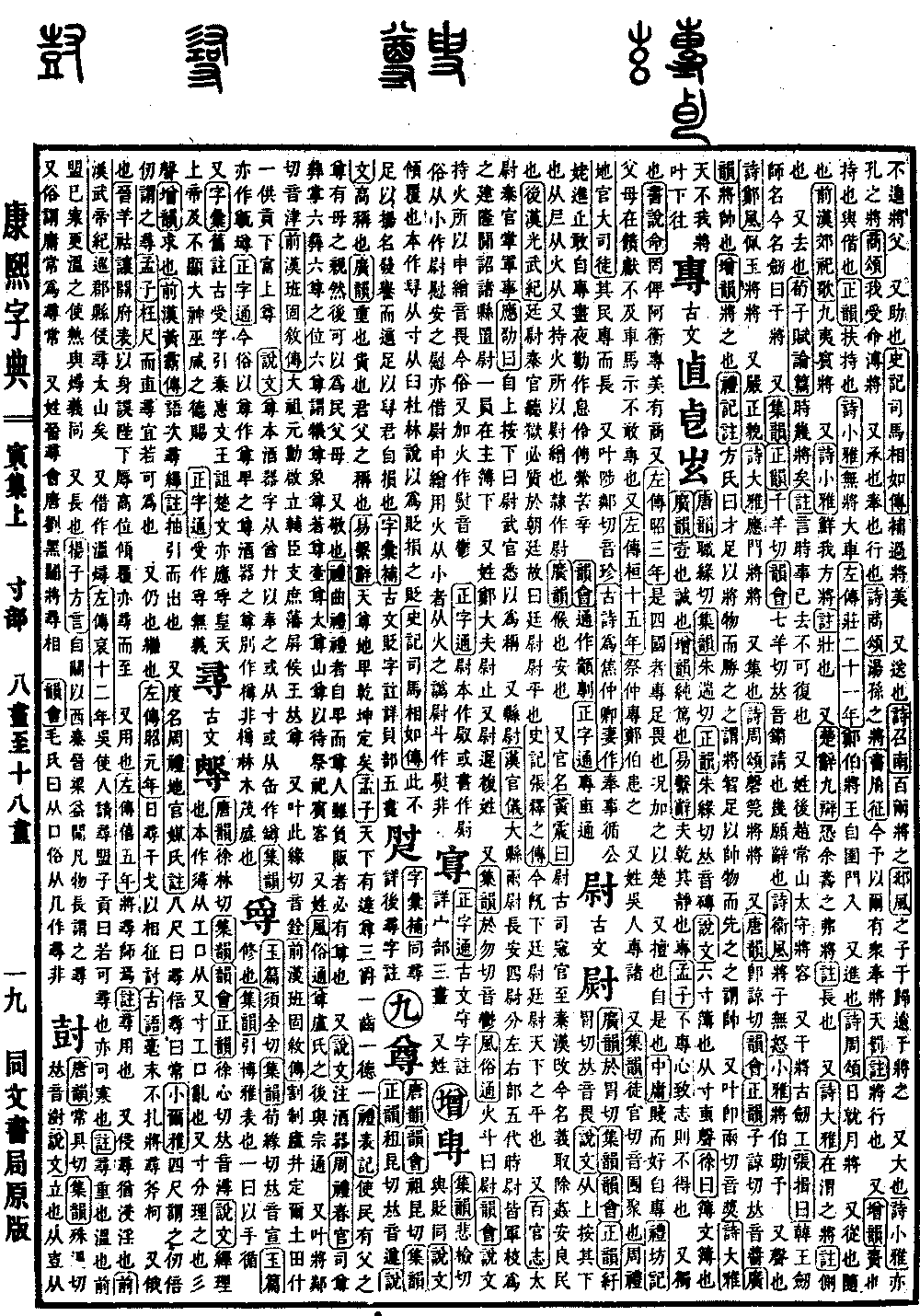
Yin Collection, Upper Volume
Radical: Inch (cùn)
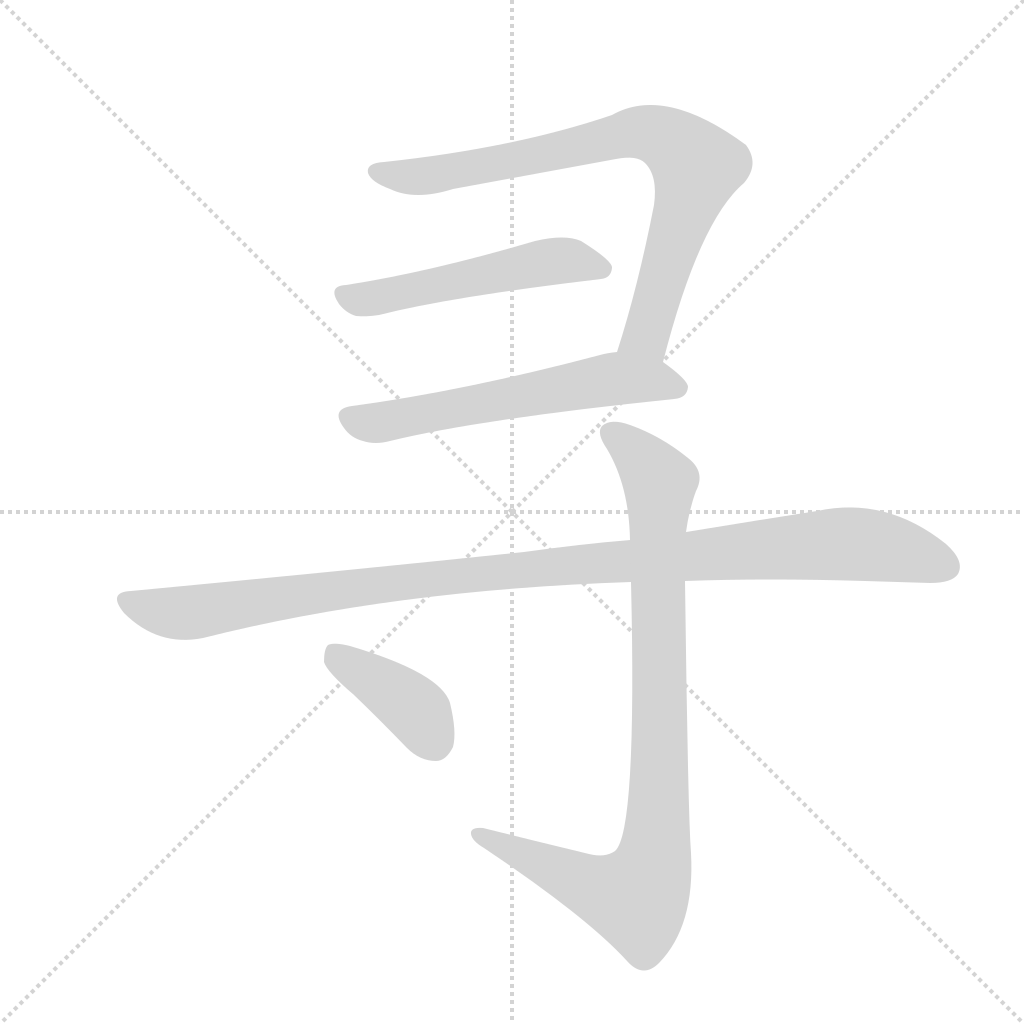
Entry: xún
Kangxi Stroke Count: 12
Page 295, Entry 01
Ancient form. According to the Tang Rhyme (Tangyun), pronounced xún. According to the Collected Rhymes (Jiyun), the Rhyme Collection (Yunhui), and the Correct Rhymes (Zhengyun), pronounced xún.
According to the Explaining Graphs and Analyzing Characters (Shuowen), it means to unravel or analyze. Originally written as a composite of the characters for work, mouth, hand, and inch. The work and mouth components denote disorder, while hand and inch denote separating and organizing. It takes its sound from the component pronounced shān.
According to the Augmented Rhymes (Zengyun), it means to seek.
In the Biography of Huang Ba from the History of the Former Han Dynasty (Qian Han Shu), it is used in the phrase to seek and unravel, with the commentary noting it means to draw out or extract.
Also a unit of measurement. The commentary to the Officer of Earth section of the Rites of Zhou (Zhouli) states that eight feet is called a xún, and twice a xún is called a cháng. The Small Er'ya states that four feet is called a rèn, and twice a rèn is called a xún. In the Mencius, it states that bending a foot to straighten a xún is considered an acceptable action.
Also means to continue or to follow. In the Zuo Tradition (Zuozhuan), First Year of Duke Zhao, it states that they sought weapons daily to wage war against one another. An old saying goes that if the tip of a hair is not pulled out, it will eventually become the handle of an axe.
Also means suddenly or quickly. In the Petition to Decline the Office of Regional Commander by Yang Hu of the Jin Dynasty, it states that because I have mistakenly occupied a high position, disaster may arrive suddenly.
Also means to use. In the Zuo Tradition (Zuozhuan), Fifth Year of Duke Xi, it states that they intended to use an army, with the commentary noting that here it means to use.
Also occurs as the term qīn xún, which has the same meaning as gradually spreading. In the Annals of Emperor Wu of the Former Han Dynasty (Qian Han Shu), it states that during an inspection of the commanderies and counties, they gradually moved toward Mount Tai.
Also borrowed to represent the character meaning to warm up. In the Zuo Tradition (Zuozhuan), Twelfth Year of Duke Ai, the state of Wu sent a messenger to request a renewal of the alliance. Zigong said: If one can warm it up, one can also cool it down, with the commentary noting that here it means to reiterate or to warm, suggesting that since the previous alliance has already cooled, it should be warmed up again to make it hot. It shares the same meaning as the character for warming.
Also means long. According to the Dialect (Fangyan) by Yang Xiong, in the regions west of the pass, and between Qin, Jin, Liang, and Yi, all long things are called xún.
Also, in common parlance, ordinary or common is referred to as xún cháng.
Also a surname. Includes Xun Hui of the Jin Dynasty and Xun Xiang, a general under Liu Heita of the Tang Dynasty.
According to the Rhyme Collection (Yunhui), Master Mao stated: It should be written with the mouth component. The common practice of writing it with the table component is incorrect.