Yin Collection, Upper Volume
Radical: Inch (cùn)
Kangxi Strokes: 11
Page 295, Entry 05
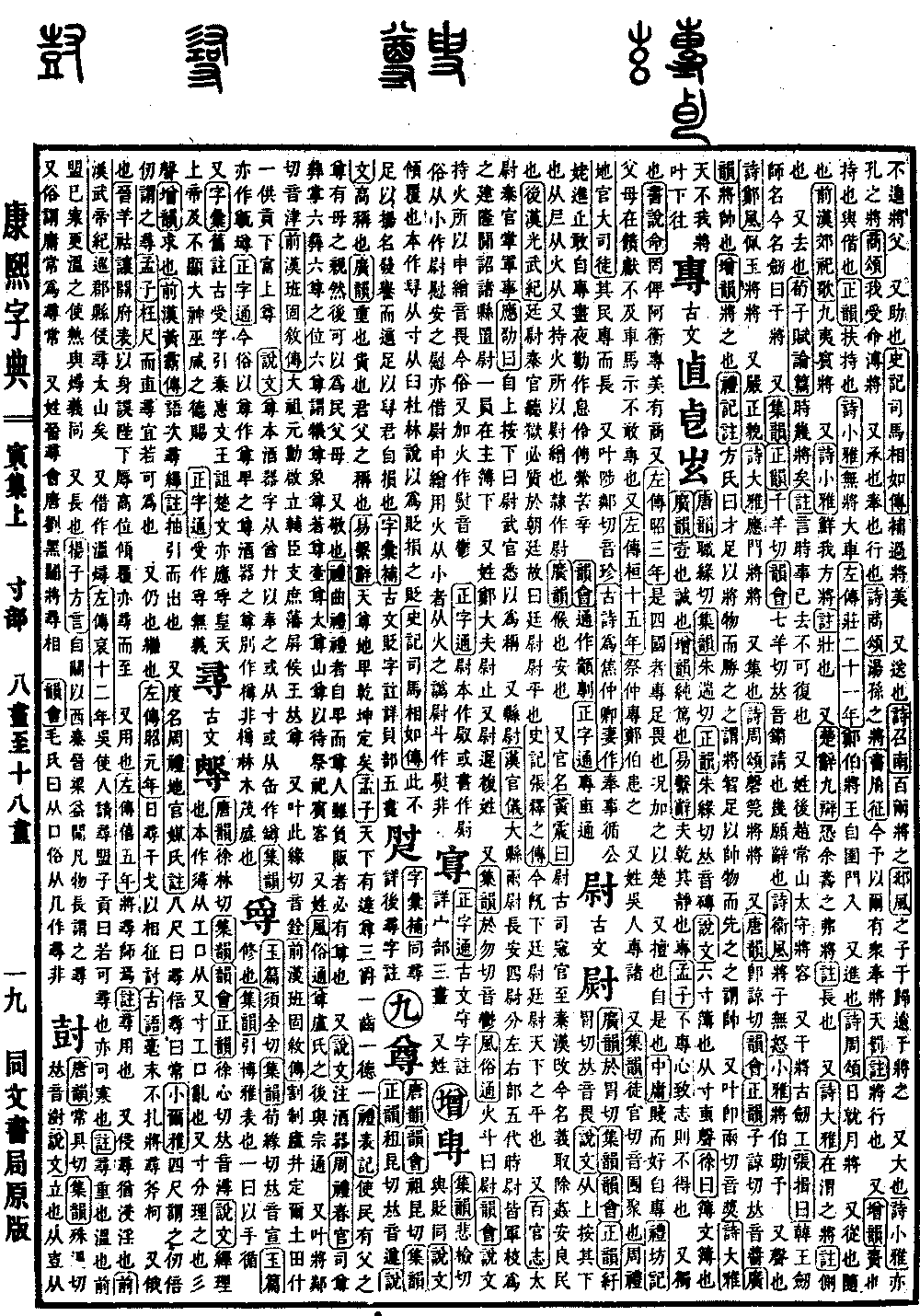
Ancient character form. According to the Extensive Dictionary of Sounds and Meanings (Guangyun), pronounced wei (falling tone). According to the Collection of Rhymes (Jiyun), the Rhyme Collection (Yunhui), and the Correct Rhymes (Zhengyun), pronounced wei (falling tone). According to the Explanations of Graphs and Analysis of Characters (Shuowen), it means to press down from above. Composed of the character for follow (cong) and fire (huo), holding fire with the hand (you), used for pressing or smoothing silk. Later written as wei. According to the Extensive Dictionary of Sounds and Meanings (Guangyun), it means to soothe or to pacify. Also an official title. Huang Zhen stated that the title was an ancient office, renamed in the Qin and Han dynasties, with the meaning of eliminating the wicked and pacifying the good people. According to the Chronicle of Emperor Guangwu in the History of the Later Han (Hou Hanshu), the Court Commandant (tingwei) was a Qin office; because cases had to be verified at court, it was called the Court Commandant. The character wei implies fairness. According to the Biography of Zhang Shizhi in the Records of the Grand Historian (Shiji), when a matter is sent to the Court Commandant, it is because the Court Commandant represents the fairness of the empire. Also, according to the Treatise on Officials (Baiguanzhi), the Grand Commandant (taiwei) was a Qin office in charge of military affairs. Ying Shao stated that because the character implies pressing down from above, it was used as a title for military officials. Also, County Commandant (xianwei). According to the Han Official Rituals (Hanguanyi), large counties had two commandants, and Chang'an had four, divided into left and right divisions. During the Five Dynasties period, commandants were all military officers; during the Jianlong era, an imperial decree mandated one commandant per county, ranked below the registrar. Also a surname; Zheng official Wei Zhi. Also Wuchi, a double surname. Also, according to the Collection of Rhymes (Jiyun), pronounced yu (entering tone). According to the Comprehensive Meaning of Customs (Fengsutong), a fire scoop is called wei. According to the Rhyme Collection (Yunhui), the Explanations of Graphs and Analysis of Characters (Shuowen) states it is used to hold fire to smooth silk, pronounced wei (falling tone). Modern usage adds the fire radical to form yun, pronounced yu (entering tone). The Correct Guide to Characters (Zhengzitong) states that the original character was written as the radical for fire or as a variant, while common usage now adds the fire radical to form wei. The character for soothe (wei) is also borrowed for this. The usage involving fire for smoothing silk, which adds the fire radical, is a misinterpretation of the original form. Writing the scoop as yun is incorrect.