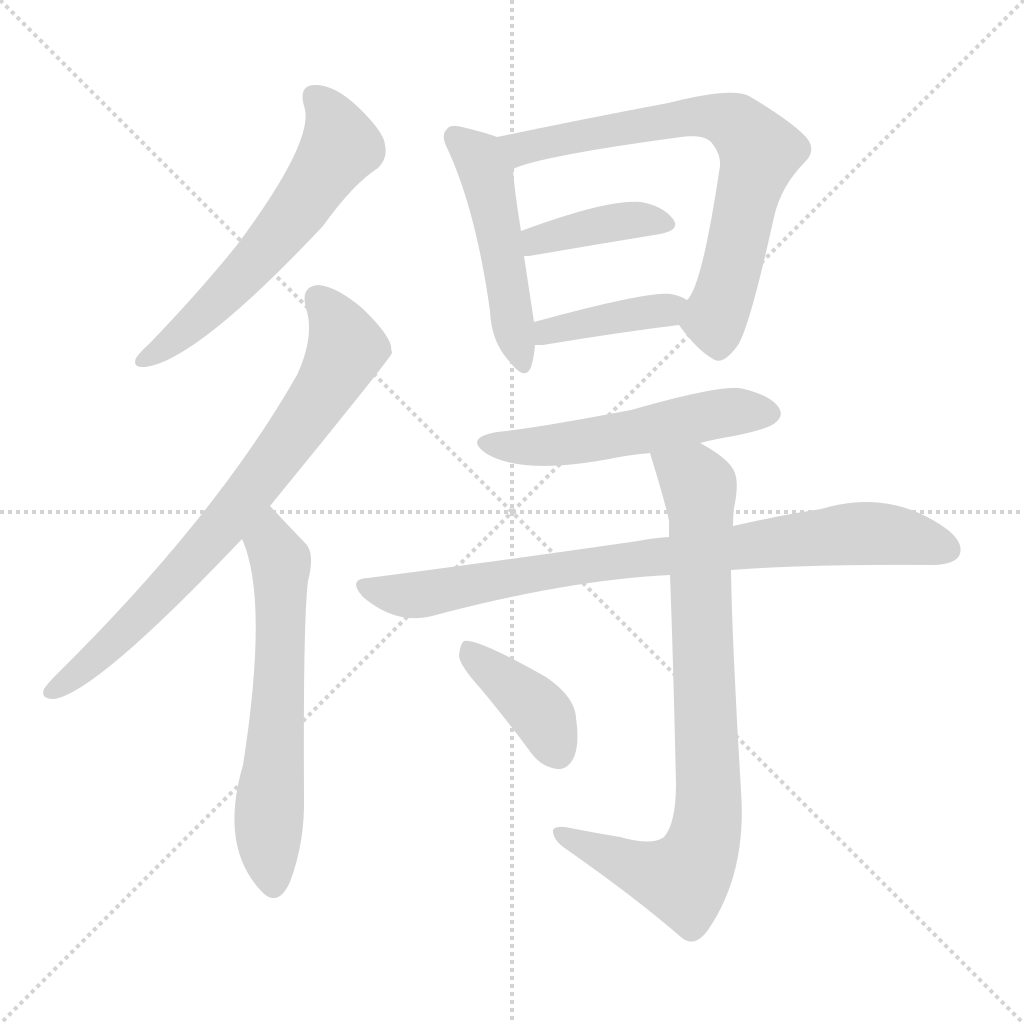
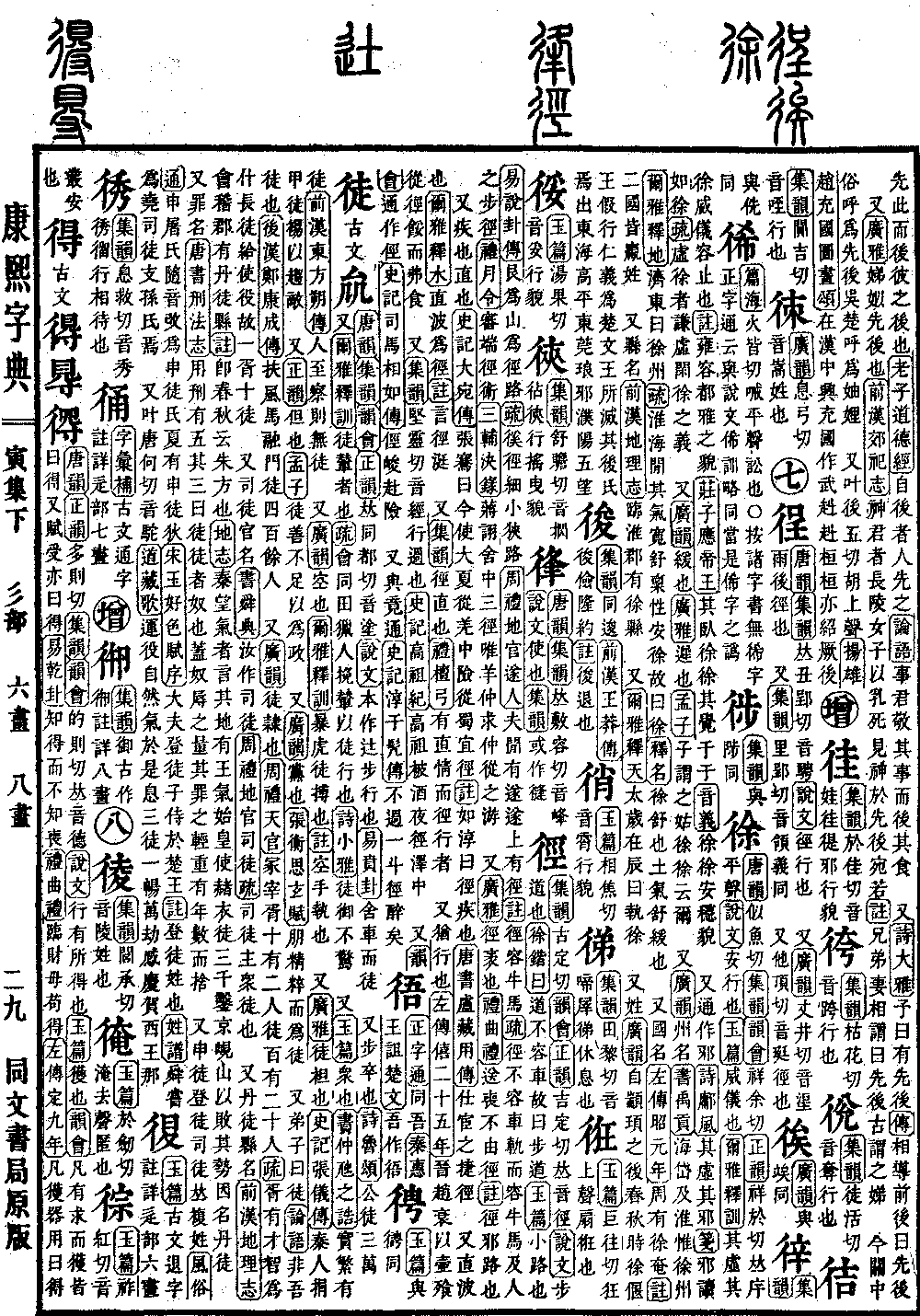
Yin Collection, Lower Volume
Radical: Step (chì)
Kangxi Dictionary stroke count: 11 strokes
Page 367, Entry 31
Pronounced dé. Matches the pronunciation of virtue (dé).
Shuowen Jiezi (Explaining Simple and Analyzing Compound Characters) defines it as walking and obtaining something.
Yupian (Jade Chapters) defines it as to obtain.
Yunhui (Collection of Rhymes) states that all instances of seeking and obtaining are called de. It also refers to giving or receiving.
Book of Changes (Yijing), Qian Hexagram: One who only knows how to obtain but does not know how to lose.
Book of Rites (Liji), Qu Li: Do not take possession of property casually.
Zuo Zhuan (Chronicle of Zuo), Ninth Year of Duke Ding: In general, obtaining an object is called de; obtaining it and putting it into use is called huo.
Mencius: Seek and you shall obtain.
It also refers to greed. The Analects (Lunyu) states: One must guard against greed.
Yunhui (Collection of Rhymes) notes: Being in agreement with others is called xiangde.
Wang Bao, Ode to the Sage Ruler Obtaining Worthy Ministers: Concentrating one’s spirit, cooperating with one another, and thus becoming more manifest.
Dede is a Tang Dynasty dialect term meaning deliberately or specifically.
Quan Tang Shihua (Complete Tang Poetry Anecdotes): When Guanxiu entered Shu, he presented a poem to Wang Jian: Carrying one bottle and one alms bowl, I grow old; crossing a thousand mountains and ten thousand waters, I have come specifically for you.
Rhyming variant: Pronounced dǔ.
Laozi, Dao De Jing (Classic of the Way and Virtue): There is no greater crime than indulging desires, no greater calamity than not knowing satisfaction, and no greater fault than greedy acquisition.
Yilin (Forest of Changes): Entering the market in search of a deer, seeing neither head nor feet, from morning until evening, eventually obtaining nothing.
Jiyun (Collection of Rhymes) records that it is also written in a variant form.